NASA Lunar Nuclear Reactor Plans Raise Space Governance Issues
Source:The Hindu ↗
Why It Matters
The pursuit of lunar nuclear power represents a pivotal shift in space exploration, directly impacting India's own space aspirations (e.g., Chandrayaan missions). It underscores the urgent need to update global space governance frameworks to address technological advancements and prevent unregulated resource competition and militarization of space.
Summary
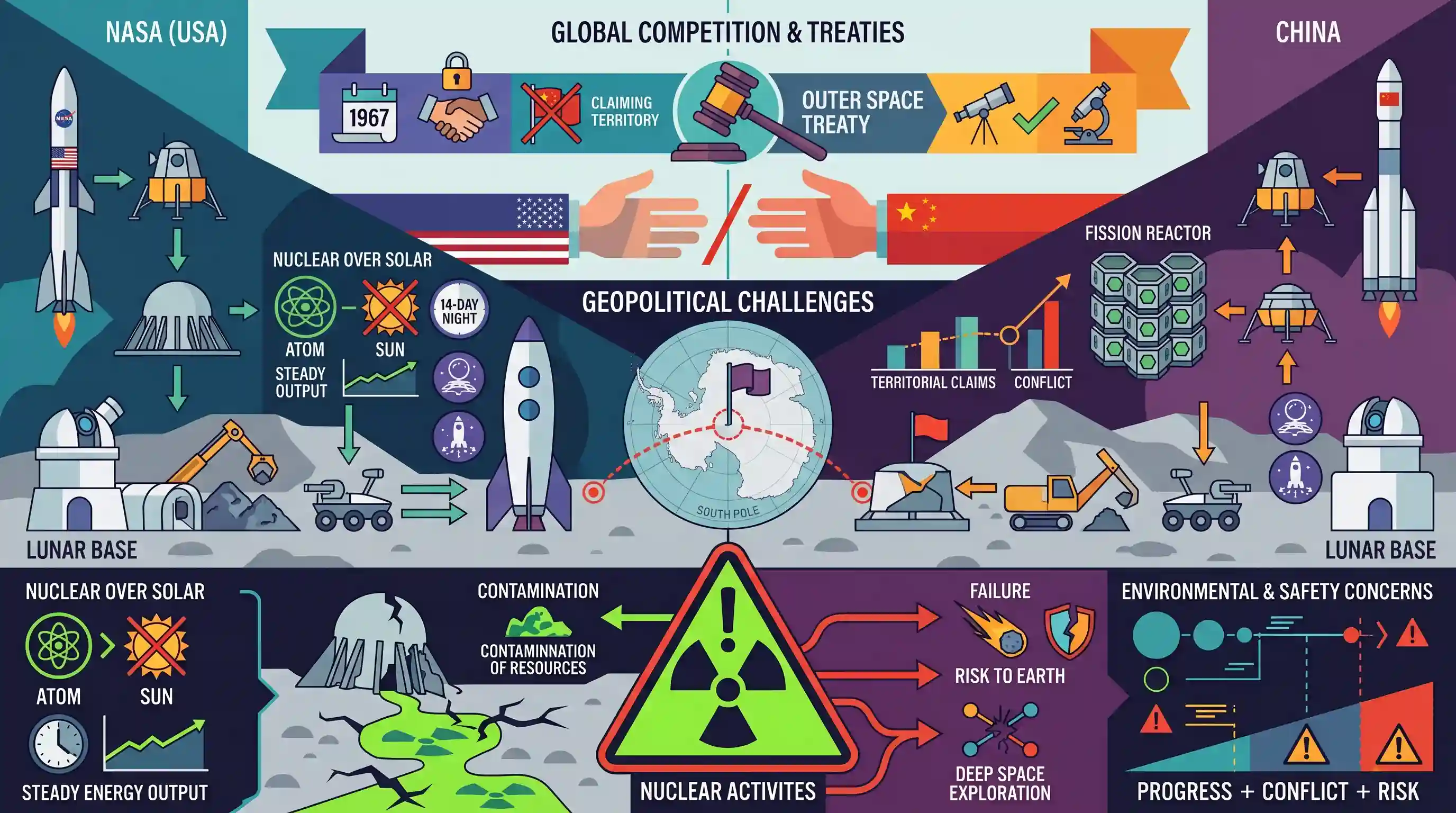
NASA and China are accelerating plans to deploy nuclear reactors on the Moon to sustain long-term lunar bases, mining operations, and future deep-space missions. Targeting the resource-rich lunar south pole, nuclear power is favoured over solar energy to ensure reliable electricity during long lunar nights. However, this technological leap introduces complex challenges regarding international space law, specifically the 1967 Outer Space Treaty. Experts warn that the establishment of such critical infrastructure could lead to de facto territorial claims, exacerbating geopolitical competition and raising significant environmental and safety concerns over nuclear activities in outer space.
Key Points
- NASA and China plan to establish nuclear reactors on the moon by 2030 and 2035 respectively, to provide reliable power for long-term bases, mining, and deep-space missions.
- The lunar south pole is a prime strategic target due to its water ice deposits, which are vital for life support and synthesizing rocket fuel.
- Nuclear energy is deemed necessary to overcome the limitations of solar power, particularly during the 14-day lunar nights and in permanently shadowed craters.
- The 1967 Outer Space Treaty prohibits sovereign claims on celestial bodies, but establishing permanent nuclear infrastructure could lead to de facto territorial claims.
- Current international frameworks, such as the UN\'s 1992 principles on nuclear power in space, are primarily geared towards Earth orbits and lack specific guidelines for lunar surface operations.
- The initiative raises significant concerns regarding environmental safety, potential radioactive contamination, and an intensifying geopolitical space race over extraterrestrial resources.
Important Terms
1967 Outer Space Treaty

A foundational 1967 treaty establishing space as a 'global common.' It prohibits weapons of mass destruction in orbit and forbids any nation from claiming sovereignty over the Moon or other celestial bodies.
UPSC context
GS Paper 2 (International Relations) and GS Paper 3 (Space); tests understanding of international law and global commons.
UN 1992 Principles on Nuclear Power Sources in Outer Space
A 1992 UN General Assembly resolution (47/68) providing safety guidelines for nuclear energy in space. It mandates safety assessments, restricts use to essential missions, and requires member states to inform the UN of launches.
UPSC context
GS Paper 3 (Science & Tech); relevant for safety regulations, environmental protection, and nuclear applications in space.
Artemis Program
NASA's multi-national program aiming to return humans to the Moon by the late 2020s. It focuses on the lunar south pole to establish a sustainable base for future Mars missions.
UPSC context
GS Paper 3 (Science & Tech); critical for space exploration topics, international cooperation, and India's participation in the Artemis Accords.
Fission Surface Power (FSP)
A technology development project by NASA and the Department of Energy to deploy a 40-kilowatt nuclear reactor on the Moon by 2030 to provide reliable power during the long lunar night.
UPSC context
GS Paper 3 (Science & Tech); specific application of nuclear energy for deep-space sustainability and infrastructure.
Common Heritage of Mankind
A legal principle, primarily in the 1979 Moon Agreement, asserting that the Moon’s resources belong to all humanity and cannot be appropriated by any single state or entity.
UPSC context
GS Paper 2 (International Relations); central to debates on space resource mining, territorial claims, and equity between nations.
Prelims Trap
"The 1967 Outer Space Treaty prohibits the deployment of any nuclear technology or reactors on the Moon."
The treaty only bans placing nuclear weapons or WMDs in space. It permits nuclear power sources (like fission reactors) for peaceful exploration.
Static Concepts Connected
What are the core principles of the 1967 Outer Space Treaty?
- Non-appropriation: Prohibits national sovereignty or territorial claims over outer space and celestial bodies by any means.
- Peaceful purposes: Bans stationing WMDs or nuclear weapons in space, though peaceful nuclear energy is allowed.
- State liability: States bear international responsibility and liability for their national space activities, whether governmental or private.
Why is the Lunar South Pole critical for future space missions?
- Water ice: Permanently shadowed craters host primordial water ice, crucial for drinking and prolonged life support systems.
- In-situ resources: Water can be electrolysed into hydrogen and oxygen to manufacture rocket fuel directly on the Moon.
- Extreme conditions: 14-day lunar nights make solar power completely unreliable for bases, driving the need for nuclear fission reactors.
Cross-Topic Patterns
Artemis Accords vs ILRS space blocks
The push for lunar nuclear infrastructure maps directly onto the geopolitical rivalry between the US-led Artemis Accords and the China-Russia International Lunar Research Station (ILRS).
Global Commons and Safety Zones
Similar to UNCLOS Exclusive Economic Zones on Earth, creating "exclusionary safety zones" around lunar reactors acts as a backdoor for de facto territorial claims.

A 2026 question will likely test the legal nuances of the 1967 Outer Space Treaty, specifically distinguishing nuclear weapons vs. reactors.
Linked PYQs · 2
Linked PYQs · 2
- 2023MainsGS3
What is the main task of India's third moon mission which could not be achieved in its earlier mission? List the countries that have achieved this task. Introduce the subsystems in the spacecraft launched and explain the role of the Virtual Launch Control Centre' at the Vikram Sarabhai Space Centre which contributed to the successful launch from Sriharikota.
- 2017MainsGS3
India has achieved remarkable successes in unmanned space missions including the Chandrayaan and Mars Orbitter Mission, but has not ventured into manned space missions. What are the main obstacles to launching a manned space mission, both in terms of technology and logistics? Examine critically.
