NASA prepares for Artemis II crewed lunar flyby mission objectives
Source:Indian Express ↗
Why It Matters
Human spaceflight and deep-space exploration represent the next frontier in the global space race. Understanding the Artemis program provides critical context for India's own Gaganyaan mission, the geopolitical significance of the Artemis Accords, and the technological hurdles of establishing a sustainable human presence in space.
Summary
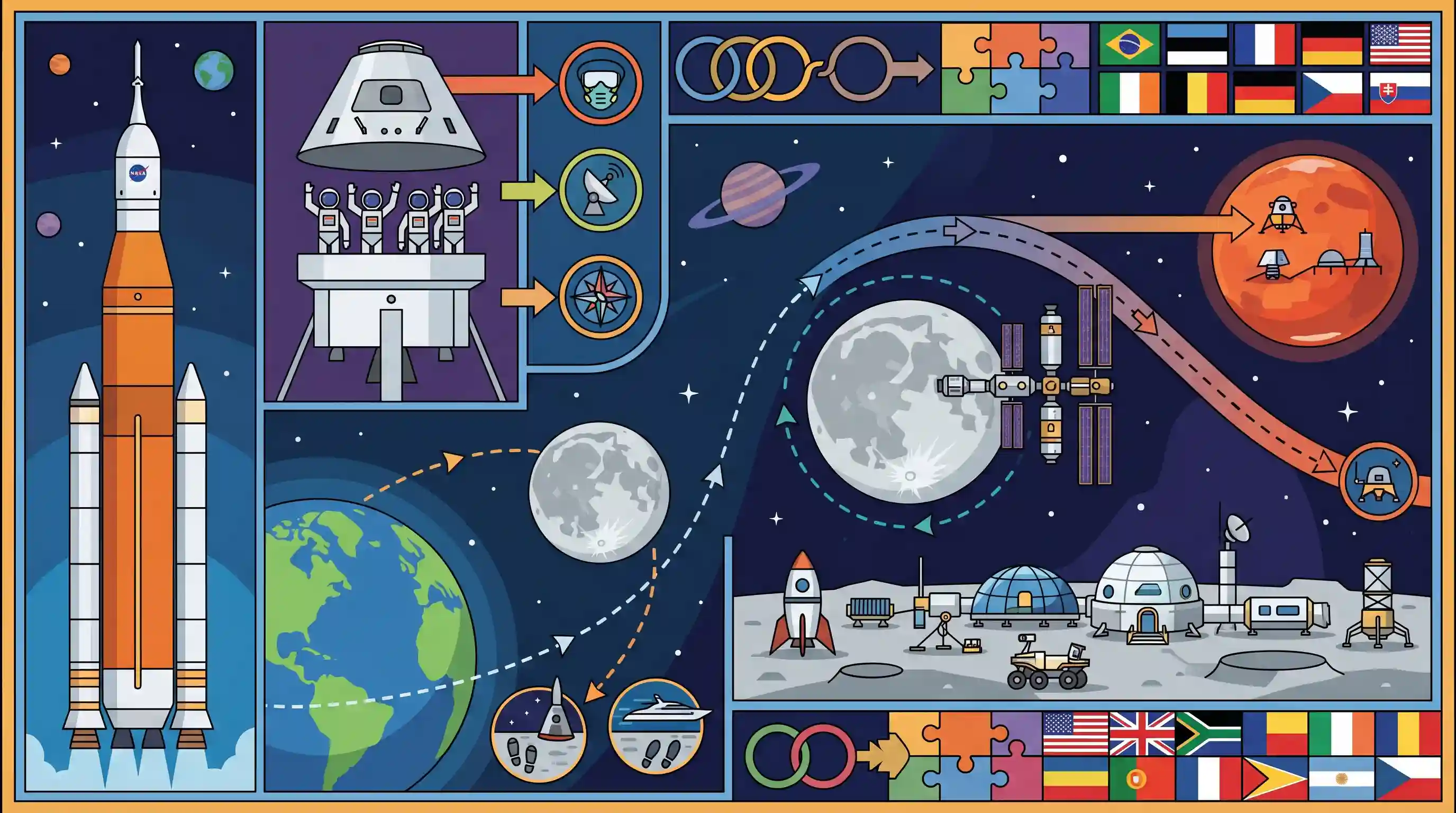
NASA's Artemis program marks humanity's return to the Moon, with Artemis II acting as a crucial stepping stone. As the first crewed lunar mission since 1972, Artemis II will send four astronauts on a flyby around the Moon using the Space Launch System (SLS) and the Orion spacecraft. The primary objective is to test critical life-support, communication, and navigation systems in deep space. Beyond Artemis II, the program envisions a sustained human presence on the Moon through the Lunar Gateway and an Artemis Base Camp, laying the essential technological and logistical groundwork for future crewed missions to Mars. For UPSC aspirants, this highlights the challenges of manned space missions and the evolving landscape of international space cooperation.
Key Points
- Artemis II Mission Profile: A crewed lunar flyby that will serve as the first crewed mission to the Moon in over 50 years, primarily testing the Space Launch System (SLS) and the Orion spacecraft's life-support and deep-space capabilities.
- Stepping Stone to Mars: The Artemis program is designed to create a sustainable lunar presence, using the Moon as a testbed for technologies (like radiation shielding and habitat modules) necessary for future multi-year human missions to Mars.
- Lunar Gateway & Base Camp: Subsequent missions aim to establish the Lunar Gateway—a space station orbiting the Moon—and the Artemis Base Camp on the lunar South Pole, shifting space exploration from short-term visits to sustained human habitation.
- Technological & Logistics Leap: Unlike the Apollo missions, Artemis relies on modern rocketry, advanced materials, and robust international and commercial partnerships to distribute costs and pool technological expertise.
- Relevance for India: Through the signing of the Artemis Accords, India aligns with this global coalition, opening avenues for technology sharing and collaboration that complement ISRO's human spaceflight (Gaganyaan) and lunar exploration (Chandrayaan) programs.
Important Terms
Artemis Program

A NASA-led international initiative to return humans to the Moon, specifically the South Pole, and establish a sustainable lunar presence to prepare for future crewed missions to Mars.
UPSC context
GS III (Space Technology). Tests knowledge of international collaboration and modern lunar exploration milestones.
Artemis Accords
A non-binding set of principles, signed by India in 2023, for transparent and peaceful cooperation in civil space exploration, grounded in the 1967 Outer Space Treaty.
UPSC context
GS II (International Relations) & GS III (Space Policy). Essential for understanding India's strategic space alliances.
Gaganyaan Mission
ISRO's maiden human spaceflight mission aiming to send a crew of three into a 400 km low-Earth orbit for three days and return them safely to Earth.
UPSC context
GS III (Indigenization of Technology). Evaluates India's self-reliance in advanced crewed spaceflight capabilities.
Chandrayaan-3
ISRO's successful 2023 lunar mission that made India the first nation to soft-land a craft near the Moon’s South Pole, demonstrating critical landing and roving capabilities.
UPSC context
GS III (S&T Developments). Significant for lunar resource exploration and India's global space stature.
NASA
The U.S. government's civil space agency leading major international projects like the Artemis program and the International Space Station (ISS).
UPSC context
GS III (Global Tech Cooperation). Tests knowledge of international partners and major space exploration entities.
ISRO
India's premier space agency responsible for the development of launch vehicles, satellites, and planetary exploration missions like Chandrayaan and Gaganyaan.
UPSC context
GS III (Institutional Frameworks). Central to India’s science and technology development and international standing.
Prelims Trap
The Artemis Accords is a legally binding UN treaty governing lunar resource extraction.
The Accords are a US-led, non-binding multilateral framework, not a UN treaty, though they are rooted in the UN Outer Space Treaty of 1967.
Static Concepts Connected
What are the core principles of the UN Outer Space Treaty (1967)?
- Non-appropriation: Bans national sovereignty claims or occupation over outer space and celestial bodies.
- Peaceful purposes: Prohibits placing nuclear weapons or weapons of mass destruction in Earth orbit or on the Moon.
- State liability: Nations bear international responsibility for national space activities and are liable for damage caused by their space objects.
How does the Lunar Gateway differ from the International Space Station (ISS)?
- Orbit type: The ISS is in Low Earth Orbit (LEO), whereas the Gateway will be placed in a Near-Rectilinear Halo Orbit (NRHO) around the Moon.
- Occupancy: The ISS is continuously inhabited; the Gateway will be largely autonomous and periodically uncrewed between Artemis missions.
- Primary function: The Gateway serves as a staging hub and relay station for deep-space and lunar landing missions, unlike the ISS's primary focus as an orbital laboratory.
Cross-Topic Patterns
Artemis Accords vs Sino-Russian ILRS
India’s signing of the US-led Artemis Accords positions it against the Sino-Russian International Lunar Research Station (ILRS), reflecting emerging bipolar geopolitics and alliance-building in outer space.
Lunar resources & Cold Traps
The geopolitical rush for the Lunar South Pole’s water ice mirrors Earth’s critical minerals scramble, tying GS-3 space tech directly to GS-2 international resource diplomacy.

A 2026 Prelims question will likely test the non-binding nature of Artemis Accords against the 1967 Outer Space Treaty.
Linked PYQs · 5
Linked PYQs · 5
- 2017MainsGS3
India has achieved remarkable successes in unmanned space missions including the Chandrayaan and Mars Orbitter Mission, but has not ventured into manned space missions. What are the main obstacles to launching a manned space mission, both in terms of technology and logistics? Examine critically.
- 2023MainsGS3
What is the main task of India's third moon mission which could not be achieved in its earlier mission? List the countries that have achieved this task. Introduce the subsystems in the spacecraft launched and explain the role of the Virtual Launch Control Centre' at the Vikram Sarabhai Space Centre which contributed to the successful launch from Sriharikota.
- 2025PrelimsGS1
Consider the following space missions : I. Axiom-4 II. SpaDeX III. Gaganyaan How many of the space missions given above encourage and support micro-gravity research?
- 2024PrelimsGS1
With reference to radioisotope thermoelectric generators (RTGs), consider the following statements: 1. RTGs are miniature fission reactors. 2. RTGs are used for powering the onboard systems of spacecrafts. 3. RTGs can use Plutonium-238, which is a by-product of weapons development. Which of the statements given above are correct?
- 2016PrelimsGS1
Consider the following statements: The Mangalyaan launched by ISRO 1. is also called the Mars Orbiter Mission 2. made India the second country to have a spacecraft orbit the Mars after USA 3. made India the only country to be successful in making its spacecraft orbit the Mars in its very first attempt Which of the statements given above is/are correct?
