NASA Invitation to ISRO for Lunar Base Programme Cooperation
Source:The Hindu ↗
Why It Matters
This development highlights India's emergence as a premier global spacefaring nation capable of deep-space exploration and collaborative lunar habitation, while emphasizing the deepening strategic technology partnership between India and the United States.
Summary
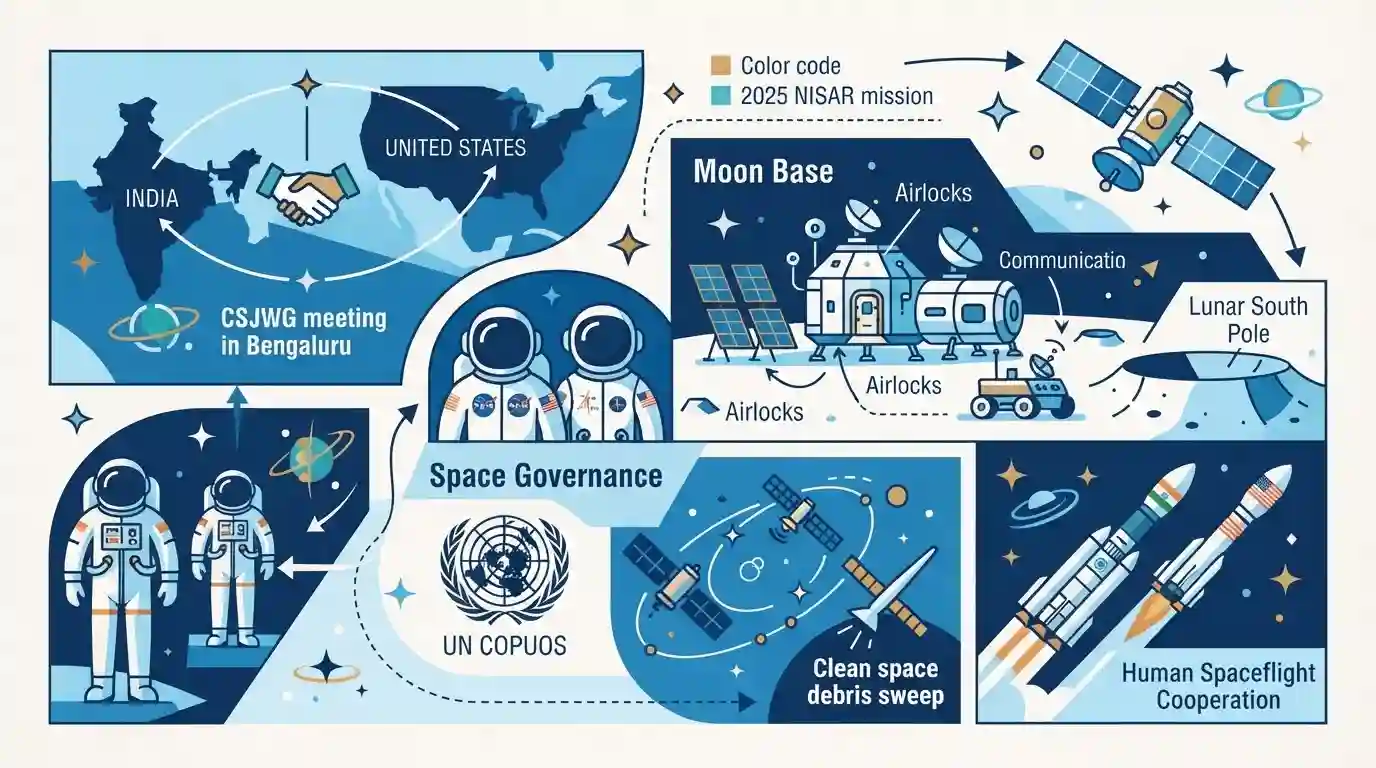
NASA has formally invited ISRO to collaborate on its ambitious three-phase Moon Base programme, which plans to construct humanity's first lunar outpost near the lunar South Pole. Extended during the 9th India-U.S. Civil Space Joint Working Group (CSJWG) meeting in Bengaluru, the partnership builds on the Artemis Accords and the U.S.-India Transforming the Relationship Utilizing Strategic Technology (TRUST) Initiative (stemming from the February 2025 Modi-Trump Joint Statement). The meeting also reviewed further scientific data sharing, human spaceflight cooperation, celebrated the 2025 NISAR mission launch, and reaffirmed adherence to UN COPUOS space sustainability guidelines.
Key Points
- NASA extended a formal invitation to ISRO to join its Moon Base programme during the 9th Civil Space Joint Working Group (CSJWG) meeting in Bengaluru.
- The Moon Base programme aims to build the first human outpost on another celestial body near the lunar South Pole, structured to be executed in three phases.
- The cooperation is anchored under the Artemis Accords, which India signed in 2023, and will involve advancing discussions on open scientific data sharing.
- Civil and commercial space cooperation is being driven by the U.S.-India Transforming the Relationship Utilizing Strategic Technology (TRUST) Initiative, aligned with the February 2025 Modi-Trump Joint Leaders' Statement.
- Both agencies highlighted their expanding collaboration following the successful launch of the joint NASA-ISRO Synthetic Aperture Radar (NISAR) mission in 2025 and reiterated their commitment to the UN COPUOS guidelines on long-term sustainability of outer space.
Important Terms
Artemis Accords

A US-led, non-binding multilateral agreement grounded in the 1967 Outer Space Treaty. It establishes practical principles for transparent, safe, and sustainable civil space exploration. India became a signatory in 2023.
UPSC context
Crucial for GS-2 (International Relations) and GS-3 (Space Technology) regarding global space governance and India-US strategic ties.
U.S.-India TRUST Initiative
The "Transforming the Relationship Utilizing Strategic Technology" framework upgrades the earlier iCET agreement. Launched in 2025, it accelerates India-US collaboration across defense, AI, semiconductors, biotechnology, and space technologies.
UPSC context
Highly relevant for GS-2 (Bilateral Relations) and GS-3 (Science & Tech) testing knowledge on emerging technologies and geopolitics.
NISAR Mission
The NASA-ISRO Synthetic Aperture Radar is an advanced Earth observation satellite launched in 2025. Using dual-frequency radar, it monitors global environmental changes, ice-sheet dynamics, and natural hazards with centimeter-level precision.
UPSC context
Key for GS-3 (Space Technology & Disaster Management) covering joint international satellite missions and remote sensing applications.
UN COPUOS
Established in 1959, the United Nations Committee on the Peaceful Uses of Outer Space governs global space cooperation. It formulates treaties and frameworks, including the 2019 guidelines for long-term space sustainability.
UPSC context
Essential for GS-2 (International Organizations) testing knowledge of global frameworks for space governance and orbital debris mitigation.
Moon Base Programme
Part of NASA's Artemis architecture, this initiative aims to establish humanity's first permanent outpost near the Moon's South Pole. It focuses on scientific discovery, resource utilization, and preparing for future Mars missions.
UPSC context
Relevant for GS-3 (Awareness in Space), testing ISRO's evolving role in deep-space exploration and international lunar missions.
India-U.S. Civil Space Joint Working Group (CSJWG)
A dedicated bilateral forum that facilitates India-US strategic dialogue on space. It coordinates cooperation on Earth observation, human spaceflight, open scientific data sharing, and commercial space partnerships.
UPSC context
Important for GS-2 (Bilateral Agreements), tracking the institutional mechanisms driving India-US diplomatic and scientific cooperation.
Prelims Trap
The Artemis Accords are a legally binding UN treaty that allows nations to claim sovereign ownership over lunar resource extraction zones.
The Artemis Accords explicitly reinforce the 1967 Outer Space Treaty, which prohibits national appropriation. They do not grant sovereign ownership or establish a legally binding UN treaty regime.
Static Concepts Connected
What is the Outer Space Treaty of 1967 and its core tenets?
- Foundation: Formally the Treaty on Principles Governing the Activities of States in the Exploration and Use of Outer Space, including Celestial Bodies.
- Non-Appropriation: Declares that outer space, including the Moon, is not subject to national appropriation by claim of sovereignty, use, or occupation.
- Peaceful Uses: Explicitly bans weapons of mass destruction in Earth orbit or stationed on celestial bodies, limiting usage to peaceful purposes.
What is the difference between L-band and S-band radar in Earth observation?
- L-Band Radar: Operates at a lower frequency (1-2 GHz), providing deep penetration through dense forest canopies and ice for subsurface imaging.
- S-Band Radar: Operates at a higher frequency (2-4 GHz), optimized for surface monitoring like agriculture, coastal winds, and near-surface vegetation dynamics.
- NISAR Application: Developed jointly by NASA (L-band) and ISRO (S-band), making NISAR the first dual-frequency civil radar imaging satellite.
Cross-Topic Patterns
Space Diplomacy & Critical Tech Geopolitics
The transition from iCET to the TRUST Initiative highlights how civil space cooperation acts as a strategic vector for wider US-India technology-sharing in critical semiconductors and defense.
Outer Space Resources vs. Global Commons
The race to the lunar South Pole tests the friction between traditional UN-led multilateralism (COPUOS) and minilateral, Western-led frameworks (Artemis Accords) regarding resource ownership.

UPSC may contrast the non-binding Artemis Accords with the 1967 Outer Space Treaty, likely paired with NISAR's dual-frequency band roles.
Linked PYQs · 2
Linked PYQs · 2
- 2023MainsGS3
What is the main task of India's third moon mission which could not be achieved in its earlier mission? List the countries that have achieved this task. Introduce the subsystems in the spacecraft launched and explain the role of the Virtual Launch Control Centre' at the Vikram Sarabhai Space Centre which contributed to the successful launch from Sriharikota.
- 2025PrelimsGS1
Consider the following space missions : I. Axiom-4 II. SpaDeX III. Gaganyaan How many of the space missions given above encourage and support micro-gravity research?
