Artemis 2 Wet Dress Rehearsal Clears Path for Crewed Moon Mission
Source:The Hindu ↗
Why It Matters
The Artemis program marks humanity's return to crewed lunar exploration after more than half a century. Understanding these missions and associated technologies like the SLS and Orion capsule is crucial for the Science & Technology syllabus in GS Paper 3 and Prelims.
Summary
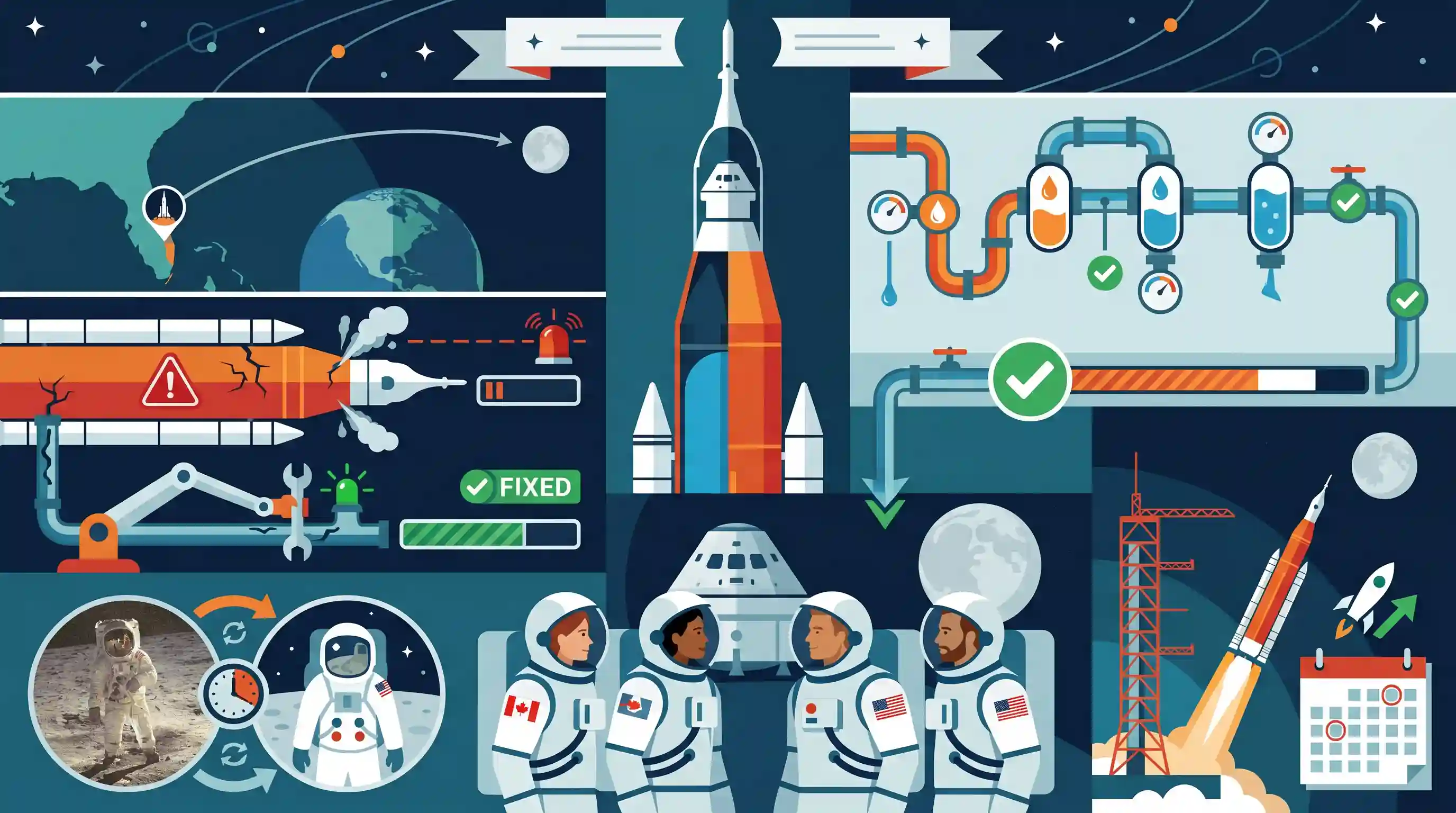
NASA has successfully conducted a critical wet dress rehearsal for its Artemis 2 mission at Cape Canaveral, Florida, testing the massive Space Launch System (SLS) rocket and the Orion crew capsule. This test paves the way for the first crewed mission to orbit the Moon in over 50 years. Despite an earlier delay caused by a liquid hydrogen leak, the successful rehearsal clears the path for NASA to set a firm launch date for the mission, which will carry three Americans and one Canadian astronaut.
Key Points
- NASA successfully completed a wet dress rehearsal for the Artemis 2 lunar mission, which will be the first crewed mission to fly past the Moon in more than 50 years.
- The rehearsal was conducted at Cape Canaveral in Florida and involved the Space Launch System (SLS) rocket and the Orion crew capsule.
- The mission will carry three American astronauts and one Canadian astronaut around the Moon.
- An earlier rehearsal attempt in February was cut short due to technical problems, including a liquid hydrogen leak.
Important Terms
Artemis 2 mission

The first crewed mission of NASA's Artemis program, which performed a lunar flyby in April 2026. It carried four astronauts, marking humanity's first return to the lunar vicinity since 1972.
UPSC context
GS Paper III (Science & Tech); tests awareness of international space cooperation and milestones in human deep-space exploration.
Space Launch System (SLS)
NASA's super heavy-lift expendable launch vehicle designed to carry the Orion spacecraft and heavy cargo to deep space, including the Moon and eventually Mars.
UPSC context
GS Paper III (S&T); significant for questions on heavy-lift rocket technology and comparative space capabilities (e.g., vs. ISRO's LVM3).
Orion crew capsule
A deep-space spacecraft designed to carry up to four astronauts beyond low Earth orbit. It consists of a crew module and a European-built service module for propulsion and life support.
UPSC context
GS Paper III; relevant for understanding human-rated spacecraft design, re-entry technologies, and international collaborative modules in space missions.
Wet dress rehearsal
A comprehensive pre-launch test where a rocket is fueled and a full countdown is performed to the point of ignition to verify systems and ground procedures.
UPSC context
GS Paper III (S&T); tests technical understanding of mission readiness protocols and pre-launch safety milestones in high-stakes space exploration.
Artemis program
A NASA-led international mission series aiming to establish a sustainable human presence on the Moon and utilize it as a stepping stone for future crewed missions to Mars.
UPSC context
GS Paper III & II; important for international relations (Artemis Accords) and global scientific governance in the 'New Space' era.
Prelims Trap
"Artemis 2 will be the first crewed mission to land on the lunar surface in over 50 years."
Artemis 2 is exclusively a lunar FLYBY mission. The actual crewed lunar landing (putting boots on the Moon) is planned for the subsequent Artemis 3 mission.
Static Concepts Connected
What are the foundational principles of the Artemis Accords?
- Non-binding nature: They are a set of non-binding principles grounded in the 1967 Outer Space Treaty, not a legally enforceable treaty.
- Peaceful interoperability: Promotes cooperative, transparent, and peaceful space exploration, along with the interoperability of space hardware systems.
- Space resource extraction: Allows for the extraction and utilization of space resources (like lunar water/minerals) under the auspices of the Outer Space Treaty.
What distinguishes Deep Space launch vehicles from standard LEO rockets?
- Payload capacity: Deep space rockets like SLS require super heavy-lift capacity (100+ tonnes to LEO) to break Earth's gravity, compared to medium-lift rockets.
- Cryogenic propulsion: High reliance on advanced cryogenic stages (Liquid Hydrogen/Oxygen) for sustained, high-efficiency thrust beyond Earth's gravitational pull.
Cross-Topic Patterns
Artemis Accords vs China's ILRS
The Artemis Accords represent a US-led block in space governance, competing directly with the China-Russia International Lunar Research Station (ILRS). India signing the Accords was a definitive geopolitical space alignment.
Gaganyaan's synergy with Artemis diplomacy
India's Gaganyaan mission builds domestic crewed spaceflight capacity, but strategic alignment through the Artemis Accords secures ISRO's long-term access to deep-space tech and upcoming joint NASA-ISRO ISS missions.

A 2026 Prelims question will likely test the distinction between Artemis II (flyby) and III (landing), plus Artemis Accords provisions.
Linked PYQs · 3
Linked PYQs · 3
- 2025PrelimsGS1
Consider the following space missions : I. Axiom-4 II. SpaDeX III. Gaganyaan How many of the space missions given above encourage and support micro-gravity research?
- 2008PrelimsGS1
What is the purpose of the US Space Agency's Themis Mission, which was recently in the news?
- 2023MainsGS3
What is the main task of India's third moon mission which could not be achieved in its earlier mission? List the countries that have achieved this task. Introduce the subsystems in the spacecraft launched and explain the role of the Virtual Launch Control Centre' at the Vikram Sarabhai Space Centre which contributed to the successful launch from Sriharikota.
