NASA delays crewed lunar mission due to technical complications
Source:The Hindu ↗
Why It Matters
The article demonstrates the technological complexities of manned space missions, which is directly relevant to India's own Gaganyaan mission. Furthermore, it highlights the emerging domain of space geopolitics, where lunar exploration and establishing bases on the Moon's South Pole have become central to the strategic rivalry between the US and China.
Summary
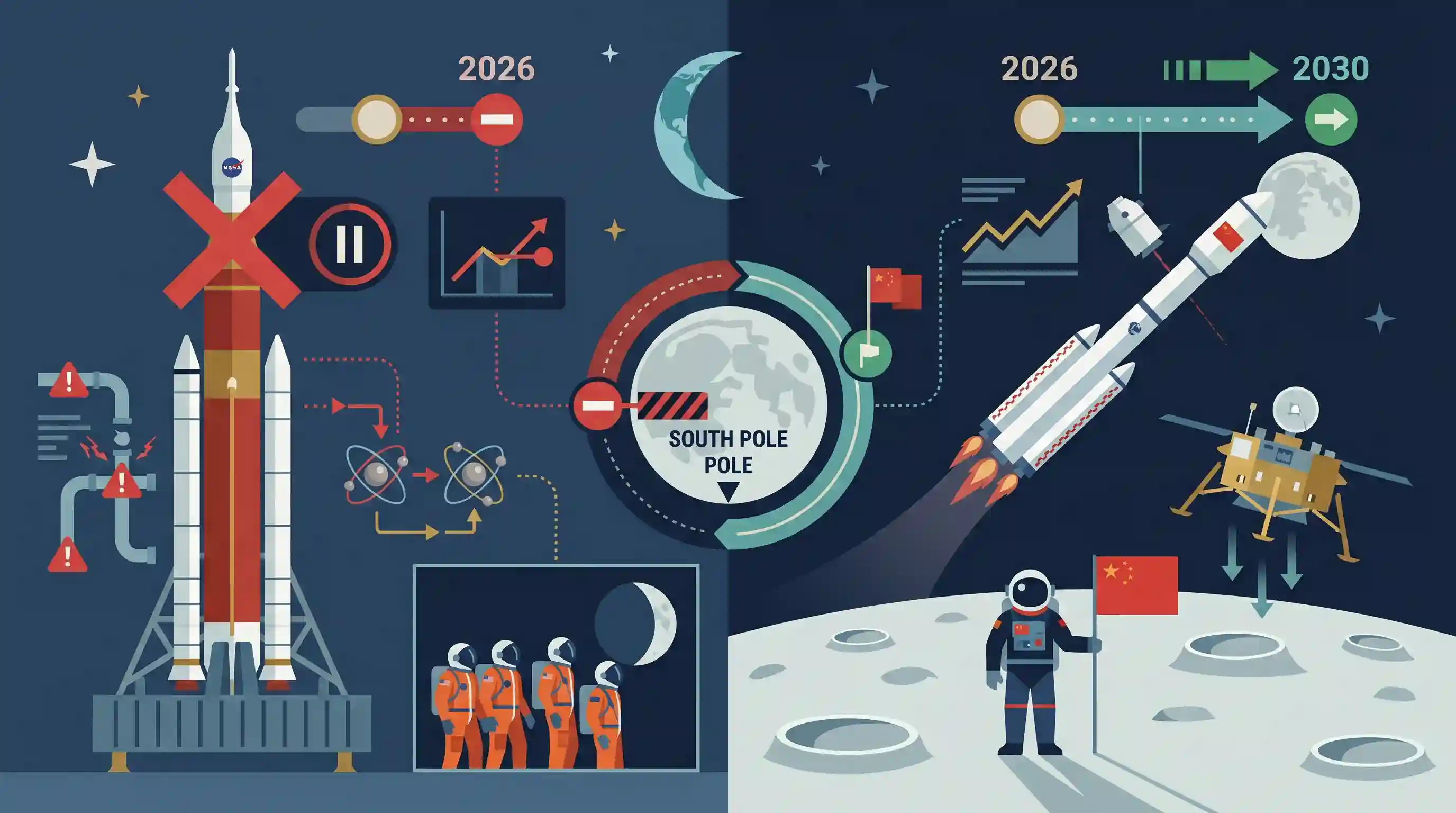
NASA Chief Jared Isaacman has ruled out a March 2026 launch for the crewed Artemis 2 lunar flyby mission due to technical issues involving the helium flow to the Space Launch System (SLS) rocket. The mission aims to send four astronauts around the Moon, paving the way for future lunar landings. This delay has significant geopolitical implications amid the escalating US-China space race, as both countries vie to land humans on the Moon's South Pole by 2030. China is currently making rapid progress with its upcoming Chang'e 7 mission and the development of its Mengzhou crewed spacecraft.
Key Points
- NASA has delayed the Artemis 2 mission, originally slated for March 2026, due to technical problems regarding the helium flow to the Space Launch System (SLS) rocket.
- Artemis 2 will be the first crewed mission to fly around the Moon in over 50 years, acting as a precursor to crewed lunar landings.
- The delay occurs against the backdrop of an intensifying US-China space race, as both nations aim to establish a permanent presence near the lunar south pole by 2030.
- China is rapidly advancing its lunar program, with the uncrewed Chang'e 7 mission planned for 2026 and ongoing development of its Mengzhou crewed spacecraft.
- The setback highlights the immense technological and logistical obstacles associated with crewed space exploration, serving as a reminder of the challenges inherent in missions like India's upcoming Gaganyaan.
Important Terms
Artemis program

NASA's international initiative to return humans to the Moon, establish a sustainable lunar presence, and prepare for future crewed missions to Mars.
UPSC context
GS-III: Science and Technology — Awareness in space; vital for questions on international space cooperation and lunar exploration.
Artemis 2
The first crewed mission of the Artemis program, designed to carry four astronauts on a lunar flyby to test deep-space life-support systems.
UPSC context
GS-III: Milestones in Space Exploration; relevant for tracking current developments in human spaceflight and NASA-ISRO potential synergies.
Space Launch System (SLS)
NASA's super heavy-lift expendable rocket designed to launch the Orion spacecraft and heavy payloads beyond Earth's orbit for deep-space exploration.
UPSC context
GS-III: Launch Vehicle Technology; comparative analysis with India's LVM3 or SpaceX's Starship in heavy-lift capabilities.
Chang'e lunar program
The China National Space Administration's (CNSA) phased lunar exploration project, encompassing robotic orbiters, landers, sample-return missions, and eventually crewed landings.
UPSC context
GS-II/III: Geopolitics of Space and Science Tech; tests understanding of the global space race and China's lunar advancements.
Mengzhou spacecraft
China's next-generation crewed spacecraft, formerly the "Next-Gen Crewed Spacecraft," designed for deep-space missions to the Tiangong space station and the Moon.
UPSC context
GS-III: Space Technology; relevant for comparing international crewed vehicle architectures (Orion vs. Mengzhou vs. Gaganyaan).
Lunar South Pole
A resource-rich region of the Moon targeted for exploration due to potential water-ice deposits in permanently shadowed craters.
UPSC context
GS-III: Space Resources and Geography; significant for India's Chandrayaan-3 and the future "lunar economy."
Prelims Trap
Helium is used as a highly efficient cryogenic rocket fuel in the Space Launch System.
Helium is chemically inert. It is used in launch vehicles as a pressurant to push liquid propellants into the engine and purge lines, never as a combustible fuel.
Static Concepts Connected
Why is the Lunar South Pole the primary target for global space missions?
- Water Ice: Permanently shadowed craters contain trapped water ice, a critical resource for deep-space missions.
- Resource Utilization: Extracted water can be electrolyzed to create hydrogen (for rocket fuel) and oxygen (for astronaut life support).
- Solar Power: Elevated regions and crater rims receive near-constant sunlight, essential for powering lunar bases continuously.
What is the roadmap for India's upcoming human spaceflight and lunar exploration?
- Gaganyaan: India's inaugural human spaceflight program aiming to send astronauts to Low Earth Orbit (LEO) and safely return them.
- Bharatiya Antariksha Station: ISRO's planned indigenous space station, targeted to be operational in orbit by 2035.
- Crewed Lunar Landing: India's long-term vision aims to land its first astronaut on the lunar surface by 2040.
Cross-Topic Patterns
Space as a Geopolitical Theatre
The race for the Lunar South Pole mirrors Earth's geopolitical blocs, pitting the US-led Artemis Accords (which India joined) against the China-Russia International Lunar Research Station (ILRS).
Cryogenic Tech & Launch Vehicles
NASA's SLS pressurization issues highlight the extreme complexity of super-cooled rocket stages, paralleling ISRO's own historical challenges and ultimate indigenization of the CE-20 cryogenic engine for LVM3.

Expect a multi-statement Prelims question comparing Artemis, Chang'e, and Gaganyaan objectives, specifically targeting South Pole resources.
Linked PYQs · 3
Linked PYQs · 3
- 2023MainsGS3
What is the main task of India's third moon mission which could not be achieved in its earlier mission? List the countries that have achieved this task. Introduce the subsystems in the spacecraft launched and explain the role of the Virtual Launch Control Centre' at the Vikram Sarabhai Space Centre which contributed to the successful launch from Sriharikota.
- 2017MainsGS3
India has achieved remarkable successes in unmanned space missions including the Chandrayaan and Mars Orbitter Mission, but has not ventured into manned space missions. What are the main obstacles to launching a manned space mission, both in terms of technology and logistics? Examine critically.
- 2021MainsGS2
“The USA is facing an existential threat in the form of a China, that is much more challenging than the erstwhile Soviet Union.” Explain.
