NASA Artemis 2 Crewed Lunar Mission and Deep Space Exploration
Source:Indian Express ↗
Why It Matters
The Artemis mission is highly relevant for GS-3 (Space Technology). It provides a comparative benchmark for India's own space endeavors, such as the Chandrayaan lunar missions and the upcoming Gaganyaan human spaceflight program. Understanding the technological complexities and objectives of returning humans to the Moon is crucial for answering questions on space exploration and international space collaborations.
Summary
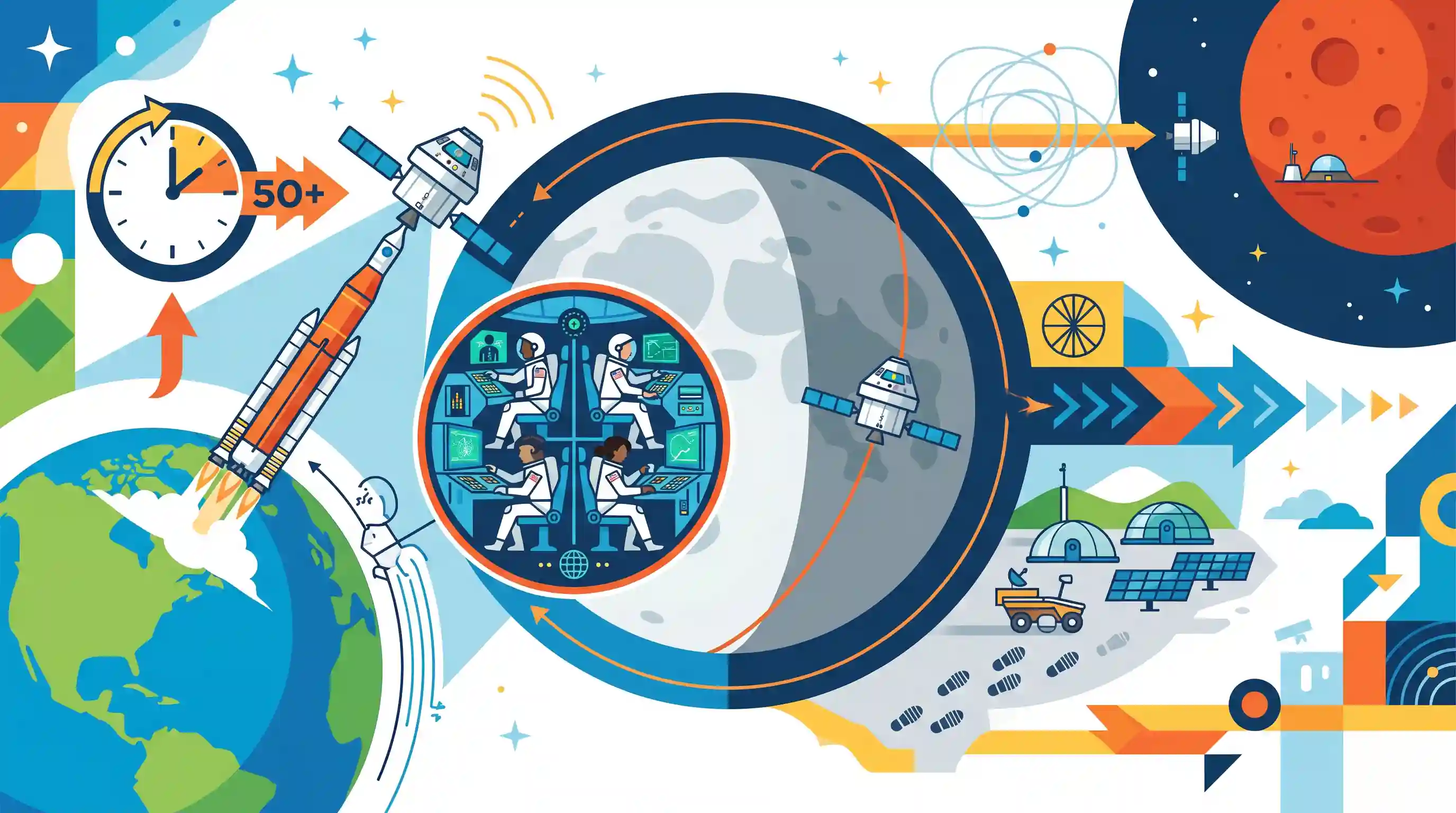
NASA has announced March 6 as the target launch date for its historic Artemis 2 mission, marking the first human lunar flight in over 50 years. The mission will send a crew of astronauts around the Moon's far side to test deep-space habitation and operational capabilities. As a critical step in the Artemis program, it paves the way for a sustainable human presence on the Moon and lays the groundwork for future crewed missions to Mars.
Key Points
- NASA has targeted March 6 for the launch of the Artemis 2 mission, which will be the first human lunar flight in over 50 years.
- The mission will carry astronauts on a trajectory around the Moon's far side without landing, testing vital life-support systems.
- Artemis 2 acts as a precursor to Artemis 3, which aims to eventually land humans back on the lunar surface.
- The mission signifies a renewed era of deep-space exploration, demonstrating the capabilities of the Orion spacecraft and Space Launch System (SLS) rocket.
Important Terms
Artemis Program

NASA's multi-phase program to return humans to the Moon, establish a sustainable lunar presence, and develop technologies for future crewed missions to Mars.
UPSC context
Mains Paper III (S&T); tests knowledge of international space exploration milestones and India's strategic role in global space governance.
Artemis 2 Mission
The first crewed flight of NASA's Artemis program, involving a 10-day lunar flyby mission to test deep-space habitation and life-support systems without landing.
UPSC context
Paper III (S&T); high-priority current affairs topic regarding human spaceflight capabilities and lunar mission trajectories.
Space Launch System (SLS)
NASA's super heavy-lift launch vehicle designed to propel the Orion spacecraft and heavy payloads beyond Earth's orbit for deep-space missions.
UPSC context
Paper III (S&T); relevant for questions on space infrastructure, launch vehicle categories, and deep-space propulsion technologies.
Orion Spacecraft
The crewed spacecraft for the Artemis program, designed for long-duration deep-space travel with advanced heat shields and emergency abort systems.
UPSC context
Paper III (S&T); tests understanding of crew module technology and safety systems in the context of human space missions.
Lunar Far Side
The lunar hemisphere that never faces Earth; its exploration presents unique communication challenges and holds critical geological data about the early solar system.
UPSC context
Paper III (S&T); covers lunar geography, the significance of lunar landing sites, and the role of relay satellites.
Artemis Accords
A non-binding international agreement for peaceful and sustainable lunar exploration, setting principles like transparency and scientific data sharing; India is a signatory.
UPSC context
Paper II (International Relations) & III (S&T); evaluates awareness of international space laws and India's diplomatic space-strategic commitments.
Prelims Trap
Artemis 2 will safely land the first crew of astronauts on the Moon's South Pole.
Artemis 2 is strictly a crewed lunar flyby. The actual surface landing, targeting the South Pole, is scheduled for the subsequent Artemis 3 mission.
Static Concepts Connected
How do the Artemis Accords relate to the 1967 Outer Space Treaty?
- Outer Space Treaty: A binding 1967 UN treaty prohibiting national appropriation of space and banning the placement of weapons of mass destruction in orbit.
- Artemis Accords: A US-led, non-binding multilateral framework (2020) built on OST principles to govern peaceful, interoperable civil space exploration and resource utilization.
- India's Position: India signed the Accords in 2023, signaling a strategic geopolitical shift toward US-led space architecture and deep-space data sharing.
What are the mechanical differences between Low Earth Orbit (LEO) and lunar trajectories?
- LEO: Orbit under 2,000 km altitude. This is where the International Space Station operates and where India's Gaganyaan module will orbit.
- Translunar Injection: A propulsive maneuver used to push a spacecraft out of Earth orbit and onto a trajectory toward the Moon.
- Free-return trajectory: A specialized path using lunar gravity to loop a spacecraft back toward Earth without requiring major engine burns, utilized by Artemis 2.
Cross-Topic Patterns
Artemis Accords + iCET framework
India's entry into the Artemis Accords is heavily tied to the broader Indo-US Initiative on Critical and Emerging Technology (iCET), accelerating ISRO-NASA joint missions and Gaganyaan training.
Lunar Far Side + Relay Satellites
Since the Moon is tidally locked, far-side missions lack direct radio contact with Earth, requiring specialized relay satellites at Earth-Moon Lagrange points to maintain communication.

Expect a 2026 Prelims question mixing Artemis mission phases (flyby vs landing) with India’s Gaganyaan and Artemis Accords obligations.
Linked PYQs · 2
Linked PYQs · 2
- 2023MainsGS3
What is the main task of India's third moon mission which could not be achieved in its earlier mission? List the countries that have achieved this task. Introduce the subsystems in the spacecraft launched and explain the role of the Virtual Launch Control Centre' at the Vikram Sarabhai Space Centre which contributed to the successful launch from Sriharikota.
- 2017MainsGS3
India has achieved remarkable successes in unmanned space missions including the Chandrayaan and Mars Orbitter Mission, but has not ventured into manned space missions. What are the main obstacles to launching a manned space mission, both in terms of technology and logistics? Examine critically.
