Kasturirangan Report and Western Ghats Ecological Sensitivity
Source:The Hindu ↗
हे का महत्त्वाचे आहे
It addresses the crucial policy friction between ecological conservation of fragile regions like the Western Ghats and state-level developmental demands, a recurring theme in environmental governance.
सारांश
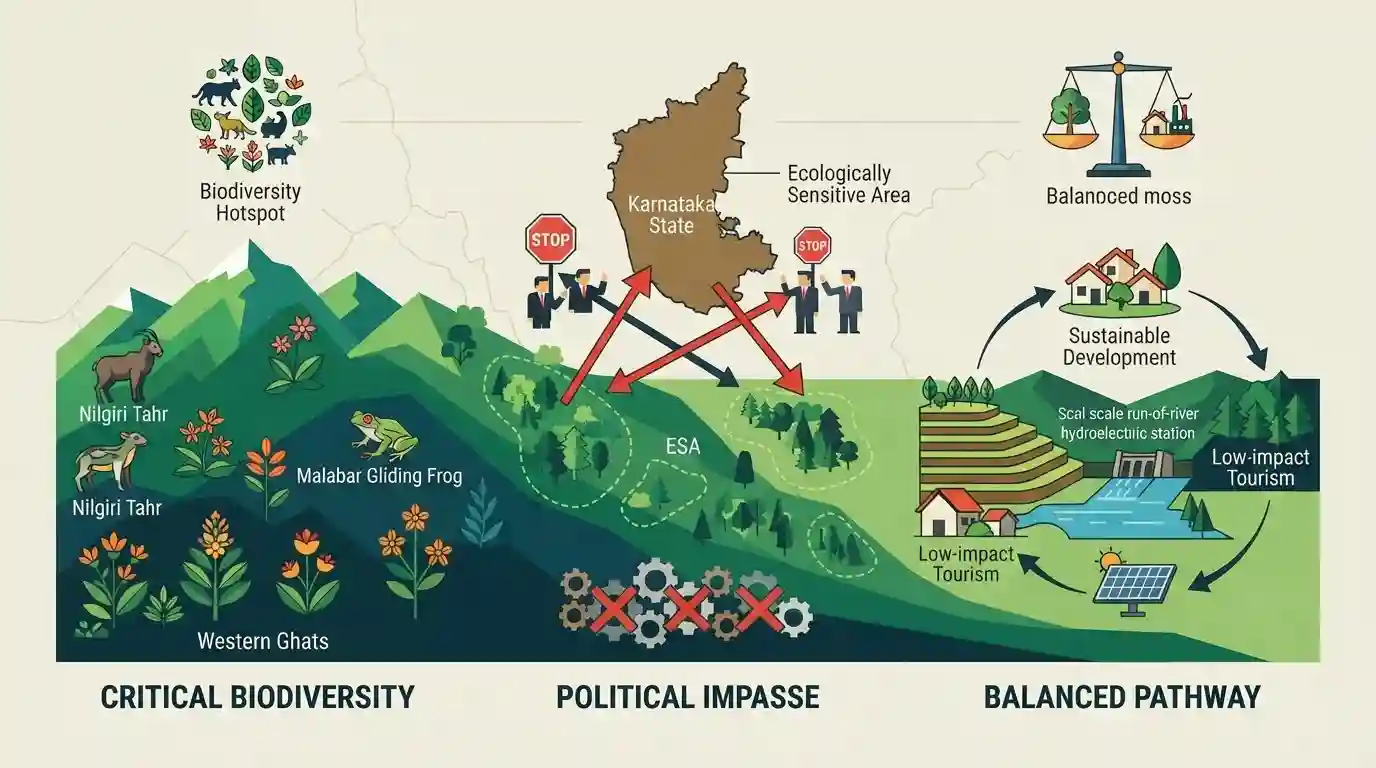
The editorial discusses the debate surrounding the Kasturirangan Report on the Western Ghats, criticizing political resistance in States like Karnataka to notifying Ecologically Sensitive Areas (ESAs) and emphasizing the need for balancing environmental conservation with sustainable development.
मुख्य मुद्दे
- The editorial critiques the Karnataka government's narrowed and short-sighted posture regarding the implementation of the Kasturirangan Committee Report on Western Ghats conservation.
- Balancing developmental aspirations with ecological vulnerability is critical, especially given the frequency of extreme weather events and landslides in the Western Ghats.
- Delaying or diluting Ecologically Sensitive Area (ESA) notifications under political and local pressure risks long-term ecological degradation of a global biodiversity hotspot.
महत्त्वाच्या संज्ञा
Kasturirangan Report

A high-level working group report submitted in 2013 that recommended designating roughly 37 percent of the Western Ghats as an Ecologically Sensitive Area to balance conservation and development.
UPSC context
Important for GS Paper III (Environment, Conservation, and EIA); tests understanding of ecological governance and policy trade-offs.
Gadgil Committee Report
The Western Ghats Ecology Expert Panel, chaired by Madhav Gadgil, which recommended strict ecological zoning across the entire Western Ghats region.
UPSC context
Relevant for GS Paper III (Environmental Biodiversity and Governance); tests knowledge of landmark panels on Western Ghats conservation.
Union Ministry of Environment, Forest and Climate Change
The central ministry responsible for formulating and implementing environmental policies, wildlife protection, and climate change regulations in India.
UPSC context
Essential for GS Paper II & III; tests institutional mechanisms for environmental regulation and inter-governmental coordination.
संबंधित स्थिर संकल्पना
What are the key differences between the Gadgil and Kasturirangan committees on the Western Ghats?
- Gadgil Approach: Gadgil Report recommended classifying the entire Western Ghats as Ecologically Sensitive Areas (ESA 1, 2, and 3) with stringent restrictions on all developmental activities.
- Kasturirangan Approach: Kasturirangan Report recommended bringing only 37% of the Western Ghats under ESA and used remote sensing rather than grassroots mapping.
- Landscape Distinction: Kasturirangan distinguished between natural and cultural landscapes, permitting agriculture and plantations while banning red-category industries and mining in ESAs.
आंतर-विषय नमुने
Western Ghats conservation vs Disaster Management Act
While Western Ghats notifications are delayed under state pressure, the same region's ecological vulnerability frequently triggers disaster management and federal funding debates under NDMA guidelines.
Biodiversity Hotspots vs Developmental Federalism
The debate over restricting activities in ESAs mirrors international disputes at CBD COP summits regarding indigenous rights versus biodiversity targets.

Gadgil vs Kasturirangan report recommendations and ESA percentages are frequent 2-statement matching traps in prelims.
संबंधित PYQ · 2
संबंधित PYQ · 2
- 2019MainsGS3
Define the concept of carrying capacity of an ecosystem as relevant to an environment. Explain how understanding this concept is vital while planning for sustainable development of a region.
- 2016PrelimsGS1
'Gadgil Committee Report' and 'Kasturirangan Committee Report', sometimes seen in the news, are related to
