Women Reservation Bill and Political Representation Challenges
Source:Indian Express ↗
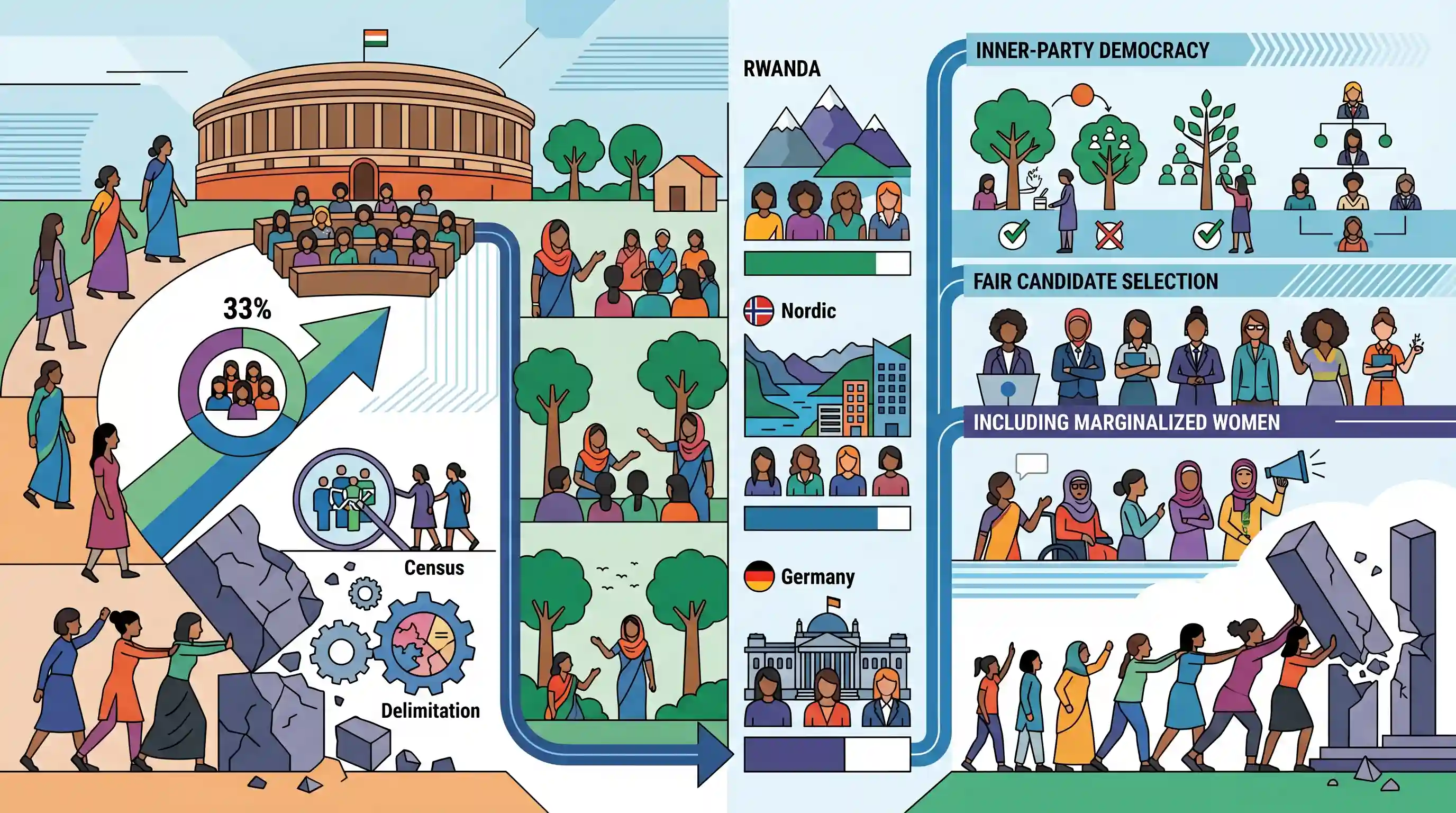
Why It Matters
Women's political representation is a perennial topic in UPSC Mains (GS1 Society and GS2 Polity). Aspirants must understand the nuances of the Women's Reservation Bill (Nari Shakti Vandan Adhiniyam), including structural hurdles like delimitation, sub-quotas, inner-party democracy, and comparative international models of representation, to write well-rounded answers on gender parity in politics.
Summary
The article strongly advocates for the swift implementation of the Nari Shakti Vandan Adhiniyam, a constitutional amendment bill reserving 33% of seats for women in the Lok Sabha and state assemblies. It contends that administrative hurdles like delimitation and census data should no longer be used to justify the political exclusion of women. Drawing on India's mixed but impactful experience with women's reservation in local panchayats, as well as international examples from Rwanda, the Nordic countries, and Germany, the author argues that a critical mass of women legislators transforms policy priorities. However, it stresses that quotas must be complemented by inner-party democracy, fairer candidate selection, and genuine opportunities for marginalized women to effectively dismantle patriarchal power structures.
Key Points
- The Nari Shakti Vandan Adhiniyam (Constitution 131st Amendment Bill, 2026) aims to reserve one-third of seats for women in the Lok Sabha and state assemblies.
- The article argues against using technical prerequisites like delimitation, the census, and sub-quota debates as excuses for indefinitely delaying women's political representation.
- Reflecting on the 1990s Panchayati Raj reforms, it highlights that despite challenges like proxy politics, women sarpanchs have successfully reoriented local agendas toward essential services like water, sanitation, and health.
- International precedents (from Rwanda's constitutional quotas to Nordic voluntary party measures) demonstrate that while quotas expand legislative perspectives, they must be paired with robust inner-party democracy and cultural shifts to overcome ingrained sexism.
- The author emphasizes that quotas are not a cure-all and require careful monitoring, including adherence to a 15-year sunset clause, campaign finance reform, and the creation of pathways for women from marginalized communities.
Important Terms
Nari Shakti Vandan Adhiniyam

Legislative act (106th Constitutional Amendment) reserving 33% of seats for women in the Lok Sabha, State Assemblies, and the Delhi Assembly for 15 years.
UPSC context
GS II: Constitution and Governance. Tests knowledge of landmark gender-based electoral reforms and their legislative journey.
Constitution (131st Amendment) Bill, 2026
A 2026 legislative proposal aiming to expedite women's reservation by decoupling its implementation from the post-2026 census, instead enabling delimitation based on 2011 data.
UPSC context
GS II: Current Affairs. Tests understanding of contemporary attempts to resolve the census-delimitation deadlock in electoral reforms.
Delimitation
The process of redrawing boundaries of territorial constituencies based on population to ensure 'One Person, One Vote, One Value.' It is a mandatory trigger for the Women’s Reservation Act.
UPSC context
GS II: Electoral Process. Tests knowledge of Articles 82/170 and the role of the Delimitation Commission in representation.
Panchayats
The rural tier of India’s local self-government. Success of women’s reservation here (via the 73rd Amendment) provided the empirical basis for extending quotas to higher legislatures.
UPSC context
GS II: Local Governance. Vital for comparing decentralization outcomes with proposed national legislative quotas.
Article 334A
The constitutional provision that makes the implementation of women's reservation contingent upon the completion of census data publication and the subsequent delimitation exercise.
UPSC context
GS II: Constitutional Provisions. Crucial for understanding the legal hurdles preventing immediate implementation of the 106th Amendment.
Inner-party democracy
The practice of maintaining democratic procedures within a political party for choosing leaders and candidates, seen as vital for the genuine effectiveness of women's quotas.
UPSC context
GS II: Electoral Reforms. Tests understanding of structural barriers beyond legislation that affect women’s political participation.
Prelims Trap
"The Act reserves 33% of seats for women in both Houses of Parliament and State Legislatures."
The 106th Amendment applies exclusively to the Lok Sabha, State Legislative Assemblies, and the NCT of Delhi. It does NOT apply to the Rajya Sabha or State Legislative Councils.
Static Concepts Connected
How does the Constitution mandate women's reservation in legislatures?
- Local Bodies: Articles 243D and 243T mandate a minimum 33% reservation for women in Panchayati Raj Institutions and Urban Local Bodies.
- Lower Houses Only: Articles 330A and 332A, inserted by the 106th CAA, introduce a 33% reservation in the Lok Sabha and State Legislative Assemblies.
- SC/ST Sub-quota: One-third of the seats already reserved for SCs and STs are explicitly reserved for women from these categories (no OBC sub-quota).
What is the Delimitation Commission's role in the Women's Reservation Act?
- Constitutional Mandate: Appointed under Article 82, its boundary-drawing orders have the force of law and cannot be challenged in any court.
- Implementation Prerequisite: Article 334A explicitly ties the rollout of the 33% women's quota to the first delimitation exercise conducted after the next Census data is published.
- Seat Rotation: The Commission will identify which specific constituencies are reserved for women, which will be subject to rotation after subsequent delimitation exercises.
Cross-Topic Patterns
Descriptive vs. Substantive Representation
Links the 'Sarpanch Pati' phenomenon in PRIs with broader social justice themes, highlighting how proxy politics undermines descriptive constitutional quotas without capacity building.
Delimitation & the North-South Divide
The prerequisite of delimitation for women's reservation intertwines women's empowerment with federalism, raising concerns about demographic penalties for Southern states in Lok Sabha seat reallocation.

Expect a multi-statement 2026 Prelims question mixing the 106th CAA's exclusion of Rajya Sabha, SC/ST sub-quotas, and Art 82 delimitation.
Linked PYQs · 3
Linked PYQs · 3
- 2023MainsGS2
Discuss the contribution of civil society groups for women's effective and meaningful participation and representation in state legislatures in India.
- 2019MainsGS2
“The reservation of seats for women in the institutions of local self-government has had a limited impact on the patriarchal character of the Indian Political Process.” Comment.
- 2025MainsGS2
Women's social capital complements in advancing empowerment and gender equity. Explain.
