Women Reservation Bill and Delimitation Exercise
Source:Indian Express ↗
Why It Matters
The intersection of the Nari Shakti Vandan Adhiniyam and the impending delimitation exercise is a central issue for Indian democracy, directly affecting federalism, electoral representation, and gender justice. It is highly relevant for GS-2 questions on the functioning of the Parliament and women's participation in politics.
Summary
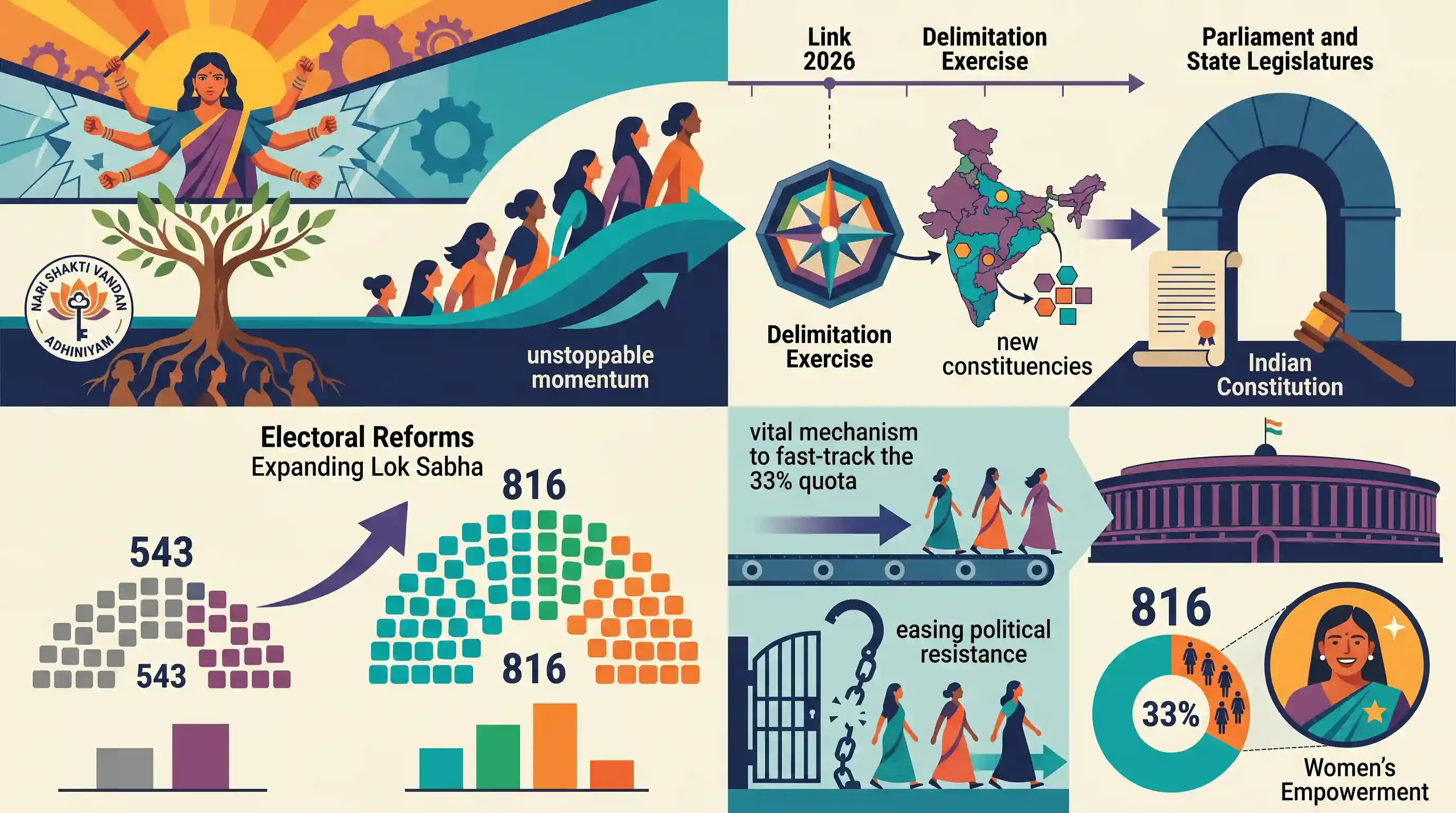
The passage examines the transformative potential of the Nari Shakti Vandan Adhiniyam (Women's Reservation Bill), noting that it acknowledges an unstoppable momentum for female political empowerment. It links the bill's implementation to the anticipated post-2026 delimitation exercise, suggesting that expanding the Lok Sabha from 543 to 816 seats could serve as a vital mechanism to fast-track the 33% quota for women by creating new constituencies and easing political resistance.
Key Points
- The Nari Shakti Vandan Adhiniyam officially recognizes the undeniable momentum for achieving gender parity in legislative representation.
- The implementation of women's reservation in Parliament is structurally tied to the upcoming delimitation exercise.
- A proposed delimitation could significantly increase the number of Lok Sabha constituencies from the current 543 to an estimated 816 seats.
- Expanding the total number of parliamentary seats provides a practical pathway to fast-track the women's quota, mitigating resistance by preventing a sharp reduction in seats available for unreserved categories.
Important Terms
Nari Shakti Vandan Adhiniyam

Popularly known as the Women's Reservation Act, this 2023 legislation mandates reserving one-third (33%) of seats for women in the Lok Sabha and State Legislative Assemblies.
UPSC context
GS II: Social Justice/Polity; tests knowledge of landmark constitutional amendments and tools for achieving gender parity in governance.
106th Constitutional Amendment Act
The legal enactment (2023) that introduced Articles 330A and 332A, formalizing women's reservation while linking its commencement to the next census and delimitation exercise.
UPSC context
GS II: Indian Constitution; essential for identifying specific amendment provisions and their direct impact on the legislative structure.
Delimitation Commission
An independent, high-powered body appointed by the President to redraw the boundaries of electoral constituencies based on population changes to ensure fair representation.
UPSC context
GS II: Electoral Reforms; central to debates on federalism, the 'one person, one vote' principle, and regional political representation.
Article 334A
A constitutional provision inserted in 2023 stating that women's reservation will only take effect after delimitation is performed following the first post-amendment census.
UPSC context
GS II: Polity; tests understanding of the legal conditions and timelines governing the implementation of major legislative reforms.
131st Constitutional Amendment Bill
A 2026 legislative proposal aiming to expand Lok Sabha seats and accelerate the 33% quota by decoupling it from the 2021 census delay.
UPSC context
GS II: Electoral Reforms; significant for current affairs topics regarding seat expansion and the evolution of the Indian Parliament.
Rotation of Seats
The legal requirement that reserved seats for women be allocated to different constituencies in states/UTs by rotation after every delimitation exercise.
UPSC context
GS II: Governance/Elections; relevant for discussing the sustainability and political impact of reservation mechanisms on constituency leadership.
Prelims Trap
The 106th Constitutional Amendment mandates an immediate 33% reservation for women in both the Lok Sabha and Rajya Sabha.
The reservation applies only to the Lok Sabha and State Assemblies, excluding the Rajya Sabha and Legislative Councils. Furthermore, implementation is contingent on a future census and delimitation.
Static Concepts Connected
How does the Constitution govern the Delimitation of Lok Sabha seats?
- Constitutional Mandate: Under Article 82, Parliament enacts a Delimitation Act after every census to readjust territorial constituencies and state-wise seat allocation.
- 84th Amendment Freeze: The 84th Constitutional Amendment (2001) froze the total number of Lok Sabha seats at 543 until the first census figures after 2026 are published.
- Unchallengeable Authority: Delimitation Commission orders hold the force of law and cannot be questioned in any court, preventing judicial delays in elections.
How does the 106th Amendment differ from local government reservations?
- Upper House Exclusion: Unlike local bodies where reservations are comprehensive, the 106th Amendment explicitly excludes the Rajya Sabha and State Legislative Councils.
- Contingent Implementation: Panchayat reservations were implemented immediately post-enactment, whereas the 106th Amendment's operation is contingent on a fresh census and delimitation exercise.
- Sunset Clause: The Nari Shakti Vandan Adhiniyam includes a 15-year sunset clause for the reservation, a feature absent in the 73rd and 74th Amendments.
Cross-Topic Patterns
Delimitation + Federalism friction
Expanding Lok Sabha seats to accommodate the women's quota risks penalizing Southern states that successfully stabilized populations, sparking intense debates on fiscal federalism and representation.
Quotas vs. Internal Party Democracy
The structural delay in implementing the 106th Amendment pushes the spotlight onto amending the Representation of the People Act to enforce women's quotas in internal party tickets and structures.

Expect a multi-statement Prelims question mixing the 106th Amendment (Art 330A/334A), the 84th Amendment freeze, and Delimitation powers.
Linked PYQs · 4
Linked PYQs · 4
- 2023MainsGS2
Discuss the contribution of civil society groups for women's effective and meaningful participation and representation in state legislatures in India.
- 2019MainsGS2
“The reservation of seats for women in the institutions of local self-government has had a limited impact on the patriarchal character of the Indian Political Process.” Comment.
- 2021MainsGS2
Discuss the desirability of greater representation to women in the higher judiciary to ensure diversity, equity and inclusiveness.
- 2024PrelimsGS1
How many Delimitation Commissions have been constituted by the Government of India till December 2023?
