India Foreign Policy Evolution Under Multi-Alignment Strategy
Source:Indian Express ↗
Why It Matters
This article highlights a foundational shift in India's international relations strategy, moving from defensive non-alignment to confident multi-alignment. It provides essential context for answering GS Paper 2 questions on India's bilateral relations, global positioning, and strategic responses to shifting geopolitical dynamics.
Summary
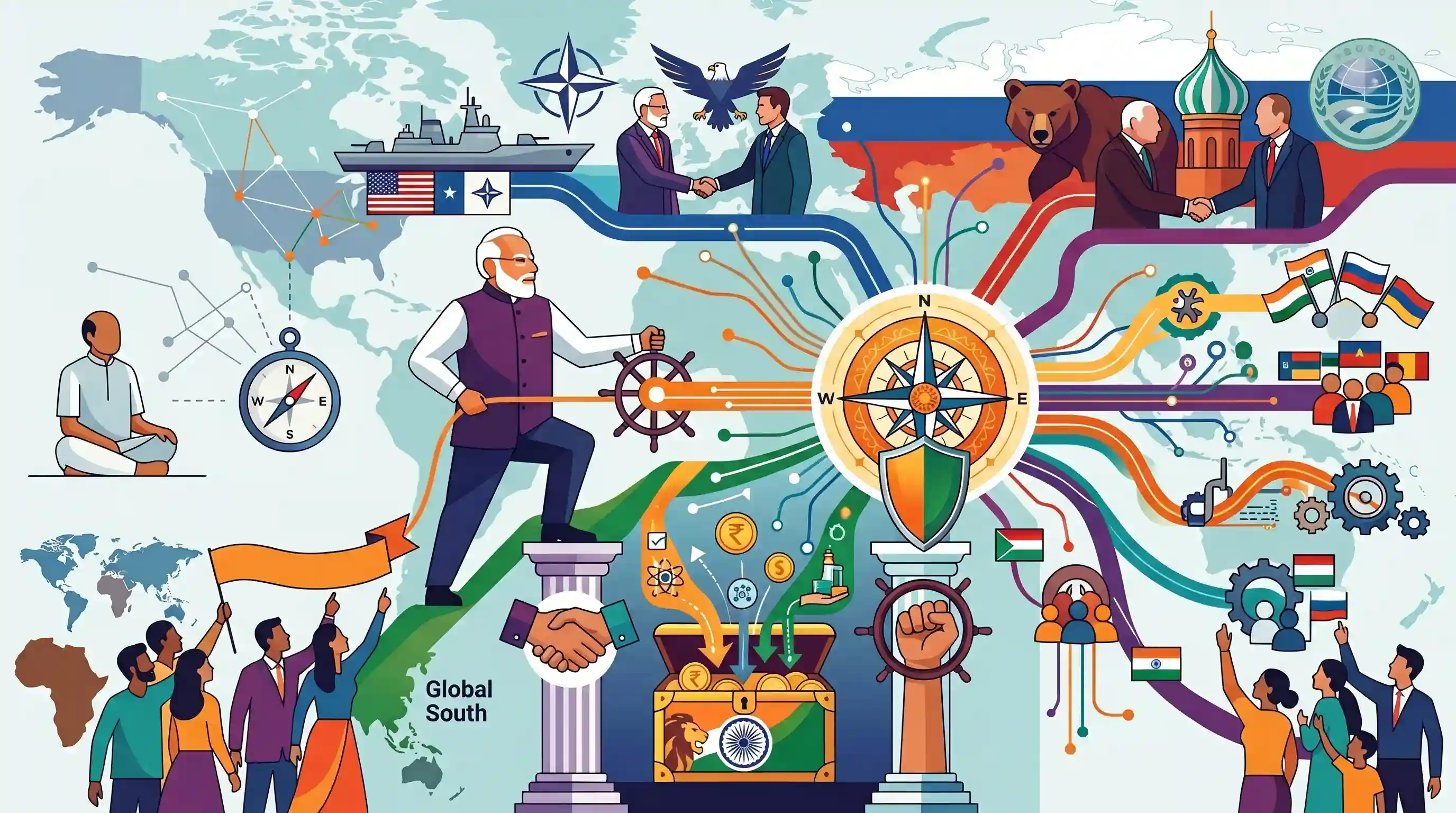
The article analyzes the evolution of India's foreign policy under Prime Minister Narendra Modi, highlighting the twin pillars of vigorous diplomacy and strategic autonomy. It observes that India has moved away from the passive posture of traditional non-alignment toward a more dynamic 'multi-alignment' strategy. This approach enables India to engage simultaneously with competing global blocs—such as partnering with the US in the Quad while maintaining historic ties with Russia and participating in the SCO. India's ability to prioritize its national interests alongside its advocacy for the Global South reflects a confident and assertive 'New India' on the global stage.
Key Points
- India's foreign policy under PM Narendra Modi is characterized by a proactive yet strategically autonomous approach, balancing relations with major global powers.
- The shift from traditional 'non-alignment' to 'multi-alignment' allows India to participate in diverse forums like the Quad and SCO simultaneously without compromising its national interests.
- India's stance on global conflicts, prioritizing its energy security and economic needs while advocating for dialogue, underscores its commitment to strategic autonomy.
- By positioning itself as the 'Voice of the Global South,' India leverages its diplomatic capital to advocate for equitable global governance, as demonstrated during its G20 presidency.
Important Terms
Multi-alignment

A pragmatic foreign policy strategy involving parallel, issue-based engagements with multiple global powers and competing blocs simultaneously to maximize national interest without formal alliance commitments.
UPSC context
GS Paper 2 (International Relations); tests India’s shift from traditional Non-Alignment to dynamic, interest-based global engagement.
Strategic Autonomy
The ability of a nation to pursue its sovereign national interests and make independent foreign policy decisions without being constrained by external pressures or formal military alliance obligations.
UPSC context
GS Paper 2 (Foreign Policy); fundamental for analyzing India’s independent stance on global conflicts and strategic partnerships.
Global South
Collectively refers to developing and least-developed nations in Asia, Africa, and Latin America, characterized by shared colonial histories and common developmental challenges like climate finance and debt.
UPSC context
GS Paper 2; tests India's leadership role and initiatives like the 'Voice of Global South Summit'.
Quad (Quadrilateral Security Dialogue)
An informal strategic forum comprising India, the US, Japan, and Australia, dedicated to maintaining a free, open, and inclusive Indo-Pacific while cooperating on maritime security and emerging technologies.
UPSC context
GS Paper 2 (Regional groupings); key for Indo-Pacific stability and counterbalancing regional assertiveness.
BRICS
An intergovernmental organization of major emerging economies (including Brazil, Russia, India, China, and South Africa) focusing on economic cooperation and the reform of Global North-dominated financial institutions.
UPSC context
GS Paper 2 (Multilateral groupings); relevant for South-South cooperation and the push for a multipolar global order.
Shanghai Cooperation Organisation (SCO)
A Eurasian political, economic, and security alliance aimed at regional stability and counter-terrorism, utilizing the Tashkent-based Regional Anti-Terrorist Structure (RATS) for intelligence sharing.
UPSC context
GS Paper 2; tests India’s engagement with Central Asia and its navigation of regional security dynamics.
G20 (Group of Twenty)
A premier forum for international economic cooperation representing 19 countries, the EU, and the African Union, accounting for approximately 85% of global GDP and 75% of global trade.
UPSC context
GS Paper 2 (International Institutions); significant for global governance and India's 2023 'Vasudhaiva Kutumbakam' Presidency.
Prelims Trap
"India's shift to multi-alignment implies a formal withdrawal from the Non-Aligned Movement (NAM)."
India never formally exited NAM. Multi-alignment is a pragmatic evolution of strategic independence, engaging with diverse blocs without abandoning NAM's core philosophy of avoiding rigid military alliances.
Static Concepts Connected
How does Multi-alignment differ from traditional Non-Alignment?
- Core Objective: NAM focused on avoiding Cold War military blocs, while multi-alignment seeks concurrent, active partnerships with competing global powers.
- Nature of Engagement: Multi-alignment utilizes flexible, issue-based minilateral groups (like Quad or I2U2) instead of maintaining rigid ideological distance.
What is 'Minilateralism' in modern diplomacy?
- Definition: Narrow, flexible, and informal coalitions of like-minded nations formed to achieve specific strategic, technological, or functional goals.
- Advantage over Multilateralism: It bypasses the consensus paralysis and veto-blocks of large bodies like the UN or WTO, enabling agile and targeted action.
Cross-Topic Patterns
Energy Security & Strategic Autonomy
India's persistent import of discounted Russian crude despite Western pressure directly links core macroeconomic stability (inflation control) with its foreign policy independence.
Global South & Multilateral Reforms
India positions itself as the Global South leader in plurilateral forums to advocate for equitable trade policies, IP waivers, and reform of Bretton Woods institutions.

Expect a 2026 GS-2 question analyzing how 'Minilateralism' (Quad/I2U2) and 'Multi-alignment' advance India's energy and maritime goals.
Linked PYQs · 3
Linked PYQs · 3
- 2025MainsGS2
"With the waning of globalization, post-Cold War world is becoming a site of sovereign nationalism.” Elucidate.
- 2024MainsGS2
‘The West is fostering India as an alternative to reduce dependence on China's supply chain and as a strategic ally to counter China's political and economic dominance.’ Explain this statement with examples.
- 2022MainsGS2
How will I2U2 (India, Israel, UAE and USA) grouping transform India's position in global politics?
