Prime Minister Address at Israeli Knesset on Security
Source:The Hindu ↗
Why It Matters
The address captures India's nuanced West Asia policy, demonstrating strong strategic solidarity with Israel on counter-terrorism while maintaining support for the Palestinian cause. The proposed integration of India's DPI and an upcoming FTA underscore the transition of India-Israel ties from defense-heavy to multi-sectoral economic partnerships.
Summary
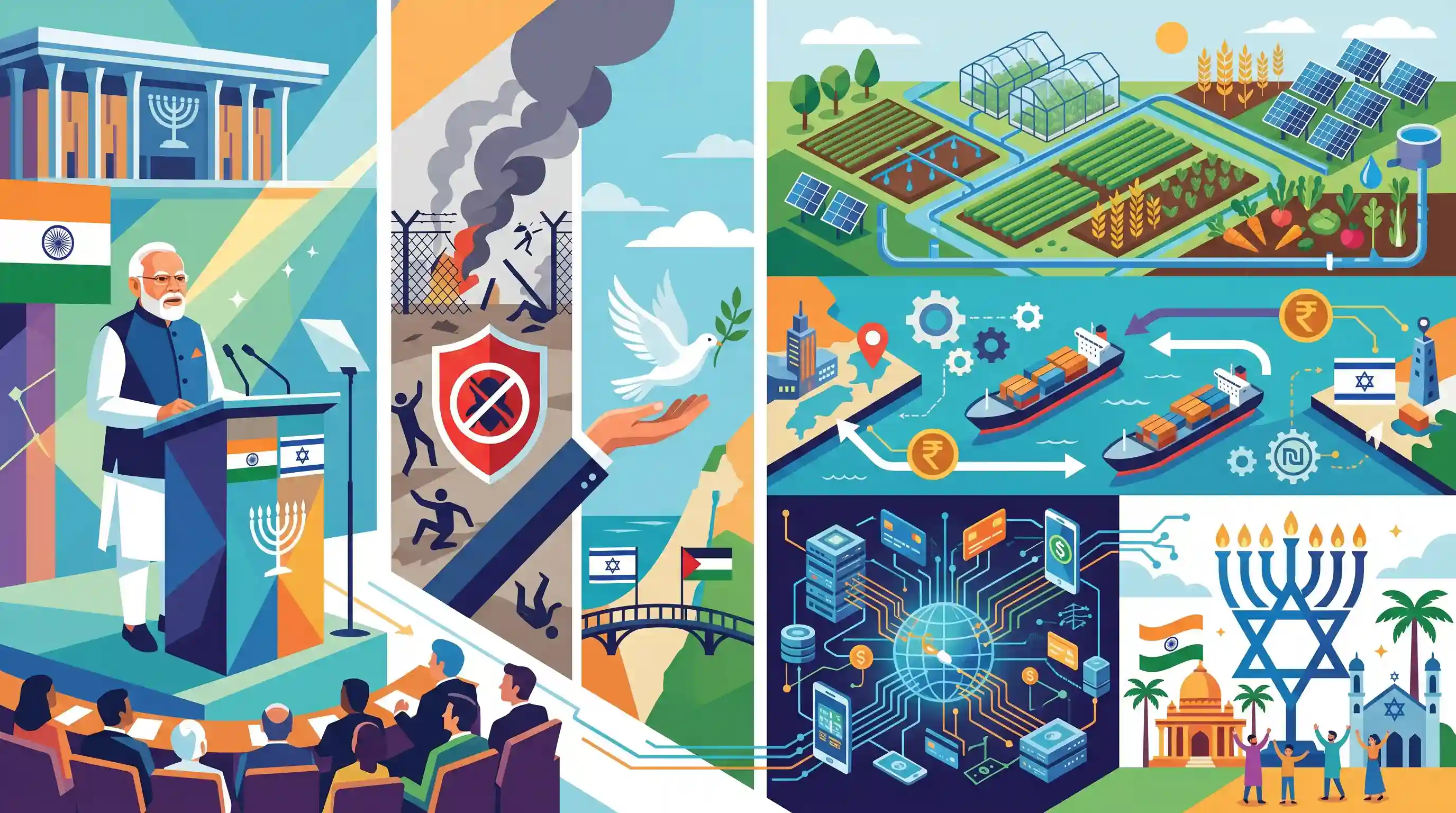
Prime Minister Narendra Modi delivered an address at the Israeli Parliament (Knesset), where he unequivocally condemned the October 7 Hamas attack and reaffirmed India's zero-tolerance policy towards terrorism. Simultaneously, he expressed support for the Gaza Peace Initiative and a durable resolution to the Palestine issue. Highlighting the evolving trajectory of India-Israel bilateral relations, Modi emphasized future cooperation in agriculture, water management, and the establishment of an ambitious Free Trade Agreement (FTA). Additionally, he proposed leveraging India's Digital Public Infrastructure (DPI) to enhance cross-border financial linkages and celebrated the historical ties of the Jewish community in India.
Key Points
- PM Modi strongly condemned the October 7 Hamas attack as barbaric terrorism, invoking a zero-tolerance policy reminiscent of India's stance post the 26/11 Mumbai attacks.
- He expressed explicit support for the Gaza Peace Initiative and advocated for a durable resolution to the Palestine issue, emphasizing a balanced diplomatic approach.
- India and Israel seek to expand ties through cooperation in water management, agriculture, and a potential Free Trade Agreement (FTA).
- Modi proposed linking India's Digital Public Infrastructure (DPI) with Israel to facilitate cross-border financial transactions.
- The speech also highlighted the Abraham Accords as a stepping stone for regional peace and underscored the rich historical presence of Jewish communities in Kerala, Kolkata, and Mumbai.
Important Terms
Digital Public Infrastructure (DPI)

Open digital systems—like Aadhaar and UPI—built on open standards to provide societal-scale services such as identity, payments, and data exchange.
UPSC context
GS-III (Economy/Tech); India's global leadership in digital governance and 'India Stack' internationalization.
Gaza Peace Initiative
A 2025/2026 multilateral framework (endorsed by the UNSC) aiming for a ceasefire, hostage release, Gaza's reconstruction, and the deployment of an International Stabilization Force.
UPSC context
GS-II (IR); West Asia peace processes and India's support for a durable Palestine resolution.
Abraham Accords
A series of 2020 normalization agreements between Israel and several Arab nations (UAE, Bahrain, Morocco), shifting the geopolitical landscape of West Asia.
UPSC context
GS-II (IR); crucial context for the I2U2 grouping and India’s 'Link West' policy.
Free Trade Agreement (FTA)
A pact between two or more nations to reduce or eliminate tariffs and trade barriers; India-Israel resumed talks for a comprehensive FTA in 2026.
UPSC context
GS-III (Economy); bilateral trade relations and India's strategy to enhance market access.
Hamas
A Palestinian Sunni-Islamic militant and political organization that governs the Gaza Strip; designated as a terrorist group by numerous countries.
UPSC context
GS-III (Security); terrorism, regional instability, and its impact on India's energy security.
Knesset
The unicameral national legislature of Israel, responsible for passing laws, electing the President and Prime Minister, and supervising the government.
UPSC context
GS-II (IR/Polity); parliamentary diplomacy and India’s strategic partnership with Israel.
Prelims Trap
"India's de-hyphenated policy indicates it no longer supports the two-state solution for Palestine."
De-hyphenation means India's relationships with Israel and Palestine are independent of each other. India actively condemns terrorism while officially continuing to support the two-state solution.
Static Concepts Connected
Who are the three distinct historical Jewish communities of India?
- Cochin Jews: Settled in Kerala; the oldest group, historically integrated into the Malabar spice trade.
- Bene Israel: Settled along the Konkan coast; traditionally agriculturalists and oil pressers who adopted Marathi culture.
- Baghdadi Jews: Migrated to Surat, Mumbai, and Kolkata in the 18th-19th centuries, becoming prominent in commerce.
What comprises India's Digital Public Infrastructure (DPI) currently being exported globally?
- Digital Identity: Aadhaar provides a foundational, biometric-based digital identity framework.
- Real-time Payments: UPI facilitates instant, interoperable financial transactions, increasingly linked with foreign cross-border networks.
- Data Empowerment: The Account Aggregator framework allows users to securely share their financial data with consent.
Cross-Topic Patterns
I2U2 Grouping + Abraham Accords
The Abraham Accords normalized Arab-Israeli ties, directly enabling the I2U2 minilateral (India, Israel, UAE, US) to seamlessly blend Middle Eastern capital, Israeli innovation, and Indian human resources.
Micro-irrigation + Centers of Excellence
UPSC frequently tests agricultural tech. The Indo-Israel Agriculture Project operates via 'Centers of Excellence' across India, focusing on micro-irrigation, protected cultivation, and advanced water management techniques.

India's "de-hyphenated" West Asia policy, I2U2 minilateral, and the Abraham Accords are prime candidates for a 2026 GS-2 IR question.
Linked PYQs · 1
Linked PYQs · 1
- 2018MainsGS2
“India’s relations with Israel have, of late, acquired a depth and diversity, which cannot be rolled back.” Discuss.
