India-France strategic partnership and innovation roadmap targets
Source:Indian Express ↗
Why It Matters
India-France ties represent a cornerstone of India's multi-aligned foreign policy and strategic autonomy. The shift from a buyer-seller relationship to joint defence manufacturing (co-development), alongside agreements in cutting-edge areas like AI governance, SMRs, critical minerals, and digital public infrastructure (UPI), demonstrates the modern trajectory of global diplomacy that UPSC candidates must analyze in GS2 and GS3.
Summary
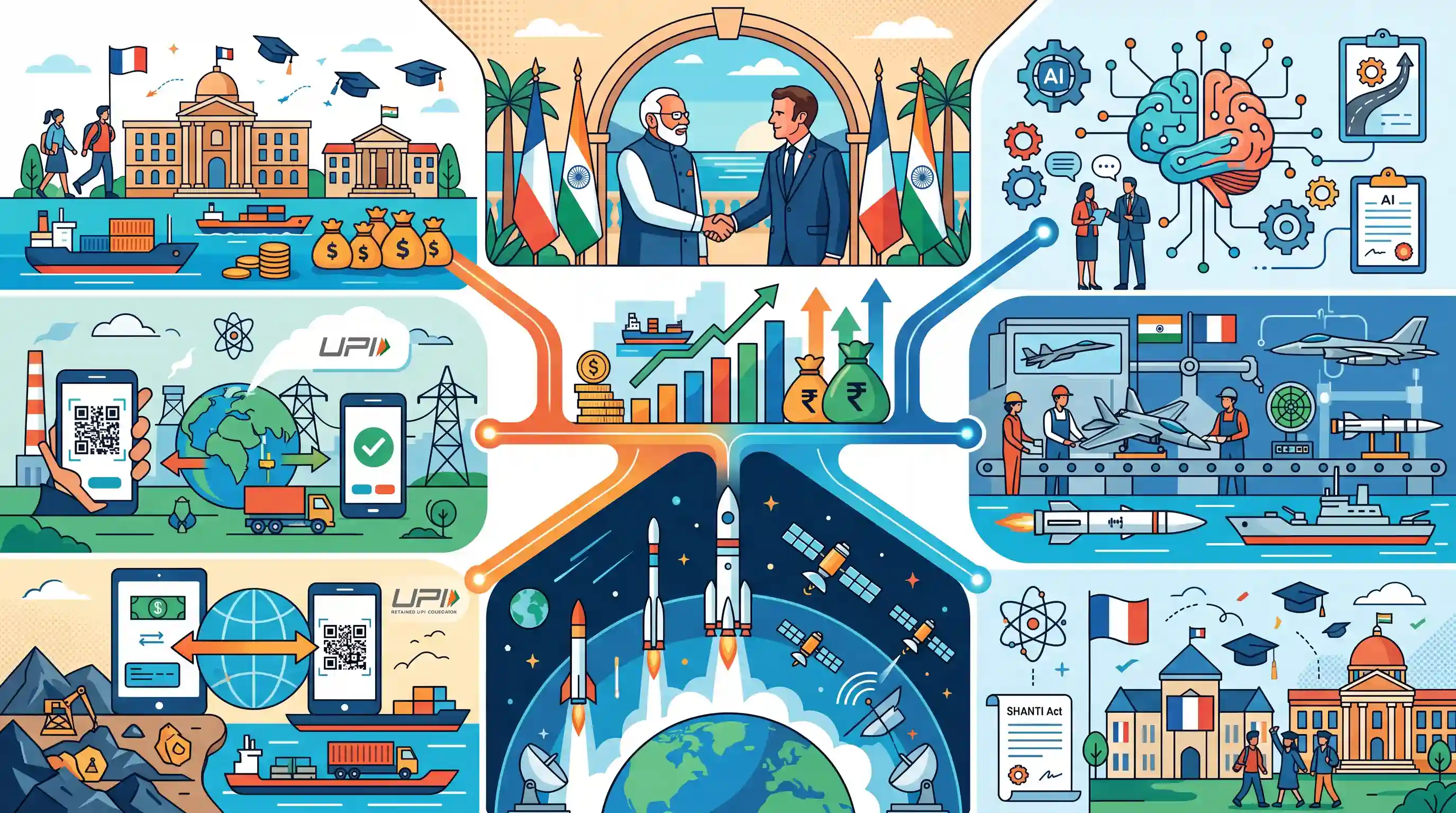
During a bilateral meeting in Nice, France, Prime Minister Narendra Modi and President Emmanuel Macron outlined ambitious goals to deepen the India-France strategic partnership. Key decisions include a target to double bilateral trade to $32 billion in five years and the adoption of the 'India-France Innovation Roadmap 2030', which features a new joint working group on AI governance. They prioritized shifting defence ties toward co-development and co-production, expanded space collaboration, and opened avenues for civil nuclear cooperation, specifically focusing on Small Modular Reactors following India's SHANTI Act. Additionally, they agreed to expand UPI acceptance in France, secure critical mineral supply chains, and bolster educational mobility by welcoming French university campuses in India.
Key Points
- India and France aim to double their bilateral trade, from $16 billion to $32 billion over the next five years.
- The leaders adopted the 'India-France Innovation Roadmap 2030' and agreed to set up a joint working group on Artificial Intelligence governance.
- Defence cooperation will focus on "co-design, co-development, and co-production", including projects like the H125 Helicopter Final Assembly Line by Tata Advanced Systems in Karnataka.
- Exploration of civil nuclear energy collaboration, particularly around Small and Advanced Modular Reactors, leveraging India's new SHANTI Act.
- Expansion of India's UPI payments system in France, and enhancing supply chain resilience regarding critical minerals.
- Cultural and educational ties boosted through 5-year Schengen visas for Indian alumni, inviting French universities to open Indian campuses under the NEP, and collaborating on a maritime heritage complex at Lothal.
Important Terms
India-France Innovation Roadmap 2030

A strategic framework adopted in 2026 guiding India-France collaboration in AI governance, semiconductors, and green energy, aligning India’s 'Viksit Bharat 2047' with France’s 2030 industrial strategy.
UPSC context
GS Paper II (International Relations); tests understanding of technology-driven strategic partnerships and emerging tech governance.
SHANTI Act
A 2025 legislative reform (Sustainable Harnessing and Advancement of Nuclear Energy for Transforming India) that ended the government monopoly in nuclear power, permitting private participation and streamlining liability.
UPSC context
GS Paper III (Energy/Economy); focuses on energy security, civil nuclear liability, and private sector roles in strategic sectors.
India-EU Free Trade Agreement
A landmark trade pact concluded in 2026 to create a massive free-trade zone, eliminating tariffs on 99% of Indian exports and facilitating professional mobility for Indian workers.
UPSC context
GS Paper II (International Relations) and GS Paper III (Economy); evaluates trade diplomacy and regional blocs.
National Education Policy (NEP) 2020
India's 2020 education reform that internationalized higher education by allowing top-ranked foreign universities to establish branch campuses and offer dual degrees within India.
UPSC context
GS Paper II (Social Justice/Education); covers reforms in the education sector and 'Vishwa Guru' aspirations.
ISRO and CNES
The Indian and French space agencies, respectively, whose 60-year partnership includes joint satellite missions like TRISHNA, SARAL, and collaboration on India’s human spaceflight program, Gaganyaan.
UPSC context
GS Paper III (Science & Technology); focuses on international space cooperation and indigenous space capabilities.
National Maritime Heritage Complex
A major maritime heritage project at the ancient Harappan site of Lothal, Gujarat, being developed with French technical expertise to showcase India's 4,500-year-old maritime history.
UPSC context
GS Paper I (Art & Culture/History); tests knowledge of Harappan sites and cultural diplomacy.
Tata Advanced Systems Limited (TASL)
A key Indian defense player partner to Airbus in Karnataka's Final Assembly Line (FAL), marking a shift from defense procurement to domestic co-production (AatmaNirbhar Bharat).
UPSC context
GS Paper III (Internal Security/Defense); evaluates indigenization of defense technology and private sector manufacturing.
Prelims Trap
"The new SHANTI Act completely removes all civil nuclear liability for accidents in India."
It removes the stringent *supplier* liability clause that deterred foreign OEMs, but the *operator* liability remains intact to align with international conventions like the CSC.
Static Concepts Connected
What are Small Modular Reactors (SMRs)?
- Capacity: They have a power capacity of up to 300 MW(e) per unit, which is roughly one-third of traditional nuclear power reactors.
- Modularity: They can be factory-assembled and transported as complete units to the installation site, significantly reducing construction time and costs.
- Passive safety: They rely heavily on passive safety systems (using natural circulation and gravity) that can shut down systems without external power or human intervention.
Why is Lothal historically significant in the IVC?
- Location: Situated near the Bhogava river in Gujarat, a tributary of the Sabarmati, functioning as a vital trade hub.
- Maritime engineering: It houses the world's earliest known man-made dockyard, indicating an advanced understanding of tides and maritime engineering.
- Trade evidence: Excavations revealed bead-making factories, the earliest evidence of rice husks, and a Persian Gulf seal proving overseas trade.
Cross-Topic Patterns
SMRs + Panchamrit Climate Pledges
France's collaboration on Small Modular Reactors under the new SHANTI Act directly links to India's COP26 Net-Zero 2070 target, pushing to replace coal baseload power with clean alternatives.
DPI as Strategic Soft Power
Expanding UPI acceptance to France highlights a broader foreign policy shift: leveraging indigenous Digital Public Infrastructure (India Stack) to build strategic soft power and reduce reliance on Western payment gateways.
Defence co-production + Aatmanirbhar Bharat
The shift from direct imports (like Rafale) to local assembly (H125 helicopters) mirrors India's Defence Acquisition Procedure (DAP) focus on Aatmanirbhar Bharat and building indigenous defence-industrial corridors.

Expect a 2026 prelims question merging the static passive-safety features of SMRs with the SHANTI Act's repeal of supplier liability.
Linked PYQs · 4
Linked PYQs · 4
- 2023MainsGS2
‘The expansion and strengthening of NATO and a stronger US-Europe strategic partnership works well for India.’ What is your opinion about this statement ? Give reasons and examples to support your answer.
- 2020MainsGS2
What is the significance of Indo-US defence deals over Indo-Russian defence deals? Discuss with reference to stability in the Indo-Pacific region.
- 2025PrelimsGS1
Consider the following statements : I. India has joined the Minerals Security Partnership as a member. II. India is a resource-rich country in all the 30 critical minerals that it has identified. III. The Parliament in 2023 has amended the Mines and Minerals (Development and Regulation) Act, 1957 empowering the Central Government to exclusively auction mining lease and composite license for certain critical minerals. Which of the statements given above are correct?
- 2025MainsGS2
India-Africa digital partnership is achieving mutual respect, co-development and long-term institutional partnerships. Elaborate.
