India ASEAN and Quad Engagement in the Indo Pacific
Source:Indian Express ↗
Why It Matters
This article is crucial for understanding India's evolving strategic priorities in Southeast Asia and the Indo-Pacific, core components of India's Act East policy and multilateral diplomacy.
Summary
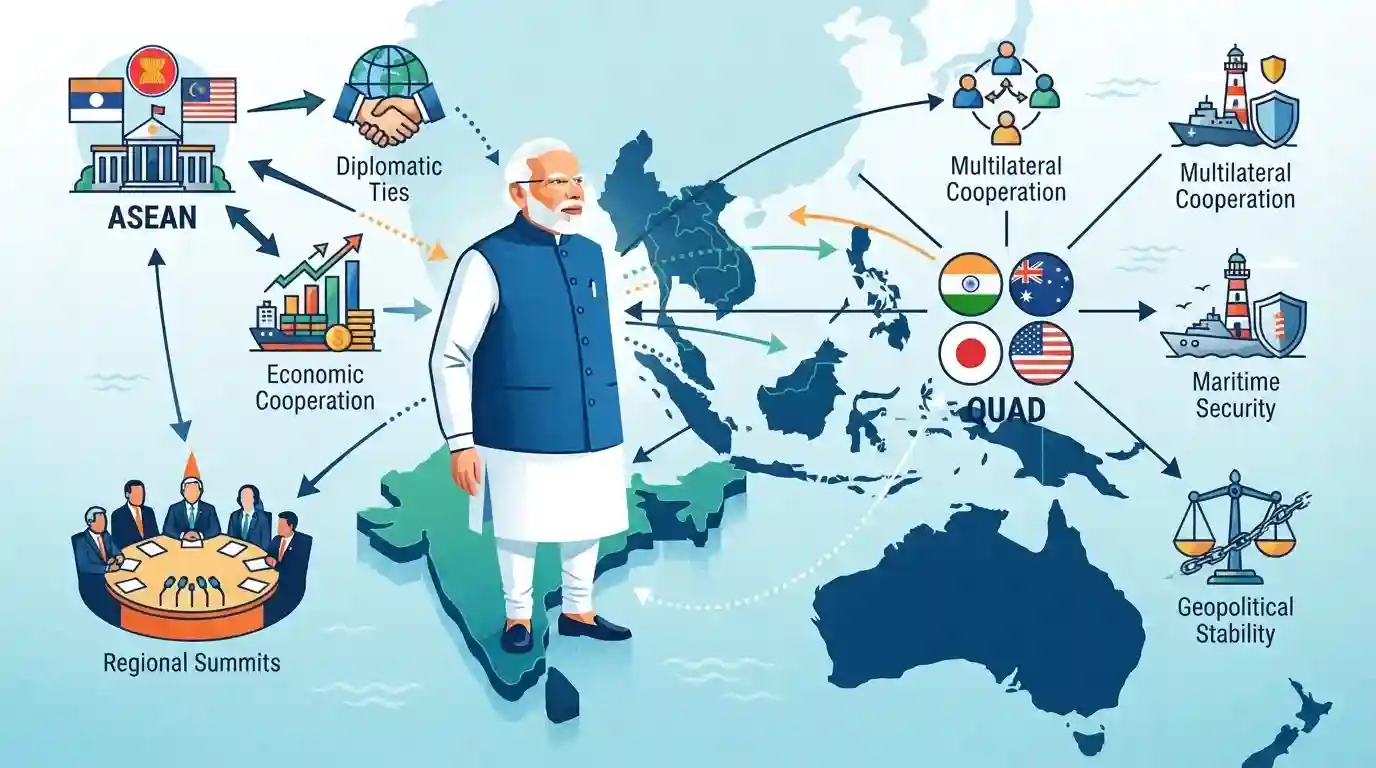
Prime Minister Narendra Modi's visits to ASEAN and participation in regional summits highlight India's commitment to strengthening diplomatic, economic, and security ties in the Indo-Pacific. The engagements emphasize multilateral cooperation, maritime security, and countering geopolitical challenges in partnership with key regional groupings like the Quad.
Key Points
- Prime Minister Narendra Modi's visits highlight India's deepening strategic and diplomatic engagement with ASEAN and the Quad.
- Focus remains on maritime security, freedom of navigation, and economic cooperation in the Indo-Pacific region.
- Multilateral forums like ASEAN and Quad serve as critical pillars for India's Act East Policy and regional stability.
Important Terms
ASEAN

A political and economic union of ten Southeast Asian member states. It is a vital anchor for regional stability, trade, and ASEAN-centric multilateral frameworks in the Indo-Pacific.
UPSC context
GS Paper II (International Relations - Bilateral, Regional, and Global Groupings involving India and affecting India's interests).
Quad
An informal strategic dialogue between India, the United States, Japan, and Australia focused on ensuring a free, open, and inclusive Indo-Pacific region through cooperative security and economic initiatives.
UPSC context
GS Paper II (International Relations - Important International Institutions, Agencies, and Fora and their Structure, Mandate).
Prelims Trap
Quad functions as a formal mutual defense alliance ensuring regional security in the Indo-Pacific.
Aspirants often assume the Quad is a formal military alliance with a mutual defense clause resembling Article 5 of NATO, whereas it is an informal minilateral grouping without a collective defense mandate.
Static Concepts Connected
What are the core pillars and institutional principles of the Association of Southeast Asian Nations (ASEAN)?
- Centrality Pillar: ASEAN Centrality principle ensures that regional architectures are shaped and led by Southeast Asian nations rather than external powers.
- Decision Making: Decision-making within ASEAN strictly adheres to consensus and non-interference in internal affairs, known informally as the 'ASEAN Way'.
- Wider Forums: The East Asia Summit (EAS) and ASEAN Regional Forum (ARF) provide broader strategic dialogue platforms including dialogue partners like India.
Cross-Topic Patterns
Minilateralism + Naval Interoperability
India's Indo-Pacific maritime security framework intersects with naval exercises like Milan and Malabar, linking minilateral diplomacy with direct operational interoperability.
Act East Policy + Land-Sea Connectivity
Act East Policy evolution bridges land connectivity projects (IMT Trilateral Highway) with maritime security architecture in the South China Sea.

Quad vs formal military alliances (like NATO) and ASEAN Centrality principles are prime targets for UPSC conceptual statements.
Linked PYQs · 3
Linked PYQs · 3
- 2024MainsGS2
Discuss the geopolitical and geostrategic importance of Maldives for India with a focus on global trade and energy flows. Further also discuss how this relationship affects India's maritime security and regional stability amidst international competition ?
- 2020MainsGS2
Quadrilateral Security Dialogue (Quad)' is transforming itself into a trade bloc from a military alliance, in present times - Discuss.
- 2021MainsGS2
The newly tri-nation partnership AUKUS is aimed at countering China's ambitions in the Indo-Pacific region. Is it going to supersede the existing partnerships in the region? Discuss the strength and impact of AUKUS in the present scenario.
