Macroeconomic Pressures and Balance of Payments Risks
Source:Indian Express ↗
Why It Matters
Provides real-time insight into India's external sector challenges. The interaction between global geopolitical shifts, capital flight, currency depreciation, and CAD is a recurring theme in GS3 (Economy) and GS2 (International Relations) for understanding macroeconomic resilience.
Summary
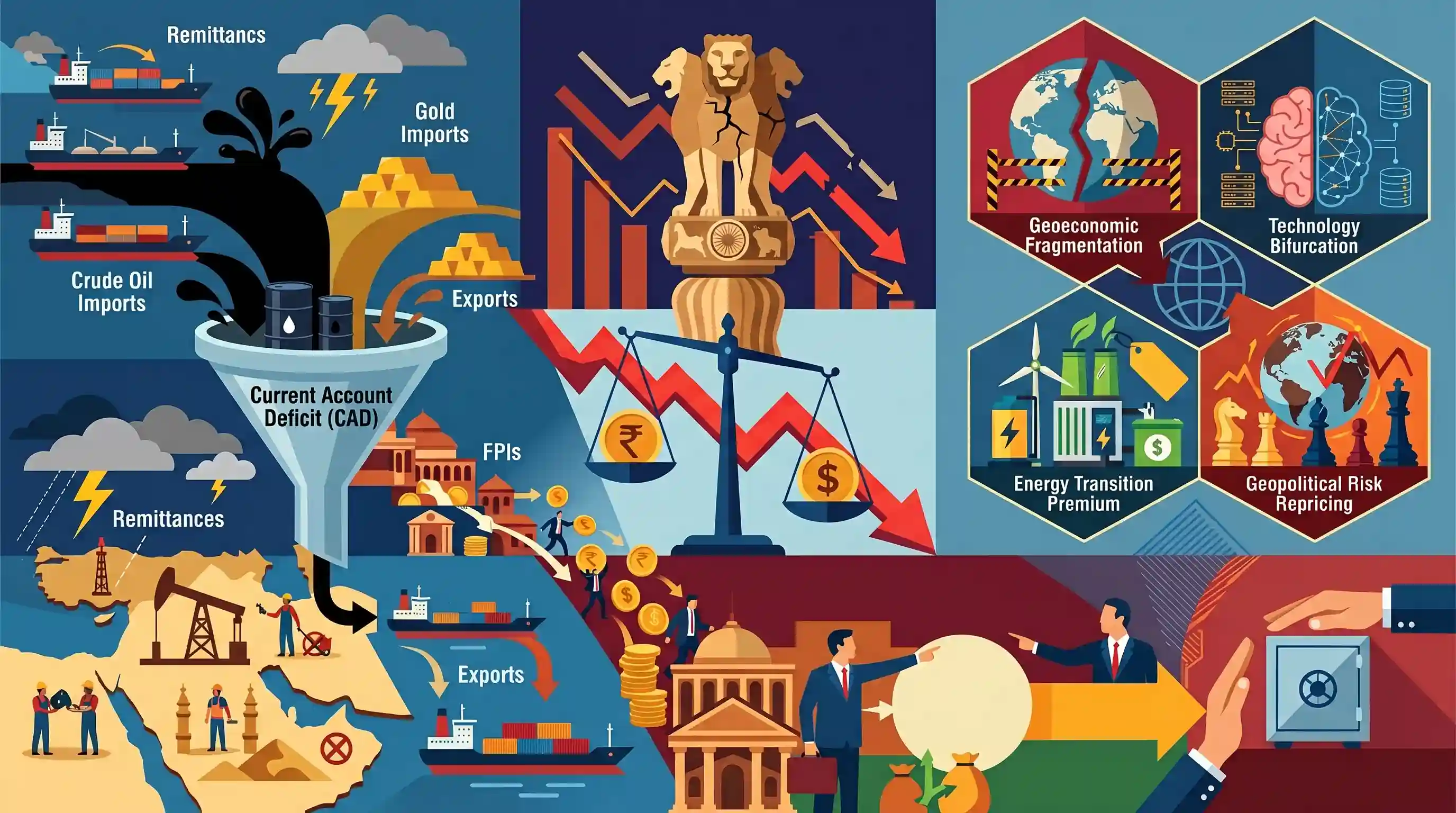
Chief Economic Advisor V. Anantha Nageswaran has raised alarms over India's macroeconomic stability for FY27 as the Rupee hits a record low of 95.75 per dollar and Foreign Portfolio Investors (FPIs) exit domestic markets. India's Balance of Payments (BoP) is projected to turn negative due to a widening Current Account Deficit (CAD), driven by surging crude oil and gold import bills, sluggish exports, and threats to remittances stemming from the West Asia crisis. Nageswaran attributes these challenges to four global structural shifts: geoeconomic fragmentation, technology bifurcation, the energy transition premium, and geopolitical risk repricing. The government has emphasized the need for domestic consumption changes to conserve foreign exchange reserves and manage external sector vulnerabilities.
Key Points
- The Indian Rupee depreciated to an all-time low of 95.75 against the US dollar amid capital flight, with Foreign Portfolio Investors (FPIs) withdrawing $23 billion from domestic markets.
- Chief Economic Advisor (CEA) V. Anantha Nageswaran warned that India's Balance of Payments (BoP) is headed into the negative zone for FY27, driven by a widening Current Account Deficit (CAD).
- The CAD is under pressure due to high import bills for crude oil and gold, muted Foreign Direct Investment (FDI), and weak export performance exacerbated by the conflict in West Asia.
- Nageswaran identified four global structural shifts impacting the economy: geoeconomic fragmentation, technology bifurcation, the energy transition premium, and the repricing of geopolitical risks.
- To preserve foreign exchange reserves, Prime Minister Modi has suggested shifting consumption behavior, including minimizing gold purchases, avoiding unnecessary foreign travel, and prioritizing local goods.
Important Terms
Balance of Payments (BoP)

A systematic record of all economic transactions between the residents of a country and the rest of the world during a specific period.
UPSC context
GS Paper III (Economy); fundamental for understanding external sector resilience and potential BoP crises.
Current Account Deficit (CAD)
A situation where a country's total imports of goods, services, and transfers exceed its total exports, indicating it is a net borrower.
UPSC context
GS Paper III; critical indicator of macroeconomic stability and external sector vulnerability.
Foreign Portfolio Investment (FPI)
Investment in a foreign country's financial assets like stocks and bonds, typically characterized by passive ownership and high volatility (hot money).
UPSC context
GS Paper III; affects capital account stability, stock market volatility, and exchange rates.
Geoeconomic Fragmentation
The policy-driven reversal of global economic integration, marked by rising trade barriers and countries forming rival geopolitical/economic blocs.
UPSC context
GS Paper II & III; crucial for analyzing shifts in global trade, 'friend-shoring,' and decoupling.
Currency Depreciation
The decrease in the value of a domestic currency relative to foreign currencies in a floating exchange rate system due to market forces.
UPSC context
GS Paper III; impacts export competitiveness, inflation, and the value of foreign exchange reserves.
Energy Transition Premium
The additional economic cost or inflationary pressure (greenflation) associated with the global shift from fossil fuels to renewable energy systems.
UPSC context
GS Paper III; examines the fiscal and structural challenges of meeting climate commitments.
Prelims Trap
"A widening Current Account Deficit (CAD) automatically results in a Balance of Payments deficit."
A CAD only causes a BoP deficit if it isn't offset by a Capital Account surplus. India usually runs a CAD but historically avoids BoP deficits via strong FDI/FPI.
Static Concepts Connected
What are the primary sub-components of the Balance of Payments?
- Current Account: Records trade in goods (visible) and invisibles (services, inward remittances, and income transfers). India usually runs a deficit here.
- Capital Account: Records financial flows like Foreign Direct Investment (FDI), Foreign Portfolio Investment (FPI), and External Commercial Borrowings (ECBs).
- Official Reserve Account: Reflects the net changes in the RBI's foreign exchange reserves used to bridge any gap between the Current and Capital accounts.
How does a sharp currency depreciation impact the domestic economy?
- Imported Inflation: Makes imported essentials like crude oil and edible oils more expensive, directly driving up domestic retail inflation.
- Debt Servicing Burden: Increases the rupee cost of servicing dollar-denominated overseas debt for Indian corporates.
- Export Competitiveness: Theoretically lowers the foreign currency price of Indian goods, though structural bottlenecks or weak global demand can blunt this advantage.
Cross-Topic Patterns
West Asia Crisis & Invisibles Surplus
Geopolitical instability in West Asia directly threatens India's inward remittance lifeline, which is a critical 'invisibles' component used to historically offset the country's massive merchandise trade deficit.
Technology Bifurcation & PLI Schemes
The CEA's focus on 'technology bifurcation' and 'geoeconomic fragmentation' connects directly to India's push for self-reliance via PLI schemes and the semiconductor mission amidst US-China decoupling.
Behavioral Economics & Forex Conservation
Minimizing gold imports and foreign travel to conserve forex reserves echoes the civic-duty ethos of the LiFE (Lifestyle for Environment) movement, applying it to macroeconomic stability.

A 2026 Prelims question will likely test the exact components of the Capital vs Current account in the context of a massive FPI exodus.
Linked PYQs · 5
Linked PYQs · 5
- 2014PrelimsGS1
With reference to Balance of Payments, which of the following constitutes/constitute the Current Account? 1. Balance of trade 2. Foreign assets 3. Balance of invisibles 4. Special Drawing Rights Select the correct answer using the code given below.
- 2021PrelimsGS1
Consider the following statements : The effect of devaluation of a currency is that it necessarily 1. improves the competitiveness of the domestic exports in the foreign markets 2. increases the foreign value of domestic currency 3. improves the trade balance Which of the above statements is/are correct?
- 2022PrelimsGS1
With reference to the Indian economy, consider the following statements: 1. An increase in Nominal Effective Exchange Rate (NEER) indicates the appreciation of rupee. 2. An increase in the Real Effective Exchange Rate (REER) indicates an improvement in trade competitiveness. 3. An increasing trend in domestic inflation relative to inflation in other countries is likely to cause an increasing divergence between NEER and REER. Which of the above statements are correct?
- 2017MainsGS2
The question of India's Energy Security constitutes the most important part of India's economic progress. Analyze India's energy policy cooperation with West Asian countries.
- 2025MainsGS2
"Energy security constitutes the dominant kingpin of India's foreign policy, and is linked with India's overarching influence in Middle Eastern countries.” How would you integrate energy security with India's foreign policy trajectories in the coming years?
