ASI Files FIR Against Illegal Structure Near Naneghat Caves
Source:Indian Express ↗
Why It Matters
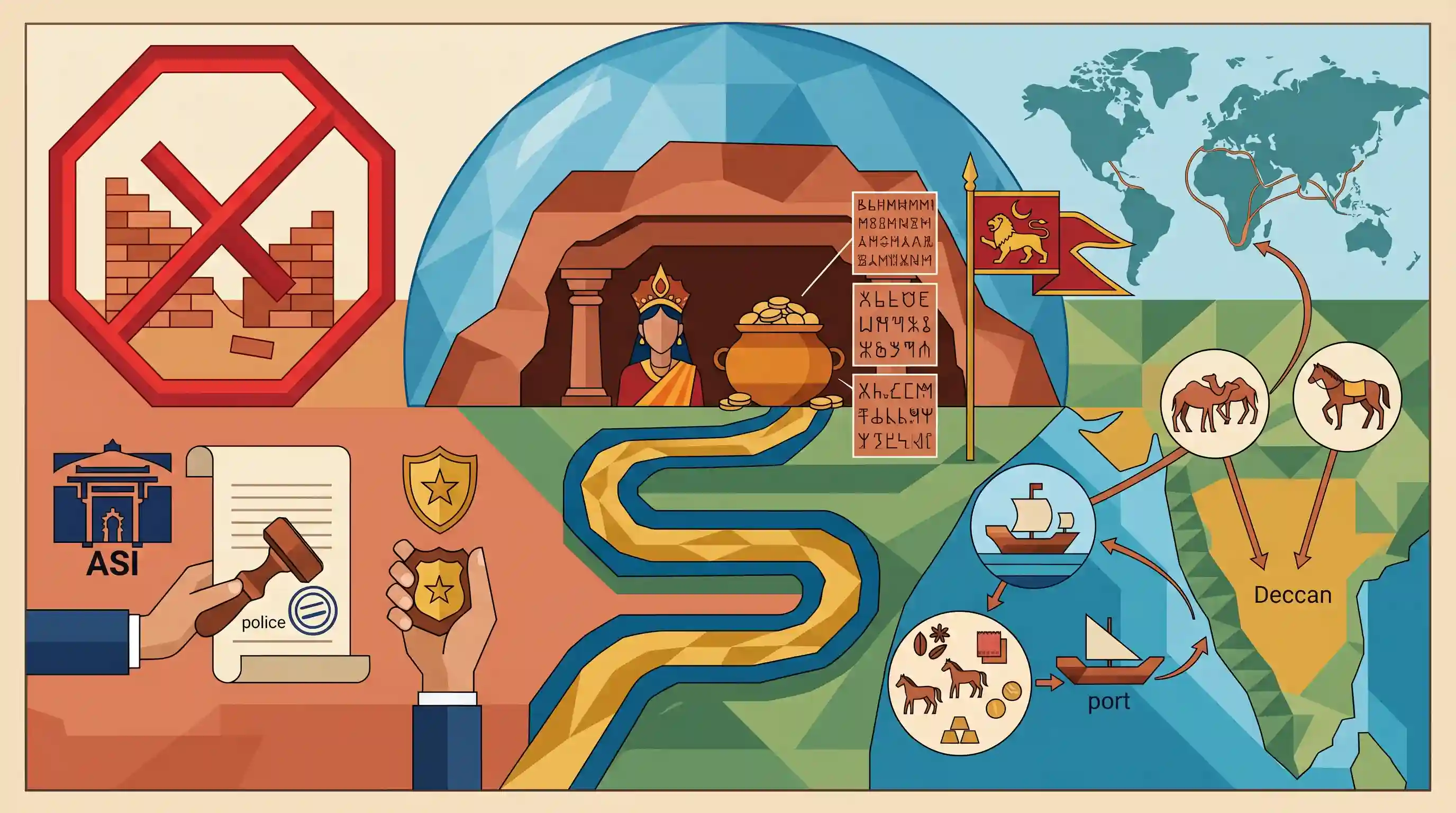
The incident perfectly illustrates the practical application of the AMASR Act in safeguarding Indian art heritage, a direct theme in GS1 Mains. Furthermore, the geographical and historical significance of Naneghat caves (Satavahana dynasty, Brahmi inscriptions, Western Ghats passes) are high-yield factual areas for Prelims.
Summary
The Archaeological Survey of India (ASI) has filed an FIR regarding an illegal structure built near the Naneghat caves in Pune's Junnar district. The action, taken under the Ancient Monuments and Archaeological Sites and Remains (AMASR) Act, underscores the persistent threat of encroachment on India's historical sites. Naneghat is a prominent ancient trade route in the Western Ghats, famous for its rock-cut caves bearing Brahmi inscriptions from the Satavahana era.
Key Points
- The ASI registered an FIR against unauthorized construction near the Naneghat caves in Pune, citing violations of the AMASR Act.
- The AMASR Act prohibits unauthorized construction or mining activities within designated protected zones around centrally protected monuments.
- Naneghat is a historically vital mountain pass in the Western Ghats that served as a major trade route between the Konkan coast and the Deccan plateau.
- The Naneghat caves are famous for their ancient Brahmi inscriptions detailing the achievements and donations of the Satavahana dynasty.
Important Terms
Ancient Monuments and Archaeological Sites and Remains (AMASR) Act

A 1958 law (amended 2010) providing for the preservation of ancient monuments and archaeological sites of national importance. It establishes prohibited (100m) and regulated (200m) zones for construction near protected sites.
UPSC context
GS Paper I (Indian Culture) & GS Paper II (Government Policies); tested in context of heritage conservation and encroachment.
Archaeological Survey of India (ASI)
The premier statutory organization under the Ministry of Culture, founded in 1861. It is responsible for archaeological research, conservation, and preservation of centrally protected monuments and sites in India.
UPSC context
GS Paper I (Art & Culture) and Paper II (Statutory Bodies); central to heritage management and historical research.
Naneghat
An ancient mountain pass in the Western Ghats (Pune) that functioned as a major trade route connecting the Konkan coast to the Deccan plateau during the Satavahana period.
UPSC context
GS Paper I (Ancient Indian History/Geography); significant for ancient trade networks and rock-cut architecture.
Satavahana Dynasty
An ancient Indian dynasty (c. 2nd Century BCE – 3rd Century CE) that ruled the Deccan region. They were prolific patrons of rock-cut architecture, maritime trade, and religious institutions.
UPSC context
GS Paper I (Ancient Indian History); key to understanding the political and cultural consolidation of Southern India.
Brahmi Script
One of the oldest writing systems of ancient India, deciphered by James Prinsep in 1837. It is the ancestor of most modern Indian scripts, including Devanagari, Tamil, and Telugu.
UPSC context
GS Paper I (Indian Culture); fundamental to studying ancient epigraphy and linguistic evolution.
Nanaghat Inscriptions
Crucial 1st-century BCE rock-cut records commissioned by Queen Naganika. They provide historical data on the Satavahana lineage, Vedic sacrifices, and contain some of the oldest known numeration symbols.
UPSC context
GS Paper I (Ancient History/Art & Culture); vital primary source for regional chronology and religious practices.
Prelims Trap
The Naneghat rock-cut caves were primarily built as Buddhist viharas by the Satavahana dynasty.
Unlike Ajanta or Ellora which were religious retreats, Naneghat caves were built for secular, administrative purposes as rest stops and tollbooths for passing merchants.
Static Concepts Connected
What historical information is derived from the Naneghat inscriptions?
- Satavahana Patronage: Commissioned by Queen Naganika (wife of Satakarni I) in the 1st Century BCE.
- Vedic Sacrifices: Details the performance of major Vedic sacrifices like Ashvamedha and Rajasuya, indicating a Brahmanical revival.
- Early Numerals: Contains some of the world's oldest known epigraphic symbols for digits like 2, 4, 6, 7, and 9.
What are the protective zones under the AMASR Act, 1958?
- Prohibited Area: A 100-meter radius around centrally protected monuments where no new construction is permitted.
- Regulated Area: The subsequent 200 meters where construction or mining requires National Monuments Authority (NMA) approval.
Cross-Topic Patterns
Naneghat and the Dakshinapatha trade
Maps connecting Konkan ports (Sopara, Kalyan) to Deccan centers (Junnar) are prime candidates for UPSC ancient geography and trade-route questions.
AMASR Act vs. Infrastructure Push
This highlights the ongoing tension between enforcing the 100m prohibited zone and the recent push to amend the AMASR Act for public works.

Expect a paired-matching Prelims question linking ancient caves (Naneghat, Nasik, Karle) to their distinct primary purposes or royal patrons.
Linked PYQs · 2
Linked PYQs · 2
- 2018MainsGS1
Safeguarding the Indian art heritage is the need of the moment. Discuss.
- 2020MainsGS1
The rock-cut architecture represents one of the most important sources of our knowledge of early Indian art and history. Discuss.
