India Highlights Climate Progress and Gender Roles at BRICS Forum
Source:The Hindu ↗
Why It Matters
This article provides useful statistics on India's climate goals (emission intensity, non-fossil fuel capacity, Ramsar sites) that can be used to substantiate answers in GS3 Environment. It also successfully links gender empowerment with environmental conservation (a potential GS1 or Essay theme) and contextualizes it within a major multilateral forum (BRICS, GS2).
Summary
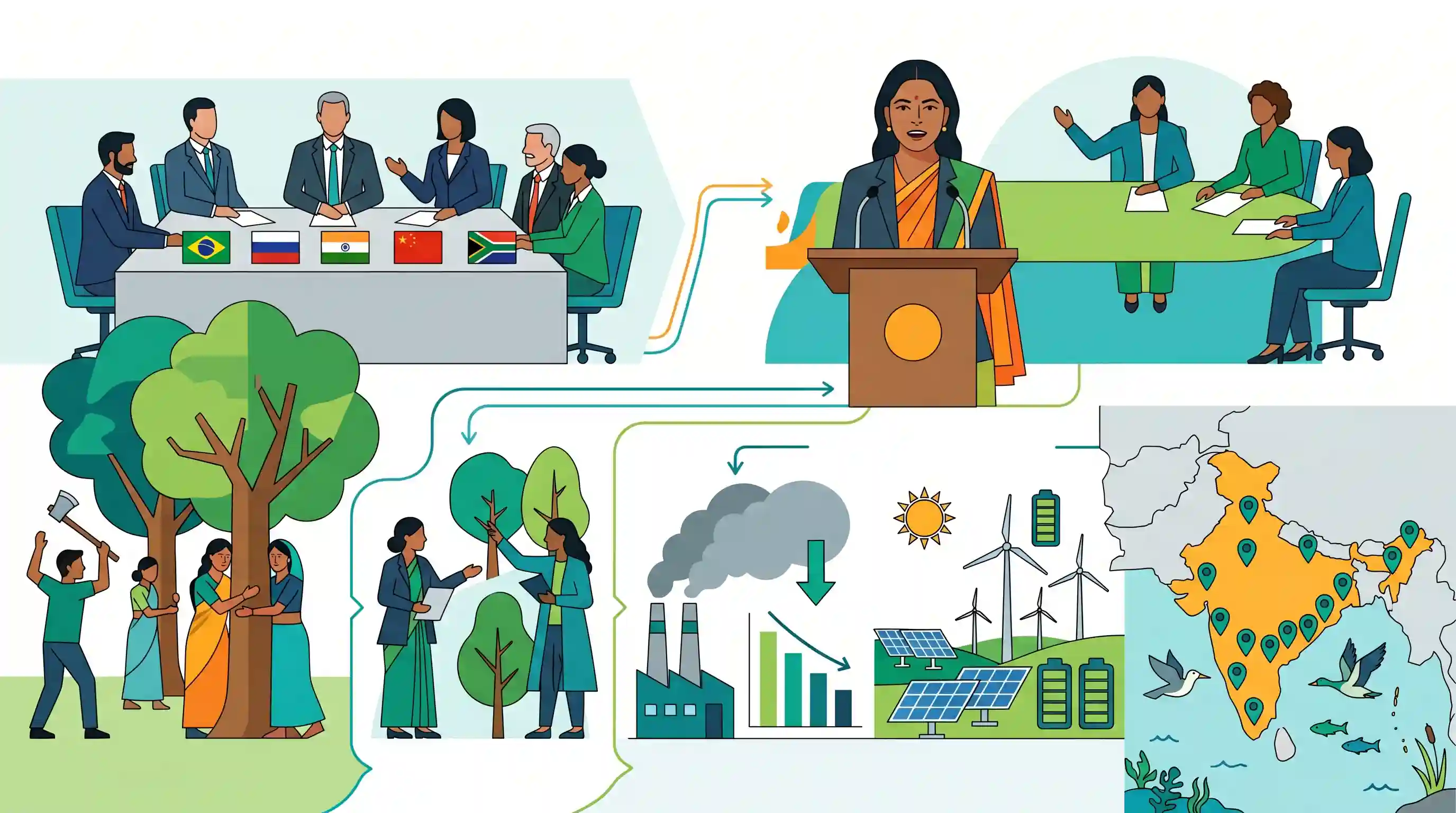
At the BRICS Parliamentary Forum in Brazil, Nandyal MP Byreddy Shabari underscored India's historical and current commitments to environmental protection and climate goals. Highlighting the pivotal role of women since the 1970s Chipko Movement, she advocated for gender-inclusive climate policies. Furthermore, she presented key achievements in India's climate action, including a 24% drop in emission intensity, the establishment of 159 GW of non-fossil fuel capacity, and maintaining the highest number of Ramsar sites in South Asia.
Key Points
- Nandyal MP Byreddy Shabari represented India at the BRICS Parliamentary Forum in Brazil, emphasizing the historical role of Indian women in environmental protection, specifically citing the 1970s Chipko Movement.
- She outlined India's recent climate achievements, notably a 24% reduction in emission intensity and the addition of 159 GW of non-fossil fuel capacity.
- India's leadership in wetland conservation was highlighted, as the country hosts the largest number of Ramsar sites in South Asia.
- The MP underscored the critical need for gender-inclusive climate policies and recognized the significant impact women can have in managing the climate crisis.
Important Terms
Ramsar Convention

An international treaty (1971) for the conservation and sustainable use of wetlands. India has the highest number of designated sites in South Asia, critical for biodiversity and climate resilience.
UPSC context
GS III Environment (Conservation); frequently tested in Prelims regarding site locations and the Montreux Record.
BRICS
A grouping of major emerging economies (originally Brazil, Russia, India, China, South Africa) that expanded in 2024 to include Egypt, Ethiopia, Iran, and UAE, aimed at promoting South-South cooperation.
UPSC context
GS II International Relations; central to topics on multilateral groupings and India's global strategic interests.
BRICS Parliamentary Forum
An inter-parliamentary platform for legislators from BRICS nations to align laws, exchange experiences, and strengthen multilateralism. The 11th forum was hosted by Brazil in 2025.
UPSC context
GS II International Relations & Polity; tests knowledge of parliamentary diplomacy and institutional mechanisms of global blocs.
Emission Intensity
The ratio of greenhouse gas emissions produced per unit of Gross Domestic Product (GDP). India aims to reduce this by 45% by 2030 from 2005 levels.
UPSC context
GS III Environment; key metric for India's Nationally Determined Contributions (NDCs) under the Paris Agreement.
Chipko Movement
A non-violent forest conservation movement started in the 1970s in Uttarakhand, notable for the primary leadership and participation of rural women in protecting trees.
UPSC context
GS I Social Issues & GS III Environment; tests history of environmental movements and the role of women in conservation.
Lok Sabha
The directly elected lower house of India's Parliament. Members represent constituencies and participate in international delegations to represent India's legislative stance on global stages.
UPSC context
GS II Polity; fundamental to understanding the legislative structure and the representative role of an MP.
Prelims Trap
"India currently hosts the highest number of Ramsar sites in Asia."
India holds the highest number of Ramsar sites in *South Asia*, not the entire Asian continent (China holds more). UPSC often swaps regional descriptors.
Static Concepts Connected
What are India's updated Nationally Determined Contributions (NDCs) under the Paris Agreement?
- Emission Intensity: Reduce the emission intensity of its GDP by 45% by 2030, from 2005 levels.
- Energy Capacity: Achieve 50% cumulative electric power installed capacity from non-fossil fuel-based energy resources by 2030.
- Carbon Sink: Create an additional carbon sink of 2.5 to 3 billion tonnes of CO2 equivalent through additional forest and tree cover by 2030.
What characterized the 1970s Chipko Movement in terms of leadership and method?
- Eco-feminism: It was a pioneer socio-ecological struggle where rural women physically embraced trees to prevent commercial logging, becoming a global symbol of women-led conservation.
- Non-violent Resistance: The movement heavily relied on Gandhian methods of non-violent resistance (Satyagraha) in the Garhwal Himalayas.
Cross-Topic Patterns
Eco-feminism & Local Governance
The role of women in the Chipko movement parallels modern mandates for women in Panchayati Raj institutions driving local climate adaptation, water conservation, and forest rights management.
Expanded BRICS Climate Agenda
With new fossil-fuel-heavy members joining BRICS, India's push for renewable milestones within BRICS forums signals a strategic shift toward South-South climate diplomacy and technology transfers.

Expect a multi-statement question linking India's updated NDC targets with women's role in historical eco-movements (Chipko/Appiko).
Linked PYQs · 4
Linked PYQs · 4
- 2019PrelimsGS1
Consider the following statements: 1. Under Ramsar Convention, it is mandatory on the part of the Government of India to protect and conserve all the wetlands in the territory of India. 2. The Wetlands (Conservation and Management) Rules, 2010 were framed by the Government of India based on the recommendations of Ramsar Convention. 3. The Wetlands (Conservation and Management) Rules, 2010 also encompass the drainage area or catchment regions of the wetlands as determined by the authority. Which of the statements given above is/are correct?
- 2022MainsGS3
Do you think India will meet 50 percent of its energy needs from renewable energy by 2030 ? Justify your answer. How will the shift of subsidies from fossil fuels to renewables help achieve the above objective ? Explain.
- 2016MainsGS3
Give an account of the current status and the targets to be achieved pertaining to renewable energy sources in the country. Discuss in brief the importance of National Programme on Light Emitting Diodes (LEDs).
- 2012MainsGS2
Compare the significance of IBSA and BRICS in the context of India's multilateral diplomacy.
