High Speed Rail Corridor Extension Planned to Rishikesh
Source:indian-economic-observer ↗
Why It Matters
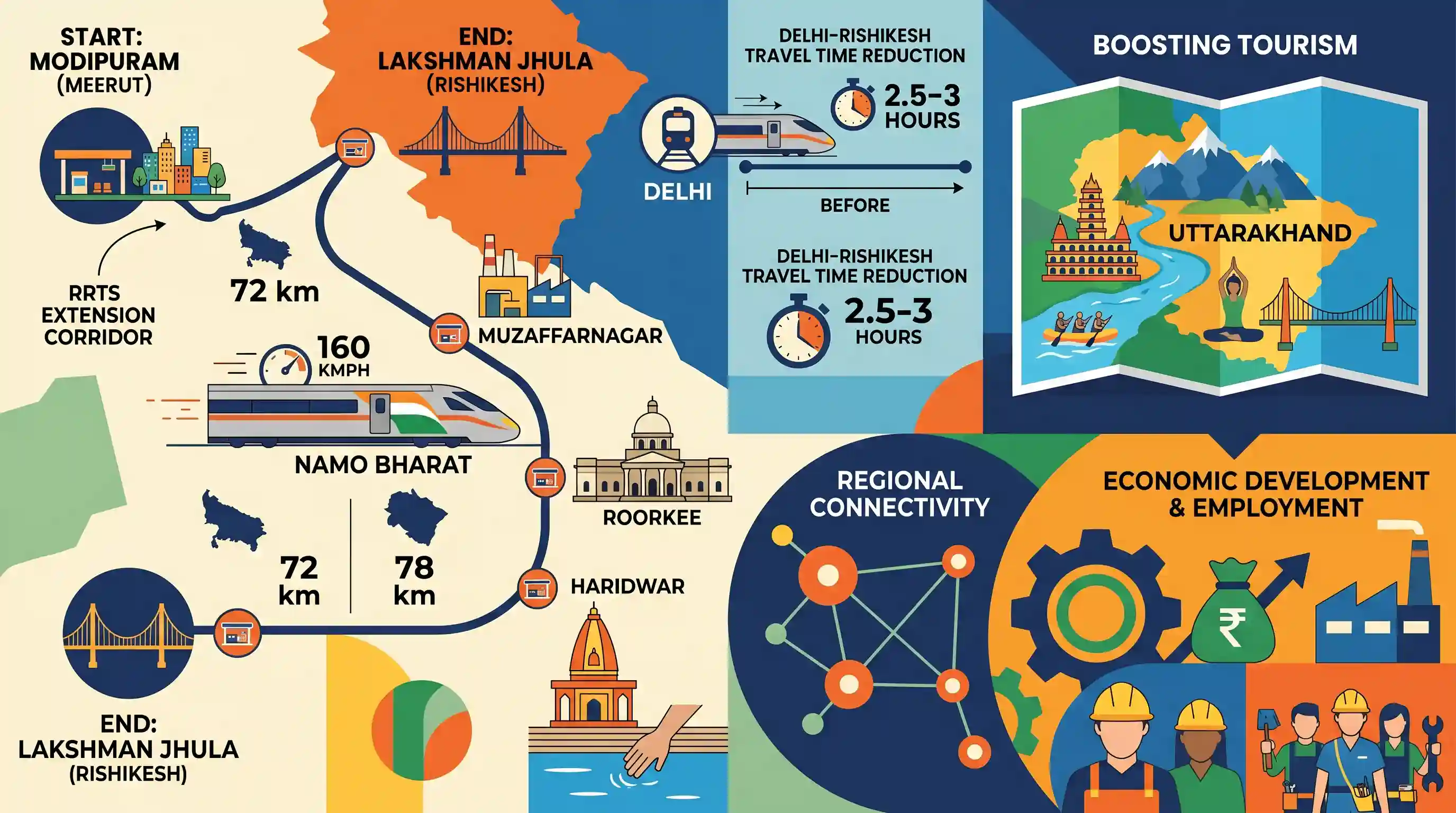
The extension of the RRTS (Namo Bharat) deep into Uttarakhand represents a major leap in high-speed regional transport infrastructure. It directly addresses the economic and spiritual-tourism needs of the state by radically decreasing travel times from Delhi, enhancing the safety of pilgrims, and fostering sustainable transit-oriented development.
Summary
The high-speed Namo Bharat (RRTS) train service is set to be extended by 150 km from Modipuram (Meerut) to Lakshman Jhula (Rishikesh). Approved in principle by the Central Government, the project is a collaborative effort between the governments of Uttarakhand and Uttar Pradesh and the NCRTC. The 150 km corridor (72 km in UP, 78 km in Uttarakhand) will pass through major hubs like Muzaffarnagar, Roorkee, and Haridwar. Operating at speeds up to 160 kmph, it will cut Delhi-Rishikesh travel time to 2.5–3 hours, significantly boosting tourism, regional connectivity, and employment opportunities in Uttarakhand.
Key Points
- The Government of Uttarakhand, Government of Uttar Pradesh, and the National Capital Region Transport Corporation (NCRTC) have agreed to extend the high-speed Namo Bharat (RRTS) corridor from Modipuram in Meerut to Lakshman Jhula in Rishikesh.
- The proposed rail corridor spans 150 kilometres, with 72 kilometres in Uttar Pradesh and 78 kilometres in Uttarakhand.
- The route will pass through Modipuram (Meerut), Muzaffarnagar, Roorkee, Haridwar (including Har Ki Pauri), and terminate near Lakshman Jhula (Rishikesh).
- Operating at speeds of up to 160 kmph, the Namo Bharat train is expected to reduce Delhi-to-Rishikesh travel time from 5–6 hours (by road) to approximately 2.5–3 hours.
- The Uttarakhand Government has designated Additional Secretary Reena Joshi as the nodal officer to oversee the project's execution and coordinate the upcoming Detailed Project Report (DPR) survey.
- In-principle approval was granted after CM Pushkar Singh Dhami met with Prime Minister Narendra Modi and Union Housing and Urban Affairs Minister Manohar Lal Khattar.
Important Terms
Regional Rapid Transit System (RRTS)

A rail-based, semi-high-speed, high-frequency mass transit system designed for intercity commuting to ensure balanced and sustainable regional development.
UPSC context
GS Paper 3: Infrastructure (Railways), urban planning, and sustainable transport solutions.
National Capital Region Transport Corporation (NCRTC)
A joint venture company of the Government of India and participating state governments, mandated to implement and operate the Regional Rapid Transit System (RRTS).
UPSC context
GS Paper 3: Infrastructure (Railways) and public-sector cooperative governance models.
Namo Bharat Train
India's first indigenous semi-high-speed aerodynamic electric train sets designed and manufactured under the 'Make in India' initiative for the Regional Rapid Transit System.
UPSC context
GS Paper 3: Indigenization of technology, manufacturing sectors, and infrastructure growth.
Union Ministry of Housing and Urban Affairs (MoHUA)
The central ministry responsible for formulation, administration, and monitoring of national policies, programs, and laws related to housing, urban planning, and urban transport.
UPSC context
GS Paper 2: Government policies and interventions for urban planning and development.
National Capital Region (NCR)
A coordinated metropolitan planning region centered on the National Capital Territory of Delhi, encompassing adjacent districts in Haryana, Uttar Pradesh, and Rajasthan.
UPSC context
GS Paper 1: Urbanization, urban sprawl, and regional planning challenges.
Prelims Trap
Uttarakhand is a permanent equity-holding partner state of the National Capital Region Transport Corporation (NCRTC) following the corridor's extension.
NCRTC is a joint venture strictly between the Centre and NCR states (Delhi, Haryana, Rajasthan, UP). Uttarakhand's partnership for this project does not alter NCRTC's core equity structure.
Static Concepts Connected
How does RRTS differ from conventional Metro Rail systems?
- Speed and Range: RRTS operates at speeds up to 160-180 kmph for long-distance regional commutes (100-250 km), whereas metros run at ~80 kmph for short urban trips.
- Station Frequency: RRTS has fewer, more widely-spaced stations to facilitate rapid transit between distant urban nodes, unlike high-frequency metro stops.
- Co-operative Execution: It is built on dedicated tracks by NCRTC, a multi-state joint venture, whereas Metros are usually single-city focused joint ventures.
What is a Special Purpose Vehicle (SPV) in Indian infrastructure?
- Distinct Entity: A separate, legally independent corporate entity created to isolate financial risk and execute a specific infrastructure project like NCRTC.
- Joint Equity: Enables multiple governments (Centre and states) to pool equity and resources without merging their independent fiscal budgets.
- Multilateral Funding: Simplifies the process of securing external debt from international bodies like the Asian Development Bank (ADB) for targeted execution.
Cross-Topic Patterns
Mass transit vs Himalayan carrying capacity
Rapid tourist influx into Rishikesh via high-speed transit intensifies ecological pressure, linking GS-3 infrastructure growth directly to environmental conservation and disaster vulnerability in the Himalayas.
Infrastructure-led regional economic integration
Extending urban corridors outside native state limits showcases how rapid transit drives spatial-economic integration, turning peri-urban zones into active economic corridors.

UPSC may frame a multi-statement question comparing RRTS, Metro, and Bullet trains, focusing on operational speed and executing agencies.
Linked PYQs · 3
Linked PYQs · 3
- 2025UKPSC_PRELIMSGS1
As per Uttarakhand Budget 2025-26, the amount allocated for Char Dham Road network improvement is
- 2024UKPSC_PRELIMSGS1
UTDB is established in Uttarakhand to promote:
- 2025UKPSC_PRELIMSGS1
Which of the following countries has the highest density of railway network ?
