Namma SAFARI Model and Karnataka Low Carbon Development Roadmap
Source:The Hindu ↗
Why It Matters
This article offers a practical, multi-sectoral case study (the Namma SAFARI Model) on how Indian states can formulate pathways for deep decarbonization and energy transition. It provides valuable fodder for Mains GS-3 answers regarding renewable energy challenges (like land-use conflicts and storage), energy efficiency, and balancing economic growth with climate commitments.
Summary
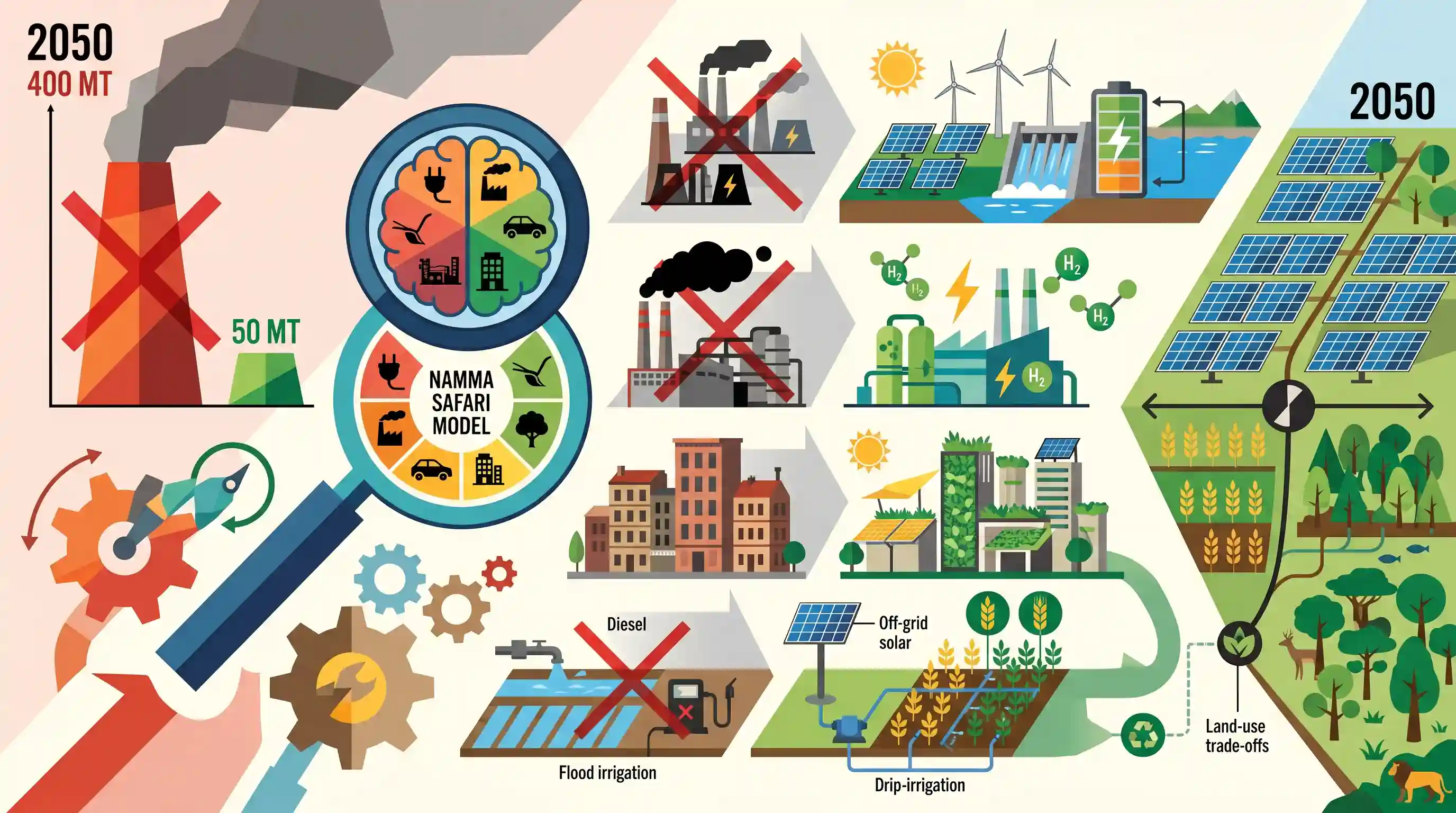
The Center for Study of Science, Technology and Policy (CSTEP) has launched the Namma SAFARI Model to guide Karnataka's transition toward low-carbon development and climate goals. By simulating scenarios across various sectors—including power, industry, transport, agriculture, and buildings—the model offers a roadmap to reduce the state's greenhouse gas (GHG) emissions from 400 MT to 50 MT by 2050. Key recommendations include halting new coal projects, adopting green construction practices, transitioning to electric or hydrogen alternatives in industries, and promoting solar pumps and micro-irrigation in agriculture. The model also underscores the necessity of pairing renewable energy with battery and hydro storage, and addresses the land-use trade-offs between massive solar expansion and food security or forestry.
Key Points
- The Namma SAFARI Model developed by CSTEP provides data-driven policy insights to help Karnataka achieve its low-carbon development goals.
- The model projects that Karnataka can reduce its GHG emissions from 400 MT to 50 MT by 2050 by halting new coal plant construction and significantly expanding renewable energy.
- Implementing green construction materials, rooftop solar panels, and passive cooling strategies can cut electricity demand in buildings by up to 25%.
- Industrial decarbonization depends on shifting from coal-heavy operations to electric and hydrogen-based alternatives.
- In agriculture, transitioning to solar pumps, micro-irrigation, and millet cultivation are recommended for climate resilience.
- To manage grid stability with increased renewables, integrating battery and hydro storage along with time-of-day tariffs is essential.
- A major challenge highlighted is the land-use conflict between large-scale solar projects and competing needs like food security, forestry, and urbanization.
Important Terms
Namma SAFARI Model

Karnataka's first integrated system dynamics model designed to simulate sector-specific growth and carbon emissions up to 2050 to inform state climate policy.
UPSC context
GS Paper III (Environment/Energy). Relevant for state-led climate action and data-driven policymaking in decarbonization strategies.
Center for Study of Science, Technology and Policy (CSTEP)
A leading Indian non-profit think tank (est. 2005) that uses science and technology-based research to inform policy in energy, climate, and sustainability.
UPSC context
GS Paper II/III. Important for understanding the role of think tanks in national and state policy formulation.
Systems Dynamics Model
A computational modelling approach that maps how different sectors (energy, transport, land use) interact and evolve over time within a complex system.
UPSC context
GS Paper III (S&T). Tests understanding of modern scientific tools used for long-term resource planning and climate mitigation.
Low-Carbon Development
A strategy aimed at achieving economic growth while minimizing greenhouse gas emissions through energy efficiency and renewable energy adoption.
UPSC context
GS Paper III (Environment). A core pillar of India’s NDCs and the global transition toward Net Zero.
Green Hydrogen
Hydrogen produced via electrolysis of water using renewable electricity, acting as a clean fuel for hard-to-abate sectors like steel and heavy transport.
UPSC context
GS Paper III (Energy/S&T). Vital for the National Green Hydrogen Mission and industrial decarbonization.
Pumped Hydro Storage (PHS)
An energy storage method using water reservoirs at different elevations to balance variable renewable energy and maintain power grid stability.
UPSC context
GS Paper III (Infrastructure/Energy). Essential for balancing the grid as renewable energy penetration increases.
Land-Use Trade-offs
Conflicts arising from competing needs for land, specifically between large-scale solar expansion, agricultural food security, and forest conservation.
UPSC context
GS Paper III (Environment/Geography). Addresses the spatial challenges and sustainability of the green energy transition.
Prelims Trap
The Namma Safari Model is a state-led wildlife conservation and eco-tourism framework.
The acronym stands for 'Sustainable Alternative Futures for India'. It is a climate decarbonization simulation tool, entirely unrelated to wildlife, eco-tourism, or forests.
Static Concepts Connected
What are Time-of-Day (ToD) tariffs and how do they support grid stability?
- Variable pricing: Electricity prices vary according to the time of day, reflecting the real-time availability and cost of power generation.
- Demand shifting: Incentivizes consumers to shift non-essential loads to off-peak hours when renewable generation (like solar) is highest.
- Grid balancing: Reduces peak load stress, limiting the need for grid operators to fire up expensive, high-carbon fossil-fuel peaker plants.
How does the Energy Conservation Building Code (ECBC) promote sustainable infrastructure?
- Statutory backing: Launched by the Bureau of Energy Efficiency (BEE) under the Energy Conservation Act, 2001, to set minimum energy standards.
- Applicability: Primarily applies to new commercial buildings having a connected load of 100 kW or more, or contract demand of 120 kVA.
- Key focus: Focuses on passive cooling design, daylighting integration, and optimized HVAC systems to cut building electricity demand by 25-50%.
Cross-Topic Patterns
Solar expansion vs. Food Security trade-off
The massive land footprint required for utility-scale solar installations directly competes with arable land and afforestation drives, requiring complex land-use governance and policy frameworks.
PM-KUSUM + Climate-resilient agriculture
Linking off-grid solar pumps (PM-KUSUM) with micro-irrigation and millet cultivation demonstrates a dual approach: decarbonizing agricultural inputs while simultaneously enhancing drought resilience.

Expect a multi-statement question linking renewable grid instability with pumped hydro storage and Time-of-Day (ToD) tariffs in Prelims.
Linked PYQs · 3
Linked PYQs · 3
- 2022MainsGS3
Do you think India will meet 50 percent of its energy needs from renewable energy by 2030 ? Justify your answer. How will the shift of subsidies from fossil fuels to renewables help achieve the above objective ? Explain.
- 2016MainsGS3
Give an account of the current status and the targets to be achieved pertaining to renewable energy sources in the country. Discuss in brief the importance of National Programme on Light Emitting Diodes (LEDs).
- 2024PrelimsGS1
Recently, the term "pumped-storage hydropower" is actually and appropriately discussed in the context of which one of the following?
