Electoral Roll Revision and Deletions in Tamil Nadu
Source:Indian Express ↗
Why It Matters
The continuous updating and purification of electoral rolls is fundamental to the democratic process. It prevents voter fraud, ensures accurate representation, and safeguards the universal adult suffrage enshrined in Article 326 of the Constitution. Understanding the Election Commission's powers and the mechanisms of the Representation of the People Act is highly relevant for GS Paper 2.
Summary
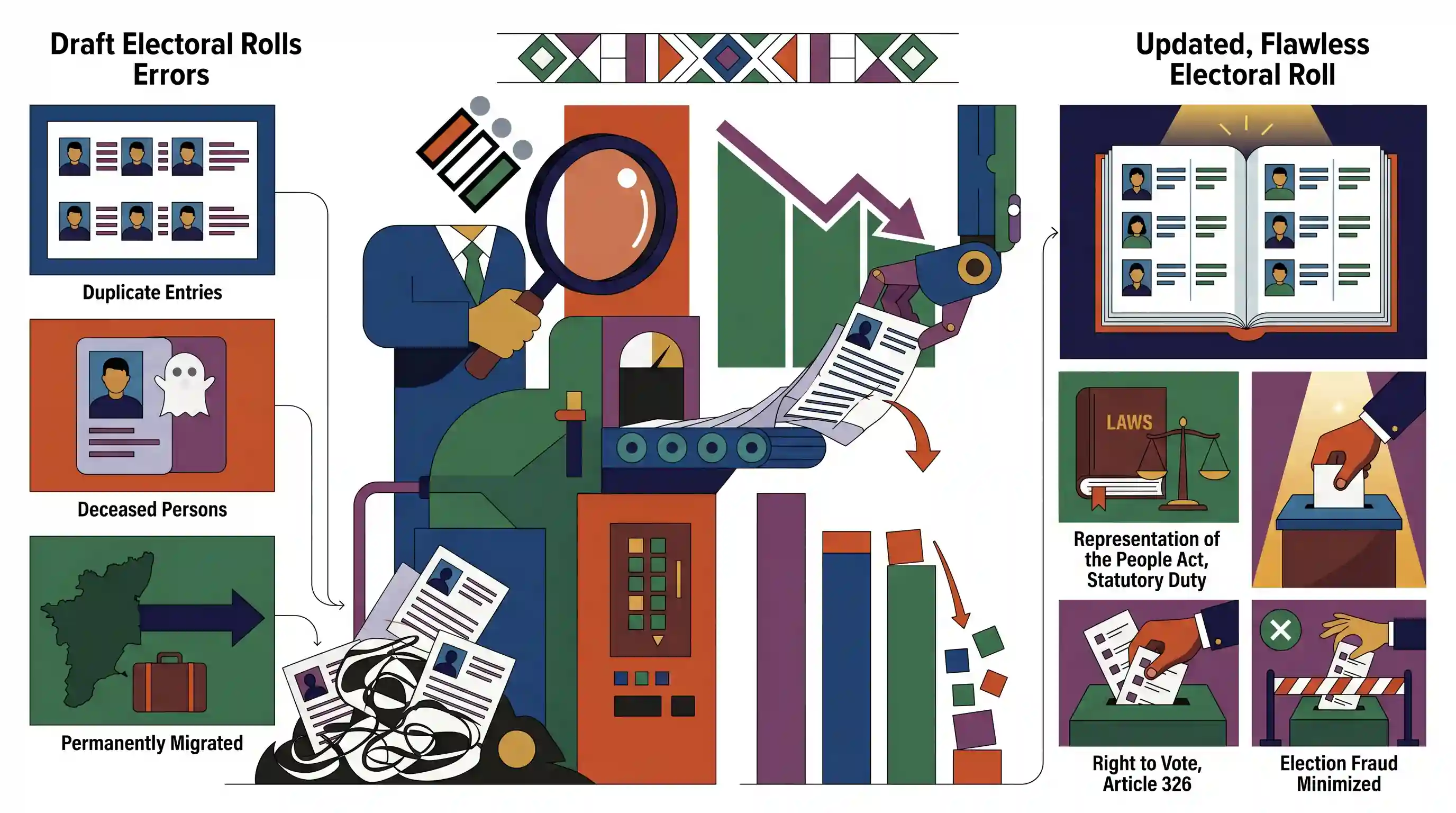
Following a Special Intensive Revision (SIR), the Election Commission of India has removed over 97 lakh names from the draft electoral rolls in Tamil Nadu. The exercise was conducted to rectify errors in the voter lists, such as duplicate entries, deceased persons, and those who have permanently migrated. Maintaining an updated and flawless electoral roll is a core statutory duty under the Representation of the People Act, 1950, ensuring that the constitutional right to vote (Article 326) is exercised fairly and that election fraud is minimized.
Key Points
- Over 97 lakh names have been deleted from the Tamil Nadu draft electoral rolls following a Special Intensive Revision (SIR).
- The cleanup aims to eliminate duplicate entries, deceased voters, and electors who have permanently relocated, ensuring the integrity of the voter base.
- Regular electoral roll revisions are a statutory and constitutional mandate of the Election Commission of India, critical for free and fair democratic elections.
- The massive deletion highlights systemic challenges in continuous voter list updates and emphasizes the importance of Booth Level Officers (BLOs) in verification.
Important Terms
Election Commission of India

An autonomous constitutional authority responsible for administering Union and State election processes, including the Lok Sabha, Rajya Sabha, and State Legislative Assemblies.
UPSC context
GS Paper II (Constitutional Bodies); critical for understanding the independence and functioning of India's electoral democracy.
Representation of the People Act, 1950
Statutory legislation providing for the allocation of seats, delimitation of constituencies, and the detailed procedures for preparing and updating electoral rolls.
UPSC context
GS Paper II (Elections); tests knowledge of legal provisions governing voter eligibility and constituency groundwork.
Representation of the People Act, 1951
Comprehensive law regulating the actual conduct of elections, member qualifications/disqualifications, registration of political parties, and prevention of corrupt practices.
UPSC context
GS Paper II (Elections); vital for understanding operational integrity and accountability in the voting process.
Article 326
A constitutional provision establishing universal adult suffrage, granting every Indian citizen aged 18 and above the right to vote in general elections.
UPSC context
GS Paper II (Polity); essential for understanding democratic participation and political equality under the Indian Constitution.
Special Intensive Revision (SIR)
A comprehensive, door-to-door verification and update drive by the ECI to ensure electoral rolls are accurate, inclusive, and free from duplicate or ineligible entries.
UPSC context
GS Paper II (Governance/Elections); tests awareness of administrative measures to prevent fraud and ensure "one person, one vote."
Electoral Roll
The official list of persons registered as electors in a specific constituency, maintained and revised to determine eligibility for voting.
UPSC context
GS Paper II (Electoral Reforms); central to discussions on voter exclusion and the integrity of democratic mandates.
Article 324
Vests the power of superintendence, direction, and control of elections to Parliament and State Legislatures in the Election Commission of India.
UPSC context
GS Paper II (Constitutional Bodies); defines the plenary and discretionary powers of the ECI to conduct free elections.
Prelims Trap
Aggrieved citizens can approach civil courts to challenge the wrongful deletion of their names from the electoral rolls.
Section 30 of the Representation of the People Act, 1950 expressly bars civil courts from adjudicating matters concerning an individual's entitlement to be registered in or deleted from an electoral roll.
Static Concepts Connected
What is the division of scope between RPA 1950 and RPA 1951?
- RPA 1950: Governs the preparation of electoral rolls, voter qualifications, delimitation of constituencies, and allocation of seats in Legislatures.
- RPA 1951: Governs the actual conduct of elections, qualifications/disqualifications of candidates, election disputes, and corrupt practices.
How does the Constitution frame the right to vote and electoral roll preparation?
- Article 324: Vests the plenary power of superintendence, direction, and control over the preparation of all electoral rolls explicitly in the Election Commission of India.
- Article 326: Establishes universal adult suffrage, which serves as the basis for UPSC recognizing the "Right to Vote" as a Constitutional Right in India.
Cross-Topic Patterns
Aadhaar linkage & Right to Privacy
The drive to eliminate duplicate voters intersects with recent Election Laws provisions allowing voluntary Aadhaar-Voter ID linkage, raising Right to Privacy and proportionality debates under the Puttaswamy judgment.
Prerequisite for One Nation, One Election
A flawless, centralized electoral roll is heavily cited as a primary administrative prerequisite for Simultaneous Elections, requiring synchronization between ECI and State Election Commissions (Article 243K).

Expect a 2026 statement contrasting RPA 1950 and 1951, specifically targeting the bar on civil courts regarding electoral roll deletions.
Linked PYQs · 2
Linked PYQs · 2
- 2017PrelimsGS1
Right to vote and to be elected in India is a
- 2017PrelimsGS1
Consider the following statements: 1. The Election Commission of India is a five-member body. 2. Union Ministry of Home Affairs decides the election schedule for the conduct of both general elections and bye-elections. 3. Election Commission resolves the disputes relating to splits/mergers of recognised political parties. Which of the statements given above is/are correct?
