Indian Astronaut Shubhanshu Shukla Reaches ISS
Source:The Hindu ↗
Why It Matters
Understanding the mechanics, logistics, and physiological challenges of human spaceflight (like microgravity) is crucial as India prepares for its first indigenous manned mission, Gaganyaan. It also highlights the growing ecosystem of private commercial spaceflights (SpaceX, Axiom Space) collaborating with national space agencies.
Summary
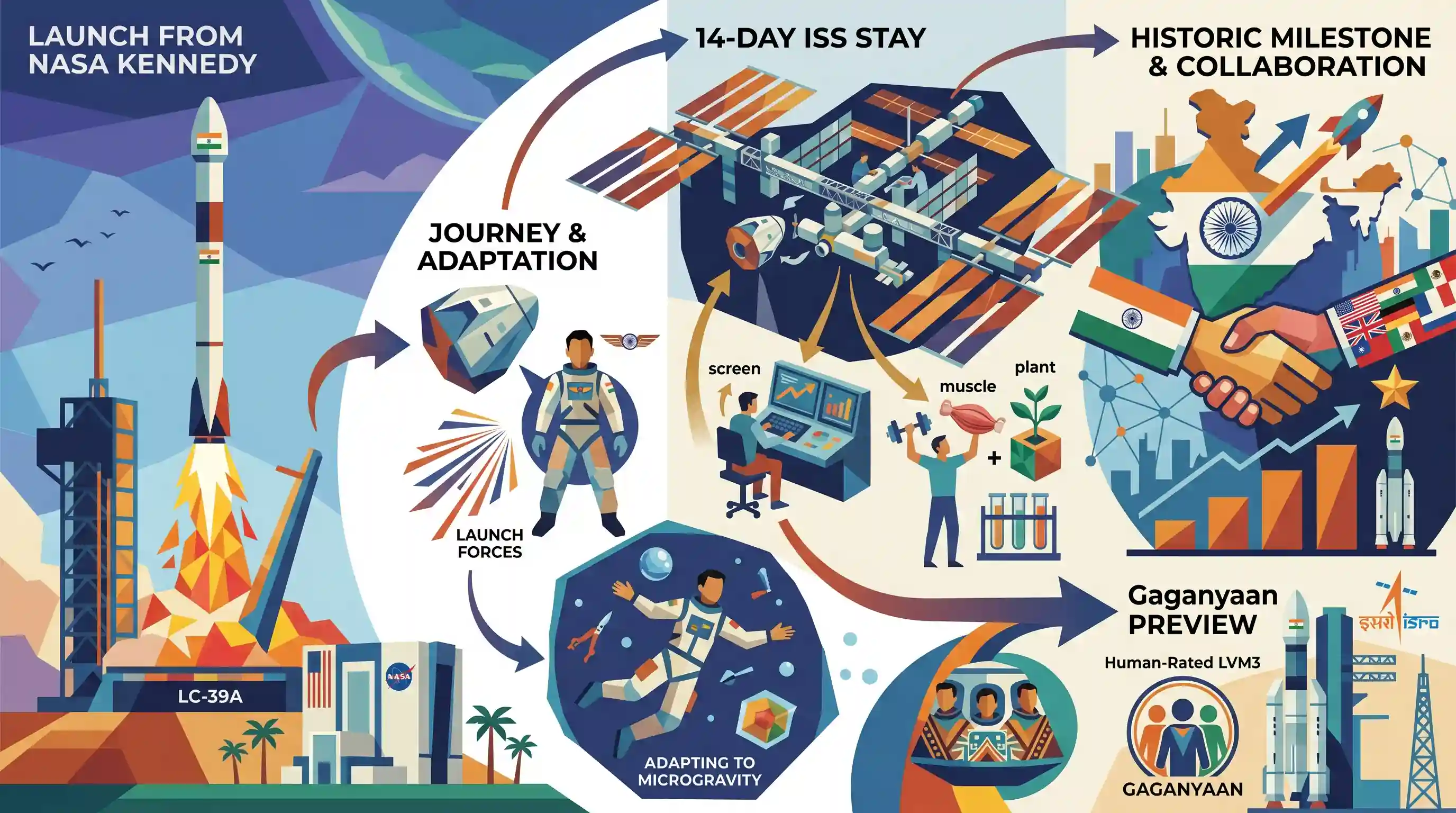
Indian astronaut Shubhanshu Shukla, participating in the Axiom-4 commercial space mission, successfully launched aboard a SpaceX Dragon spacecraft (powered by a Falcon-9 rocket) from NASA's Kennedy Space Centre. En route to a 14-day stay at the International Space Station (ISS), Shukla shared his experiences dealing with launch forces and adapting to microgravity. The journey is a historic milestone for India, showcasing international collaboration and offering crucial human spaceflight experience ahead of India's planned Gaganyaan mission.
Key Points
- Indian astronaut Shubhanshu Shukla launched toward the International Space Station (ISS) aboard SpaceX's Dragon spacecraft (named 'Grace') as part of the Axiom-4 commercial mission.
- The spacecraft was launched using a Falcon-9 rocket from NASA's Kennedy Space Centre in Florida for a 14-day stay at the ISS.
- Shukla shared his initial experiences adapting to microgravity, floating in a vacuum, and coping with intense gravitational forces during liftoff.
- A toy swan named 'Joy' accompanied the astronauts serving as a traditional 'zero-gravity indicator' on the mission.
- This mission marks a historic step in India's human spaceflight endeavors, providing essential practical experience in microgravity ahead of ISRO's indigenous Gaganyaan mission.
Important Terms
Gaganyaan

India’s first human spaceflight mission aiming to send a crew to a 400 km orbit for three days and return them safely to Earth. It demonstrates India's independent human spaceflight capability.
UPSC context
GS Paper III: Science & Technology. Tests awareness of indigenous technology and India’s global standing in space exploration.
Axiom-4 Mission
The fourth private astronaut mission to the International Space Station (ISS), operated by Axiom Space. It included Indian astronaut Shubhanshu Shukla, facilitating crucial training and microgravity research for ISRO.
UPSC context
GS Paper III: Space Technology. Relevant for questions on international collaboration and the commercialization of space.
ISRO (Indian Space Research Organisation)
India's national space agency under the Department of Space, responsible for satellite development, planetary exploration, and the indigenous human spaceflight program (Gaganyaan).
UPSC context
GS Paper III: Achievements of Indians in Science & Technology. A core institution for space-related syllabus.
Axiom Space
A private American space infrastructure developer that organizes commercial missions to the ISS and is building the world’s first commercial space station.
UPSC context
GS Paper III: Space Technology. Illustrates the shift toward private sector participation in the global space economy.
International Space Station (ISS)
A multinational collaborative space station in Low Earth Orbit, serving as a research laboratory for microgravity and space environment studies for five participating space agencies.
UPSC context
GS Paper III: Science & Tech. Tests knowledge of international scientific cooperation and the target environment for human spaceflight.
Low Earth Orbit (LEO)
An orbit around Earth with an altitude between 160 km and 2,000 km. It is the environment for the ISS, Gaganyaan, and most communication satellites.
UPSC context
GS Paper III: Science & Tech. A fundamental concept for understanding satellite deployment and manned missions.
Prelims Trap
"Shubhanshu Shukla is the first Indian citizen to travel to space aboard the Axiom-4 mission."
Rakesh Sharma was the first Indian in space (1984, Soyuz T-11). Shukla is flying on a commercial US mission to gain experience for Gaganyaan.
Static Concepts Connected
What are the core parameters of ISRO's upcoming Gaganyaan mission?
- Orbit and Crew: Aims to launch a three-member crew to a 400 km Low Earth Orbit (LEO).
- Mission Duration: Planned as a 3-day mission, concluding with a safe return and splashdown in Indian sea waters.
- Launch Vehicle: Utilizes the Human Rated LVM3 (HLVM3), which includes modified solid, liquid, and cryogenic stages to ensure crew safety.
What causes the "microgravity" experienced by astronauts on the International Space Station?
- Continuous Free-fall: Gravity still exists at ISS altitude (approx 90% of surface gravity). The weightless sensation occurs because the ISS and astronauts are constantly falling towards Earth.
- Orbital Velocity: The ISS moves sideways at roughly 28,000 km/h. This extreme lateral speed ensures its downward fall perfectly matches the curve of the Earth.
Cross-Topic Patterns
Commercial Space & India's IN-SPACe
Axiom-4 highlights the shift toward commercial LEO operations. UPSC may link this to India's own space sector reforms, particularly the roles of IN-SPACe and NSIL in privatizing ISRO's capabilities.
Artemis Accords & Space Diplomacy
NASA's facilitation of an Indian astronaut's ISS mission stems directly from the US-India initiative on Critical and Emerging Technology (iCET) and India's signing of the Artemis Accords.

Expect a 2026 question mixing Gaganyaan's LVM3 tech specs with the Artemis Accords and India-US private space collaboration.
Linked PYQs · 2
Linked PYQs · 2
- 2025PrelimsGS1
Consider the following space missions : I. Axiom-4 II. SpaDeX III. Gaganyaan How many of the space missions given above encourage and support micro-gravity research?
- 2017MainsGS3
India has achieved remarkable successes in unmanned space missions including the Chandrayaan and Mars Orbitter Mission, but has not ventured into manned space missions. What are the main obstacles to launching a manned space mission, both in terms of technology and logistics? Examine critically.
