AP Swarna Constituency Vision Plans and Data Lake Governance
Source:deccan-chronicle ↗
Why It Matters
This article is highly relevant for APPSC Group 1 Prelims and Mains as it details Andhra Pradesh's unique and pioneering constituency-level planning framework (Swarna Constituency Vision Action Plan) and the innovative P4 model. It showcases how data-driven tools (Data Lake) and structural capacity building are being integrated into public administration to achieve self-reliance and targeted welfare distribution.
Summary
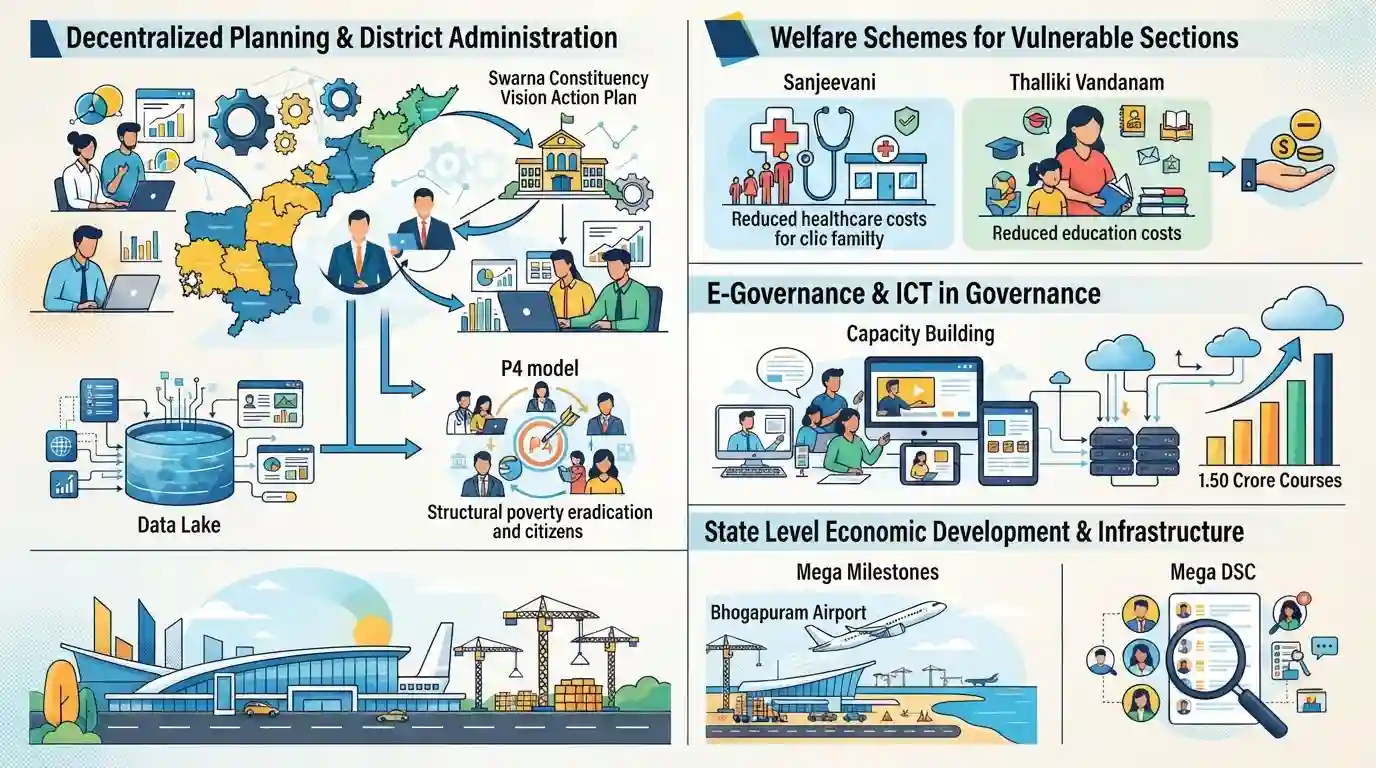
Andhra Pradesh Chief Minister N. Chandrababu Naidu has directed public representatives and officials to accelerate the implementation of the constituency-level 'Swarna Constituency Vision Action Plan'. Andhra Pradesh is the first state in the country to execute constituency-level planning, which is supported by a dedicated Data Lake for tech-enabled governance, Young Professionals, and the P4 (Public-Private-People) model aimed at structural poverty eradication. To reduce healthcare and education costs for citizens, the government is emphasizing the 'Sanjeevani' and 'Thalliki Vandanam' schemes, alongside capacity building where employees have finished 1.50 crore online courses. Additionally, major infrastructure milestones like Bhogapuram Airport and recruitment achievements like the transparent Mega DSC are being prioritized.
Key Points
- Andhra Pradesh is the first state in India to formulate and implement decentralized 'Vision Action Plans' at the constituency level (Swarna Constituency Vision Action Plan), which has earned national recognition.
- The initiative aims to eliminate poverty, rapidly resolve public grievances, and drive governance using key performance indicators (KPIs) with the support of Young Professionals, Knowledge Partners, and Swarna Office personnel.
- A technology-driven 'Data Lake' has been established to compile, analyze, and leverage diverse socio-economic datasets to optimize constituency-level outcomes.
- The P4 Model (Public-Private-People Partnership / People-Government-Enterprise-Private) is being deployed to make beneficiaries economically self-reliant by involving entrepreneurs in poverty alleviation, shifting focus away from mere direct financial doles.
- To enhance administrative efficacy, government employees in Andhra Pradesh have completed over 1.50 crore online courses for skill enhancement and capability building.
- The state is actively promoting the 'Sanjeevani' (healthcare) and 'Thalliki Vandanam' (education) schemes to reduce the burden of escalating health and education costs on poor and middle-class families. Furthermore, reforms in government schools led to over 1 lakh new admissions.
- The Chief Minister highlighted successful infrastructure and human resource milestones, specifically the progress on the Bhogapuram Airport project (marketed via the 'Wings to the Dreams of North Andhra' campaign) and the transparent completion of the Mega DSC (teacher recruitment) process.
Important Terms
Swarna Constituency Vision Action Plan

A pioneering decentralized planning framework in Andhra Pradesh translating the state's 'Swarna Andhra @2047' vision into local, measurable growth outcomes across all 175 assembly constituencies.
UPSC context
Relevant for GS Paper-III (Decentralized Planning, Governance, and Grassroots Economic Development).
P4 Project
A Public-Private-People Partnership initiative in Andhra Pradesh aiming to eradicate poverty by pairing affluent mentors ('Margadarsis') with economically vulnerable families ('Bangaru Kutumbams') to secure customized, non-cash livelihood support.
UPSC context
Key for GS Paper-III (State Economy, Welfare Schemes, and Poverty Alleviation Strategies).
Sanjeevani Scheme
A state-wide digital healthcare project in Andhra Pradesh partnered with Tata MD, utilizing universal digital health records and AI-based diagnostics to manage chronic diseases and reduce citizens' out-of-pocket health expenses.
UPSC context
Critical for GS Paper-II (Social Sector Policies - Health) and Paper-III (E-Governance/ICT).
Thalliki Vandanam Scheme
A flagship school welfare scheme in Andhra Pradesh granting ₹15,000 annually to eligible mothers of students in Classes I-XII to encourage enrollment, prevent dropouts, and support educational development.
UPSC context
Highly relevant for GS Paper-III (Welfare Schemes, Human Resource Development, and Education).
Andhra Pradesh State Development Planning Society
An autonomous, not-for-profit technical annex under AP's Planning Department that serves as the state’s key analytical and execution engine for the 'Swarna Andhra @2047' development roadmap.
UPSC context
Important for GS Paper-III (State Level Planning, Economic Governance, and Policy Institutions).
Mega DSC recruitment
Andhra Pradesh’s major direct recruitment drive for over 16,000 school teacher posts, noted for its rapid 148-day execution timeline, horizontal/vertical reservations, and transition to a fully digitized selection framework.
UPSC context
Tests knowledge of public employment, social inclusion, and educational administration under state development.
Swarna Office
Grassroots constituency-level planning support units and administrative hubs established across Andhra Pradesh to coordinate, execute, and monitor localized development targets under the Swarna Constituency Vision Action Plan.
UPSC context
Essential for GS Paper-II (Local Self-Government and Decentralized Administrative Institutions).
Prelims Trap
Under Thalliki Vandanam, the entire cash incentive of ₹15,000 is directly credited to the beneficiary's bank account via DBT.
Only ₹13,000 is transferred via DBT; ₹2,000 is deducted at source to fund school sanitation, maintenance, and infrastructure development.
Static Concepts Connected
What are the constitutional provisions for decentralized district planning in India?
- Article 243ZD: Mandates the creation of District Planning Committees (DPCs) to consolidate rural and urban developmental plans.
- DPC Composition: At least four-fifths of DPC members must be elected by elected representatives of local bodies.
- Constituency Innovation: AP's SCVAPU bypasses traditional administrative boundaries to use Assembly Constituencies as the core planning unit.
What is the DBFOT model of Public-Private Partnership?
- Full Form: Design, Build, Finance, Operate, and Transfer represents a high-risk private-sector concession framework.
- Revenue Model: Private developer finances and builds infrastructure, recovering costs through user tolls or tariffs over a fixed concession period.
- Transfer Stage: After the concession term ends, the asset is transferred back to the state government in pre-agreed conditions.
Cross-Topic Patterns
P4 Model + Fiscal Consolidation
Shifting welfare from direct financial cash transfers to private mentorship (P4) serves as an administrative strategy to reduce AP's revenue deficit while enhancing structural household livelihoods.
Bhogapuram Airport + VCIC Corridor
The operationalization of the Alluri Sitarama Raju Airport under DBFOT directly complements the industrial growth nodes of the VCIC, boosting regional logistics and tourism.

AP's transition to P4 welfare pairing and the Thalliki Vandanam DBT split are highly probable targets for multi-statement questions.
Linked PYQs · 3
Linked PYQs · 3
- 2024APPSC_PRELIMSGS1
In connection with transport and infrastructure in Andhra Pradesh, which of the following statement/statements is/are valid? I. Andhra Pradesh's first riverine project has been proposed between Muktayala and Madipadu on Krishna river. II. The Bhogapuram Greenfield International Airport had been started with a corpus fund that is sourced from National Investment and Infrastructure Fund (NIIF). III. Infrastructure investments in Andhra Pradesh are strictly implemented only with reference to strategic investments like ports and industrial corridors, but not with reference to community assets. IV. Rail Over Bridges (ROBs) are being developed in Andhra Pradesh under the Setu Bandhan Scheme. Select the correct answer using the codes given below :
- 2024APPSC_PRELIMSGS1
Which of the following statements are valid regarding the interventions of the Government of Andhra Pradesh in the context of Healthcare ? I. Telemedicine facility is available in all Ayushman Bharat Health and Wellness Centres (AB-HWCs) to avail specialist services through district hub. II. The Family Doctor Programme has been planned to be implemented as a standalone project without the need to be integrated with Primary Health Centres (PHCs). III. Dr. YSR Aarogyasri Scheme has been revamped, by increasing the income limit from ₹ 2.5 lakh to ₹ 5 lakh per annum per family. IV. 'Aarogya Aasara' Scheme is intended to provide post-operative sustenance allowance with certain eligible conditions complied with. Select the correct answer using the codes given below :
- 2023APPSC_PRELIMSGS1
One of the following welfare programmes implemented by Government of Andhra Pradesh is not part of Navaratnalu.
