Helicopter Manufacturing Facility Memorandum in Maharashtra
Source:Indian Express ↗
Why It Matters
Demonstrates the growing role of private-sector investments and state-level initiatives in fostering domestic aerospace and defence manufacturing hubs, fulfilling the objectives of 'Atmanirbhar Bharat' and boosting manufacturing-led employment.
Summary
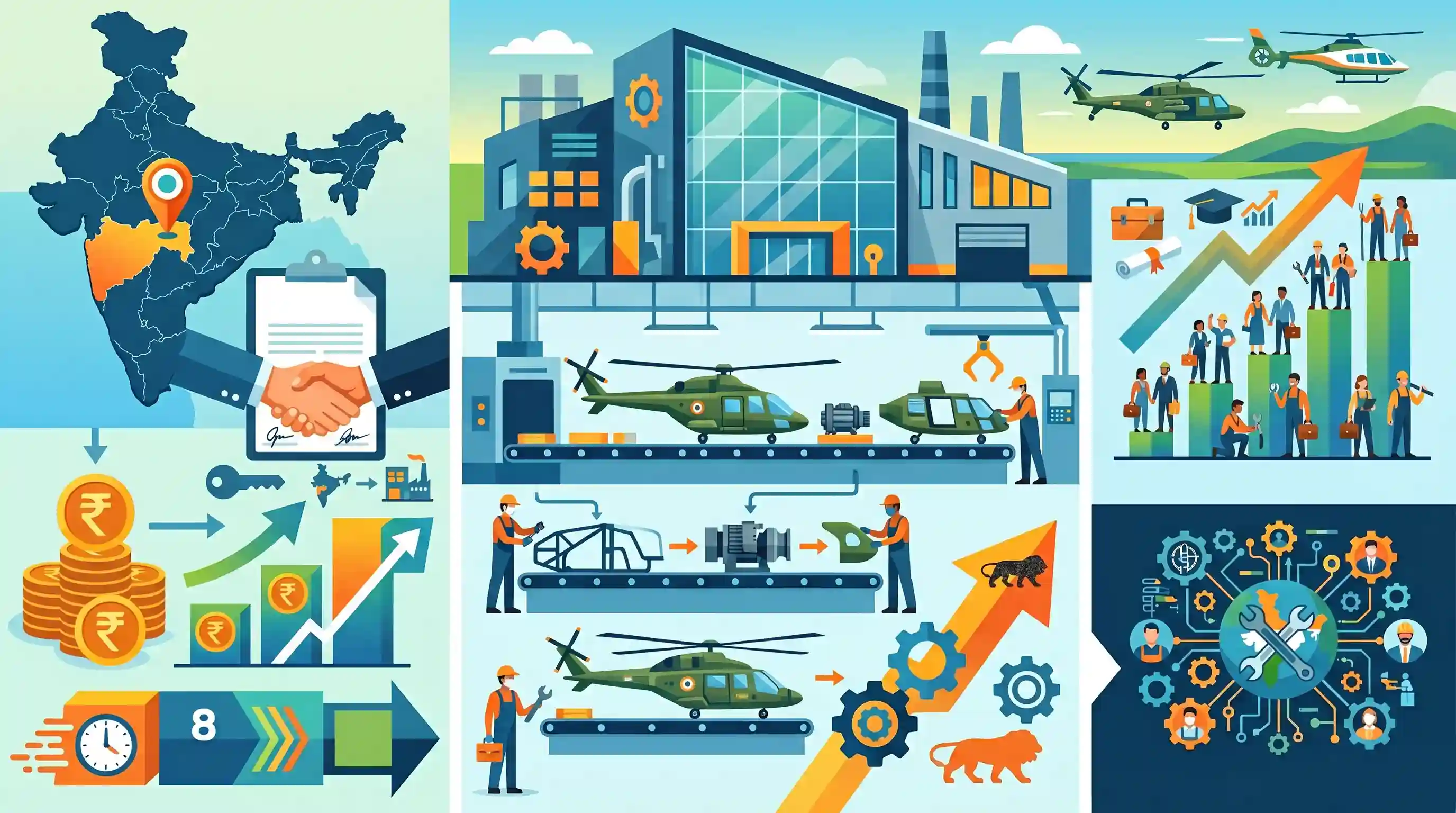
Max Aerospace and Aviation Pvt Ltd has signed a Memorandum of Understanding (MoU) with the Maharashtra state government to establish a major helicopter manufacturing facility in Nagpur. Backed by an investment of Rs 8,000 crore over eight years, the project is slated to begin operations by 2026 and aims to generate over 2,000 jobs. The facility will strengthen India's indigenous aerospace and defence manufacturing ecosystem, specifically through the customization, integration, and testing of rotary-wing platforms, thereby significantly contributing to the 'Make in India' and 'Atmanirbhar Bharat' missions.
Key Points
- Max Aerospace and Aviation Pvt Ltd signed an MoU with the Maharashtra government to set up a helicopter manufacturing facility in Nagpur.
- The project entails an investment of Rs 8,000 crore over eight years and aims to commence operations by 2026.
- It aligns with the 'Make in India' and 'Atmanirbhar Bharat' initiatives, focusing on indigenous aerospace and defence manufacturing.
- The facility will focus on customization, integration, and flight testing of rotary-wing platforms.
- Expected to generate over 2,000 direct and indirect employment opportunities.
Important Terms
Make in India

A 2014 initiative aiming to transform India into a global manufacturing hub by boosting investment, innovation, and infrastructure development across 25 key sectors.
UPSC context
GS Paper III (Indian Economy); tests knowledge of industrial policy and objectives to increase manufacturing's GDP share.
Atmanirbhar Bharat
Launched in 2020, this vision focuses on national self-reliance through five pillars—Economy, Infrastructure, System, Demography, and Demand—emphasizing indigenization in strategic sectors like defense.
UPSC context
GS Paper III (Economic Development/Security); relevant for indigenization of technology and achieving strategic autonomy.
Max Aerospace and Aviation Pvt Ltd
A Mumbai-based aviation firm that signed a ₹8,000-crore MoU with the Maharashtra government to establish a major helicopter manufacturing facility in Nagpur.
UPSC context
GS Paper III (Investment Models); demonstrates private sector participation in defense manufacturing and regional industrial development.
Government of Maharashtra
The state administrative body facilitating the Nagpur helicopter project through the Department of Industries and MIDC to establish a regional aerospace hub.
UPSC context
GS Paper II/III (Federalism/Industrial Growth); examines the role of states in competitive federalism and attracting high-value investments.
Indigenous Helicopter Manufacturing
The customization, assembly, and testing of rotary-wing aircraft within India to reduce import dependency and strengthen the domestic aerospace supply chain.
UPSC context
GS Paper III (Science & Technology); focuses on technology indigenization and the transition from MRO to full-scale production.
Prelims Trap
Helicopter and rotary-wing aircraft manufacturing in India is strictly reserved for Defence Public Sector Undertakings (DPSUs).
Recent reforms and DAP 2020 actively encourage private Indian companies to integrate and manufacture defence aerospace platforms, breaking the historical HAL/DPSU monopolies.
Static Concepts Connected
What is the Buy (Indian-IDDM) category under the Defence Acquisition Procedure?
- Highest Priority: It stands for Indigenously Designed, Developed and Manufactured, and is the most preferred category for defence capital procurement.
- Indigenous Content: Procurement requires a minimum of 50% Indigenous Content (IC) if the design is indigenous.
- Private Participation: Both public sector units (DPSUs) and private Indian vendors are eligible to supply under this category.
What are the current FDI limits in India's defence manufacturing sector?
- Automatic Route: Up to 74% Foreign Direct Investment is allowed under the automatic route for companies seeking new industrial licenses.
- Government Route: FDI beyond 74% is permitted with government approval if it results in access to modern or state-of-the-art technology.
- Security Caveat: All foreign investments in the defence sector remain subject to scrutiny on national security grounds.
Cross-Topic Patterns
MIHAN SEZ and central logistics hubs
Nagpur's MIHAN leverages geographic centrality to combine multi-modal logistics with aerospace manufacturing, illustrating how infrastructure mega-projects directly enable private defence industrialization and attract capital.
Jobless growth vs. aerospace MSME clusters
While capital-intensive manufacturing often drives "jobless growth," rotary-wing integration demands extensive MSME supply chains, demonstrating how targeted defence indigenization can absorb highly skilled technical labor.

Expect a 2026 prelims question testing the criteria for the 'Buy (Indian-IDDM)' category and the expanding role of private defence firms.
Linked PYQs · 4
Linked PYQs · 4
- 2023MainsGS3
Faster economic growth requires increased share of the manufacturing sector in GDP, particularly of MSMEs. Comment on the present policies of the Government in this regard.
- 2017MainsGS3
Account for the failure of manufacturing sector in achieving the goal of labour-intensive exports. Suggest measures for more labour-intensive rather than capital-intensive exports.
- 2014MainsGS3
Foreign Direct Investment (FDI) in the defence sector is now set to be liberalized. What influence this is expected to have on Indian defence and economy in the short and long run?
- 2016MainsGS3
Justify the need for FDI for the development of the Indian economy. Why there is gap between MOUs signed and actual FDIs? Suggest remedial steps to be taken for increasing actual FDIs in India.
