Indigenous Tetanus Diphtheria Vaccine for Universal Immunisation
Source:Indian Express ↗
Why It Matters
The role of government pharmaceutical institutes is critical for ensuring vaccine security and lowering costs in flagship programs like the UIP. It directly connects to UPSC themes around healthcare accessibility, affordability, and the role of the State in mitigating the marketization of health services.
Summary
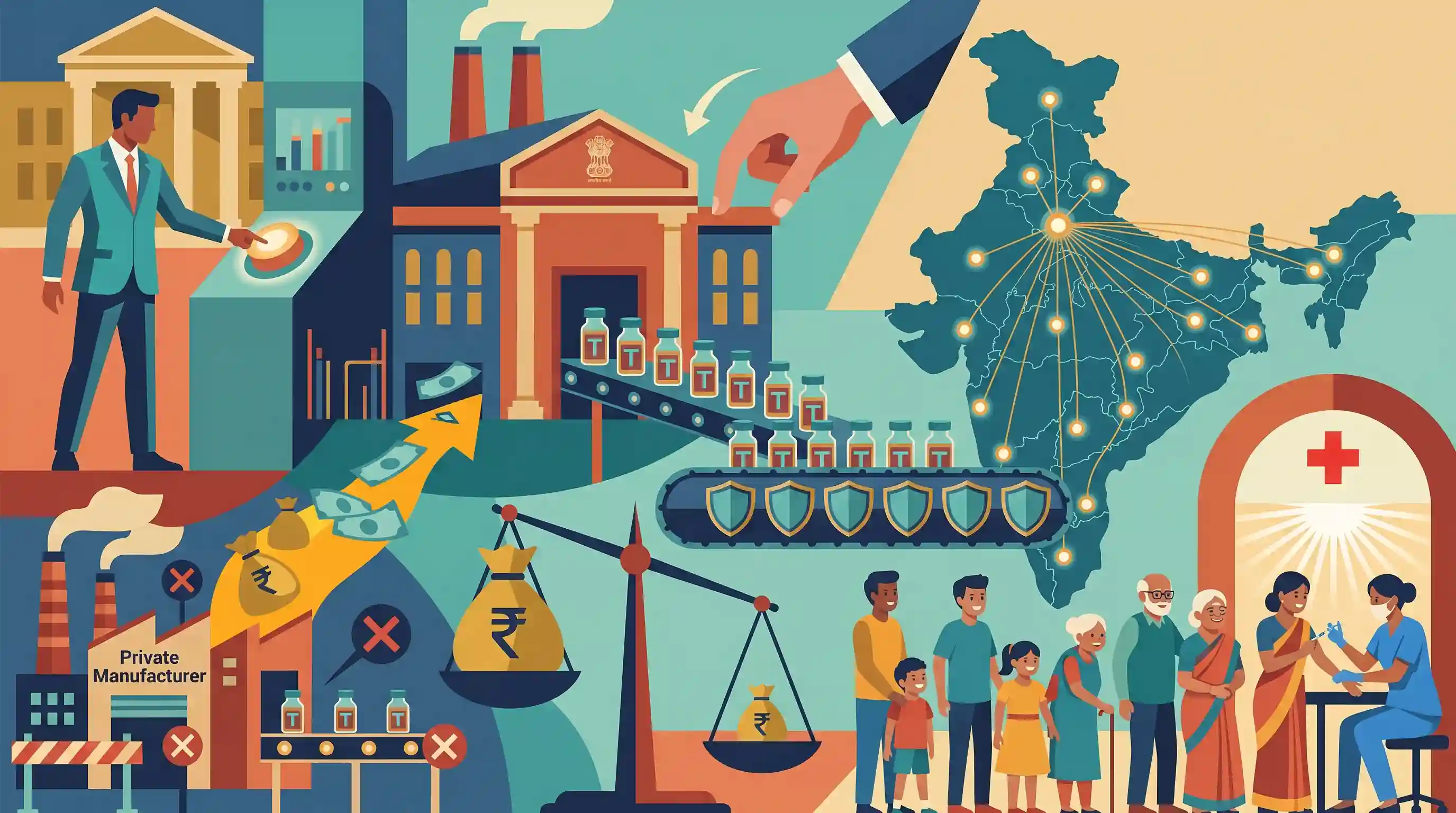
Union Health Minister J.P. Nadda launched a Tetanus and Diphtheria (Td) vaccine manufactured by a government institute. This move is designed to lower the cost of vaccine procurement for India's Universal Immunization Programme (UIP) by reducing dependence on private manufacturers. It highlights the critical role of pharmaceutical Public Sector Undertakings (PSUs) in ensuring vaccine security, maintaining uninterrupted supply chains, and keeping public healthcare affordable and accessible.
Key Points
- Union Health Minister J.P. Nadda launched a Tetanus and Diphtheria (Td) vaccine manufactured indigenously by a government institute.
- The launch signifies a strategic push to utilize pharmaceutical Public Sector Undertakings (PSUs) to manufacture essential vaccines, enhancing self-reliance and vaccine security.
- Producing vaccines in government institutes will significantly lower procurement costs for the government compared to sourcing them from private manufacturers.
- This initiative will ensure uninterrupted supply for the Universal Immunization Programme (UIP) and helps counter the adverse impacts of marketisation in the public healthcare system.
Important Terms
Universal Immunization Programme (UIP)

A flagship health initiative providing free vaccines against 12 life-threatening diseases (e.g., Polio, Measles) to millions of infants and pregnant women annually across India.
UPSC context
GS Paper II: Social Sector/Health; tests knowledge of national public health frameworks and disease elimination targets.
Mission Indradhanush
A health mission designed to achieve 90% immunization coverage by targeting underserved, hard-to-reach areas and children missed by routine vaccination schedules.
UPSC context
GS Paper II: Governance/Health; tests implementation strategies for achieving universal health coverage and inclusive growth.
Public Sector Undertakings (PSUs)
Government-owned enterprises that ensure essential services like healthcare remain affordable, maintaining national security in critical sectors and providing price benchmarking for medicines.
UPSC context
GS Paper III: Economy; tests the role of the state in providing public goods and maintaining pharmaceutical self-reliance.
Tetanus and Diphtheria (Td) vaccine
A combination vaccine replacing Tetanus Toxoid (TT) for booster doses in adolescents and adults to provide additional protection against diphtheria as immunity wanes.
UPSC context
GS Paper III: Science & Technology; relevant for biotechnology and public health immunization schedule updates.
Vaccine Security
A country's ability to maintain a sustainable, affordable, and uninterrupted supply of high-quality vaccines, reducing vulnerability to global supply chain disruptions.
UPSC context
GS Paper II: Governance; critical for discussing Atmanirbhar Bharat and India's role as the 'Pharmacy of the World'.
Ministry of Health and Family Welfare (MoHFW)
The nodal ministry responsible for health policy, including the implementation of the UIP and overseeing the revitalization of government vaccine manufacturing units.
UPSC context
GS Paper II: Governance/Health; tests understanding of the executive structure managing India's public health and social sectors.
Prelims Trap
Under the Universal Immunization Programme, the standalone Tetanus Toxoid (TT) vaccine is administered to pregnant women.
India officially replaced the standalone TT vaccine with the Td (Tetanus and adult Diphtheria) vaccine to combat waning diphtheria immunity while sustaining Maternal and Neonatal Tetanus elimination.
Static Concepts Connected
What are the core differences between routine UIP and Mission Indradhanush?
- Routine UIP: Provides free routine vaccines against 12 vaccine-preventable diseases nationally to all infants, children, and pregnant women.
- Mission Indradhanush: A targeted catch-up campaign specifically designed to fully immunize children and pregnant women who missed or dropped out of their routine UIP doses.
How do Pharmaceutical PSUs ensure India's national health security?
- Pricing Check: They act as a buffer against monopolistic pricing by private pharma, keeping procurement costs artificially low for massive government schemes.
- Supply Continuity: They ensure uninterrupted production of essential but low-profit vaccines, safeguarding national immunization schedules from private market supply chain fluctuations.
Cross-Topic Patterns
Vaccine shifts and MNT Elimination
Shifting from TT to Td in antenatal care sustains India's 2015 Maternal and Neonatal Tetanus elimination while simultaneously targeting adult diphtheria, linking maternal health to broader epidemiological defenses.
Pharma PSUs and TRIPS flexibilities
A robust public sector manufacturing base is functionally required if India ever needs to invoke compulsory licensing under WTO TRIPS to produce patented, life-saving drugs domestically.

Expect a 2026 prelims question contrasting Tetanus (soil-borne, non-communicable) with Diphtheria (airborne) alongside UIP's TT-to-Td shift.
Linked PYQs · 3
Linked PYQs · 3
- 2016PrelimsGS1
'Mission Indradhanush' launched by the Government of India pertains to
- 2024MainsGS2
In a crucial domain like the public healthcare system the Indian State should play a vital role to contain the adverse impact of marketisation of the system. Suggest some measures through which the State can enhance the reach of public healthcare at the grassroots level.
- 2015MainsGS2
Public health system has limitations in providing universal health coverage. Do you think that the private sector could help in bridging the gap? What other viable alternatives would you suggest?
