India health ministry pushes One Health approach for influenza
Source:The Hindu ↗
Why It Matters
Coordinated disease surveillance using a 'One Health' approach is critical for national and global health security. Inter-ministerial convergence helps prevent and manage zoonotic disease outbreaks and seasonal influenza effectively, reflecting the evolving role of public healthcare policies in India.
Summary
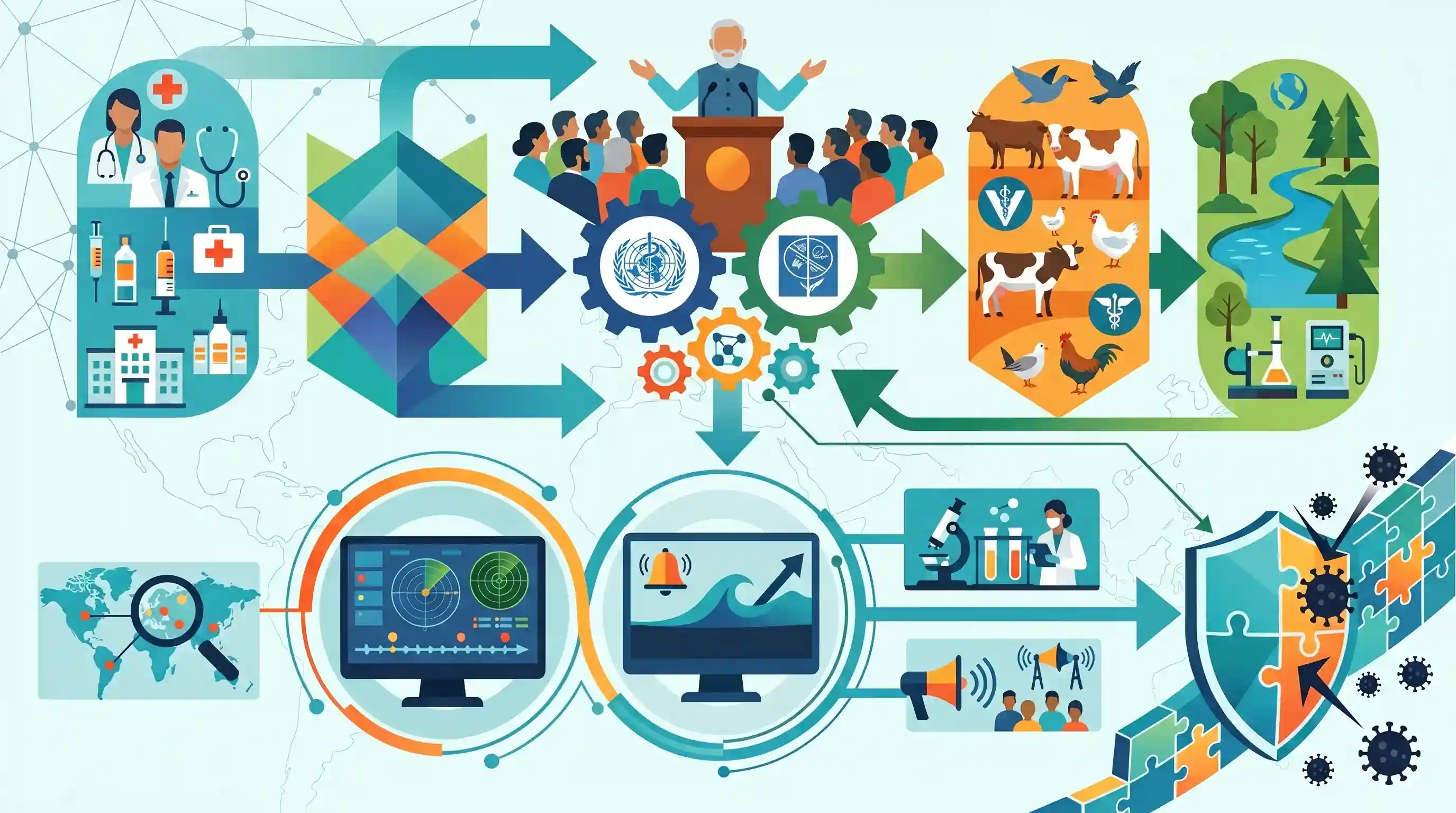
Union Health Minister J.P. Nadda emphasized the necessity of a multi-sectoral approach to enhance India's influenza preparedness at a 'Chintan Shivir' organized by the NCDC and WHO India. He stressed the importance of inter-ministerial convergence across health, animal husbandry, and environmental departments to prevent siloed efforts in disease management. The discussions highlighted the critical role of the Integrated Disease Surveillance Programme (IDSP) for real-time monitoring of seasonal outbreaks. A coordinated strategy focusing on surveillance, early warning, laboratory readiness, and effective risk communication was advocated to build resilience against potential influenza surges.
Key Points
- A two-day 'Chintan Shivir' on influenza preparedness was jointly organized by the National Centre for Disease Control (NCDC) and WHO India to strengthen inter-sectoral convergence.
- Union Health Minister J.P. Nadda emphasized breaking departmental silos and adopting a multi-sectoral approach involving human health, animal husbandry, and environmental sectors for effective disease preparedness.
- The Integrated Disease Surveillance Programme (IDSP) was highlighted as a critical tool for real-time monitoring of seasonal influenza trends across States and UTs.
- The discussions aimed to create actionable preparedness reviews and checklists for early warning, lab readiness (involving ICMR, ICAR, NIV), and risk communication.
Important Terms
National Centre for Disease Control (NCDC)

India's nodal agency for disease surveillance, prevention, and control. Operating under the Ministry of Health, it investigates outbreaks and sets national standards for managing communicable diseases.
UPSC context
GS Paper 2: Health; critical for questions on India's institutional preparedness for pandemics and outbreak management.
Integrated Disease Surveillance Programme (IDSP)
A decentralized, IT-enabled national program launched in 2004 to monitor epidemic-prone diseases. It uses real-time data to provide early warning signals and coordinate rapid response efforts.
UPSC context
GS Paper 2: Governance/Health; tests understanding of technology-led disease monitoring and decentralized healthcare delivery.
One Health Approach
An integrated, multi-sectoral framework recognizing the interdependence of human, animal, and environmental health. It is essential for managing zoonotic diseases like influenza and antimicrobial resistance.
UPSC context
GS Paper 2/3: Health & Environment; relevant for inter-disciplinary governance and emerging zoonotic threats.
WHO India
The Indian country office of the UN's specialized health agency. It provides technical expertise and collaborates with the government on disease eradication and national health strategies.
UPSC context
GS Paper 2: International Institutions; tests India’s engagement with global health bodies in managing domestic public health.
National Institute of Virology (NIV)
India’s premier virology research institute in Pune under ICMR. It serves as a WHO Collaborating Centre and is the national hub for influenza monitoring and virus sequencing.
UPSC context
GS Paper 3: Science & Technology; relevant for specialized research infrastructure and high-risk pathogen handling.
Department of Animal Husbandry and Dairying (DAHD)
Central department responsible for animal health surveillance and livestock productivity. It plays a critical role in the One Health framework by monitoring zoonotic diseases in animals.
UPSC context
GS Paper 2/3: Government Policies; tests inter-ministerial coordination for rural economy and biological disaster prevention.
Indian Council of Medical Research (ICMR)
The apex body for the formulation and promotion of biomedical research in India. It oversees specialized institutes like the NIV and shapes national medical health policy.
UPSC context
GS Paper 2: Health; key for questions on R&D in social sectors and medical innovation governance.
Prelims Trap
The National Centre for Disease Control (NCDC) is an autonomous body operating under the Indian Council of Medical Research (ICMR).
NCDC is an attached office under the Directorate General of Health Services (DGHS), Ministry of Health and Family Welfare, not under ICMR.
Static Concepts Connected
What are the key features of the Integrated Disease Surveillance Programme (IDSP)?
- Origin: Launched in 2004 with World Bank assistance to strengthen disease surveillance for epidemic-prone diseases.
- Structure: A decentralized, state-based surveillance system that operates through surveillance units at Central, State, and District levels.
- Digital tracking: Transitioned to the Integrated Health Information Platform (IHIP) for real-time, GIS-enabled electronic data reporting.
What is the 'One Health' approach?
- Definition: An integrated approach recognizing that the health of humans, domestic and wild animals, and the wider environment are closely linked.
- Zoonoses focus: Crucial for managing zoonotic diseases (e.g., Avian Influenza, Nipah, Rabies) that jump between animals and humans.
- Inter-sectoral convergence: Requires collaboration between ministries of Health, Environment, and Animal Husbandry to prevent siloed outbreak management.
Cross-Topic Patterns
Climate Change and Zoonotic Spillovers
Shifting habitats due to climate change increase human-wildlife contact, elevating the risk of zoonotic spillovers like avian influenza.
One Health tackling Antimicrobial Resistance (AMR)
Inter-ministerial convergence across health, agriculture, and environment is crucial to curb antibiotic misuse in livestock, a major driver of AMR.

Expect a 2026 multi-statement question linking IDSP’s digital transition (IHIP) with the One Health framework for zoonotic surveillance.
Linked PYQs · 3
Linked PYQs · 3
- 2015PrelimsGS1
H1N1 virus is sometimes mentioned in the news with reference to which one of the following diseases?
- 2020MainsGS2
Critically examine the role of WHO in providing global health security during the Covid-19 pandemic.
- 2024MainsGS2
In a crucial domain like the public healthcare system the Indian State should play a vital role to contain the adverse impact of marketisation of the system. Suggest some measures through which the State can enhance the reach of public healthcare at the grassroots level.
