NABARD role in Rajasthan rural infrastructure and agricultural credit
Source:rediff ↗
Why It Matters
This article is directly relevant to the RPSC RAS Prelims and Mains economic syllabus, focusing on institutional rural financing (NABARD, PACS, FPOs, and SHGs), climate-resilient projects (JIVA), and women-centric agricultural initiatives, which are highly tested topics in Rajasthan state services exams.
Summary
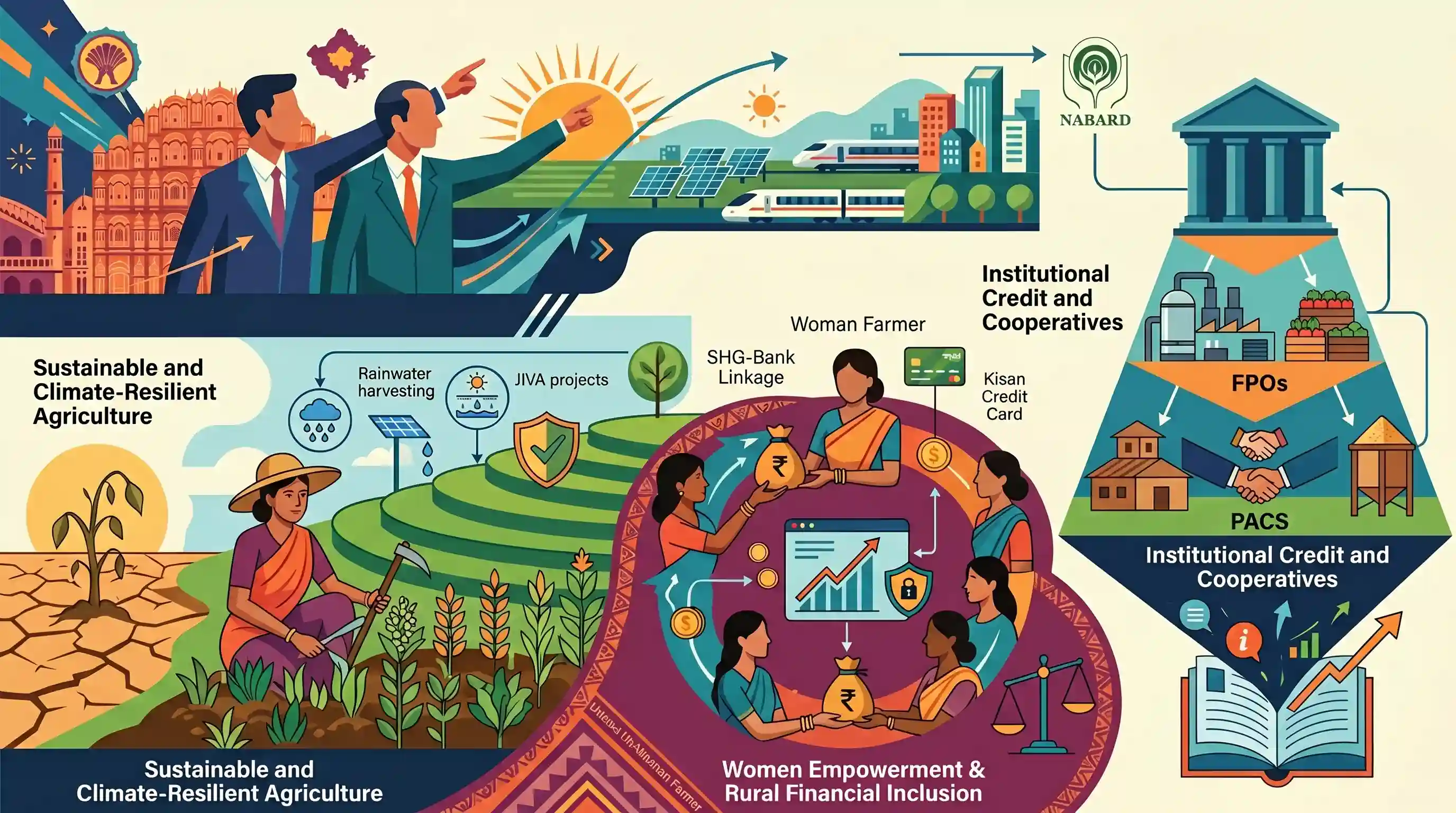
On July 13, 2026, Rajasthan Chief Secretary V Srinivas and NABARD Deputy Managing Director Rakesh Kashyap celebrated NABARD's Foundation Day in Jaipur. The event highlighted NABARD's critical role in rural infrastructure, agricultural growth, and women's empowerment under the vision of a 'Developed Rajasthan by 2047'. Highlighting the UN's designation of 2026 as the 'International Year of the Woman Farmer', officials focused on enhancing rural credit systems through FPOs, PACS, the Kisan Credit Card, and the Self-Help Group-Bank Linkage Programme. The event also featured the launch of key development publications and the sanctioning of two JIVA projects for climate-resilient agriculture.
Key Points
- NABARD celebrated its Foundation Day on July 13, 2026, in Jaipur, emphasizing its role in the state's rural development and agricultural advancement.
- Rajasthan Chief Secretary V Srinivas highlighted NABARD as a vital partner in striving for the developmental goal of a 'Developed Rajasthan by 2047'.
- The United Nations designated 2026 as the 'International Year of the Woman Farmer', highlighting the need to strengthen women's financial inclusion and empowerment in rural regions.
- NABARD Deputy Managing Director Rakesh Kashyap highlighted major supportive programs like the Kisan Credit Card (KCC), Farmers' Clubs, Farmer Producer Organisations (FPOs), and the Self-Help Group-Bank Linkage Programme (SHG-BLP).
- Two publications were released during the event: 'NABARD in Rajasthan - Achievements 2025-26' and 'Transforming Rural Rajasthan' (a success-story compilation).
- Outstanding FPOs, SHGs, PACS, and artisans were honored for their local community impact, and grant sanction letters were distributed for two JIVA projects promoting climate-resilient agriculture.
Important Terms
National Bank for Agriculture and Rural Development (NABARD)

India's apex development bank established in 1982 to promote agricultural growth, rural infrastructure development, financial inclusion, and cooperative credit supervision.
UPSC context
GS Paper III (Indian Economy & Agriculture); tests understanding of rural financial architecture and institutional credit mechanisms.
Kisan Credit Card (KCC)
A credit scheme launched in 1998 providing Indian farmers with a single-window revolving credit facility for crop cultivation, post-harvest needs, and allied agricultural activities.
UPSC context
GS Paper III (Agriculture & Economic Development); tests knowledge of formal rural credit access and financial safety nets for farmers.
Self-Help Group-Bank Linkage Programme (SHG-BLP)
A pioneering microfinance initiative launched by NABARD in 1992 that links informal rural self-help groups, predominantly of women, with formal banks for collateral-free credit.
UPSC context
GS Paper III (Inclusive Growth/Financial Inclusion) and GS Paper II (Social Justice); tests concepts of microfinance and women empowerment.
Primary Agricultural Credit Societies (PACS)
Grassroot-level cooperative credit institutions in India that provide short- and medium-term loans directly to rural borrowers and supply essential farming inputs.
UPSC context
GS Paper III (Agriculture & Cooperatives); tests understanding of the short-term cooperative credit structure and grassroots rural banking.
JIVA Projects
A NABARD agroecology-based initiative aimed at promoting sustainable natural farming, soil health conservation, biodiversity, and climate-resilient agricultural practices in watershed areas.
UPSC context
GS Paper III (Agriculture & Environment); tests understanding of climate-resilient farming systems, natural resource management, and sustainable development.
International Year of the Woman Farmer (2026)
A United Nations-designated year to spotlight the essential but often unrecognized role of women in agrifood systems and promote global actions for gender equality in agriculture.
UPSC context
GS Paper I (Society/Women) and GS Paper III (Agriculture); tests knowledge of gender issues, rural empowerment, and global development initiatives.
Prelims Trap
Kisan Credit Card (KCC) limits can be utilized by farmers to make capital investments, such as purchasing tractors or land.
KCC only covers short-term crop loans, post-harvest expenses, and working capital for asset maintenance. Long-term capital investments require separate agricultural term loans.
Static Concepts Connected
What is the mandate and ownership structure of NABARD?
- Origin & Act: Established in 1982 under the NABARD Act 1981, based on the recommendations of the B. Sivaraman Committee.
- Ownership: It is 100% owned by the Government of India, following the complete divestment of the Reserve Bank of India's stake.
- Core Mandate: Serves as the apex development financial institution for agriculture, cottage industries, and rural infrastructure development.
What is the scope of the Kisan Credit Card scheme?
- Allowed Expenses: Covers short-term crop loans, post-harvest expenses, household consumption, and working capital for maintaining farm assets.
- Exclusions: Excludes long-term capital investments, such as purchasing tractors, purchasing agricultural land, or constructing rural housing.
- Origin: Introduced in 1998 based on the recommendations of the R.V. Gupta Committee to simplify credit access.
Cross-Topic Patterns
Gender-budgeting + Rural credit systems
UN's 2026 Year of the Woman Farmer highlights the need to integrate gender-disaggregated data in SHG-BLP and land tenure rights to maximize priority sector lending.
Agroecology + Climate finance channels
NABARD's JIVA program demonstrates how traditional watershed and wadi development projects can be financially repurposed into climate-resilient natural farming systems without creating new debt burdens.

With 2026 declared as the Year of the Woman Farmer, expect a UPSC question combining SHG-BLP mechanisms with KCC credit limits.
Linked PYQs · 3
Linked PYQs · 3
- 2018RPSC_PRELIMSGS1
The program (MPoWR) implemented to reduce poverty in western Rajasthan is supported by?
- 2013RPSC_PRELIMSGS1
Match the following – Agricultural Development Program Objective 1. National Food Security Mission (i) Focusing on small and marginal farmers to increase agricultural income by adopting potential agriculture 2. National Agricultural Development Plan (ii) Increasing the production of rice, wheat and pulses 3. National Mission for Sustainable Agriculture (iii) Increasing public investment in agriculture 4. Rainfed Area Development Plan (iv) Transforming Indian agriculture into a climate-resilient production system Code:
- 2023RPSC_PRELIMSGS1
The Rajasthan State Highway Development Program-II project, which includes the upgrading of 11 highways with a length of 801 km, is financed by which agency?
