Mysterious space debris washes ashore on Australian beach
Source:Indian Express ↗
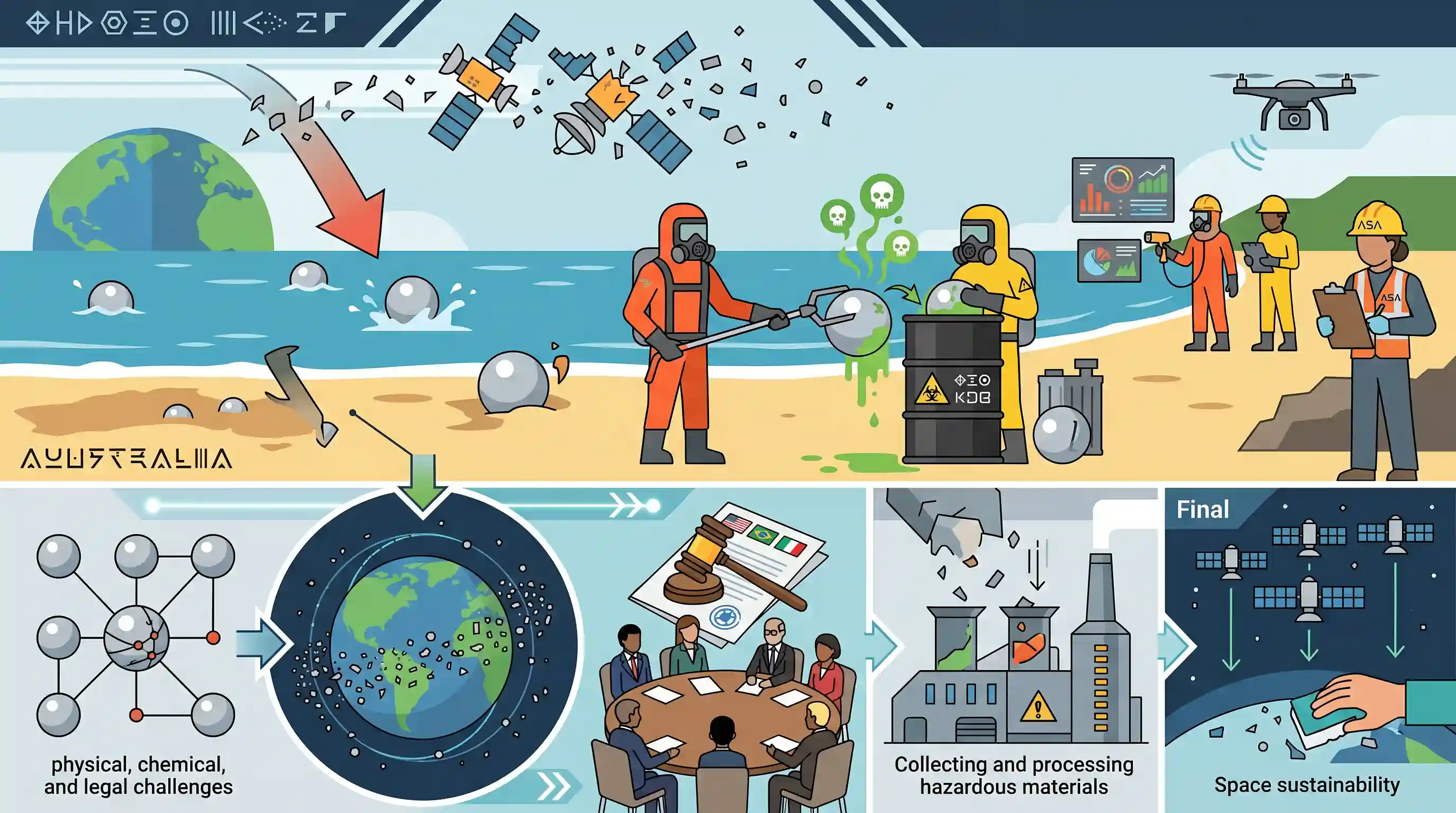
Why It Matters
This incident highlights the tangible physical and chemical hazards that space debris poses upon uncontrolled re-entry. For the UPSC CSE, it serves as a practical case study for international space treaties (like the Liability Convention 1972), space debris mitigation (such as ISRO's Project NETRA), and the legal boundaries of global space governance.
Summary
In July 2026, several mysterious silver spheres, suspected to be rocket or satellite debris, washed up on Forrest Beach in North Queensland, Australia. Due to concerns that the 'space balls' (likely titanium pressure vessels) might contain toxic propellant residues such as hydrazine, local emergency crews secured them in protective drums. The Australian Space Agency is currently investigating the debris to determine its origin. The incident underscores the physical, chemical, and international legal challenges associated with uncontrolled space debris re-entry.
Key Points
- Six large silver spherical objects (suspected rocket pressure vessels or fuel tanks, often referred to as 'space balls') washed up on Forrest Beach in north Queensland, Australia.
- The Queensland Fire Department established a 50-meter public exclusion zone and deployed specialist scientific teams in hazardous-materials gear to secure five of the objects inside drums, citing concerns over potentially toxic chemical residues like hydrazine propellant.
- The Australian Space Agency (ASA), in coordination with national emergency authorities, has launched an investigation to identify the launching nation and origin of the debris.
- The incident highlights the growing risks of uncontrolled space debris re-entry, where durable components (like titanium pressure vessels) survive atmospheric friction and land on habitable shores.
Important Terms
Outer Space Treaty 1967

A foundational international treaty regulating outer space, prohibiting national sovereignty claims and the deployment of weapons of mass destruction while ensuring peaceful exploration.
UPSC context
GS Paper II & III. Crucial for understanding global space governance, space militarization, and sustainable outer space practices.
Liability Convention 1972
An international treaty making launching states absolutely liable to pay compensation for damage caused by their space objects on Earth's surface or to aircraft.
UPSC context
GS Paper II & III. Highly relevant for space debris accidents, international disputes, and state liability for launch failures.
Rescue Agreement 1968
An international agreement mandating states to provide assistance to spacecraft personnel in distress and to safely return recovered space objects to their launching authority.
UPSC context
GS Paper II & III. Tested in international space law, disaster response, and legal duties regarding foreign space assets.
Space Debris
Non-functional, man-made objects in orbit or re-entering Earth's atmosphere, including defunct satellites, rocket stages, and collision fragments that endanger active missions.
UPSC context
GS Paper III (S&T). Critical for space sustainability questions, national debris tracking (Project NETRA), and orbital environmental security.
Australian Space Agency
The national agency of Australia responsible for regulating civil space activities, managing space sector growth, and collaborating on transboundary space debris retrieval.
UPSC context
GS Paper II. Relevant for bilateral space cooperation (such as handling PSLV debris) and joint tracking under space treaties.
Indian Space Research Organisation
India's premier space agency under the Department of Space, which designs, launches, and operates satellites, rocket stages, and deep-space missions.
UPSC context
GS Paper III. Essential for studying Indian space missions, technological milestones, and international liabilities for space debris.
Prelims Trap
The 1972 UN Liability Convention imposes absolute liability on launching states for any damage caused to other assets in outer space.
Under the 1972 Convention, liability for damage in outer space (e.g., satellite-to-satellite collisions) is fault-based, whereas absolute liability applies only to damages on Earth or to aircraft.
Static Concepts Connected
What are the dual liability standards under the 1972 UN Space Liability Convention?
- Absolute Liability: Launching states face absolute liability for any damage caused by their space objects on Earth's surface or to aircraft in flight.
- Fault-based Liability: For damage caused elsewhere, such as in outer space to another state's satellite, liability is determined solely on a fault basis.
- State Responsibility: Launching states bear international responsibility for all national space activities, whether conducted by government agencies or private commercial entities.
What is ISRO's Project NETRA and its operational mandate?
- Debris Tracking: It is India's indigenous Space Situational Awareness (SSA) system built to detect, track, and catalog space debris.
- Detection Limit: Designed to track objects as small as 10 cm in Low Earth Orbit (LEO) up to a range of 3,400 km.
- Geostationary Goal: The ultimate objective is to scale capabilities to safeguard assets located in the Geostationary Orbit (GEO) at 36,000 km.
Cross-Topic Patterns
Debris Sustainability vs Non-binding Accords
Voluntary guidelines like COPUOS struggle to prevent space debris creation, highlighting the tension between soft international laws and physical hazards washing up on sovereign coastlines.
Chemical Hazards vs Green Propulsion
The hazard of recovering corrosive hydrazine vessels highlights the urgency for green space technology, such as ISRO's HAN-based less-toxic propellant formulation.

The 1972 Liability Convention's dual-liability standards and ISRO's Project NETRA are highly likely to feature in a 2026 MCQ on space.
Linked PYQs · 2
Linked PYQs · 2
- 2014MainsGS3
International civil aviation laws provide all countries complete and exclusive sovereignty over the airspace above their territory. What do you understand by 'airspace'? What are the implications of these laws on the space above this airspace? Discuss the challenges which this poses and suggest ways to contain the threat.
- 2016MainsGS3
Discuss India's achievements in the field of Space Science and Technology. How the application of this technology has helped India in its socio-economic development?
