Myanmar military elections pose strategic dilemma for India
Source:The Hindu ↗
Why It Matters
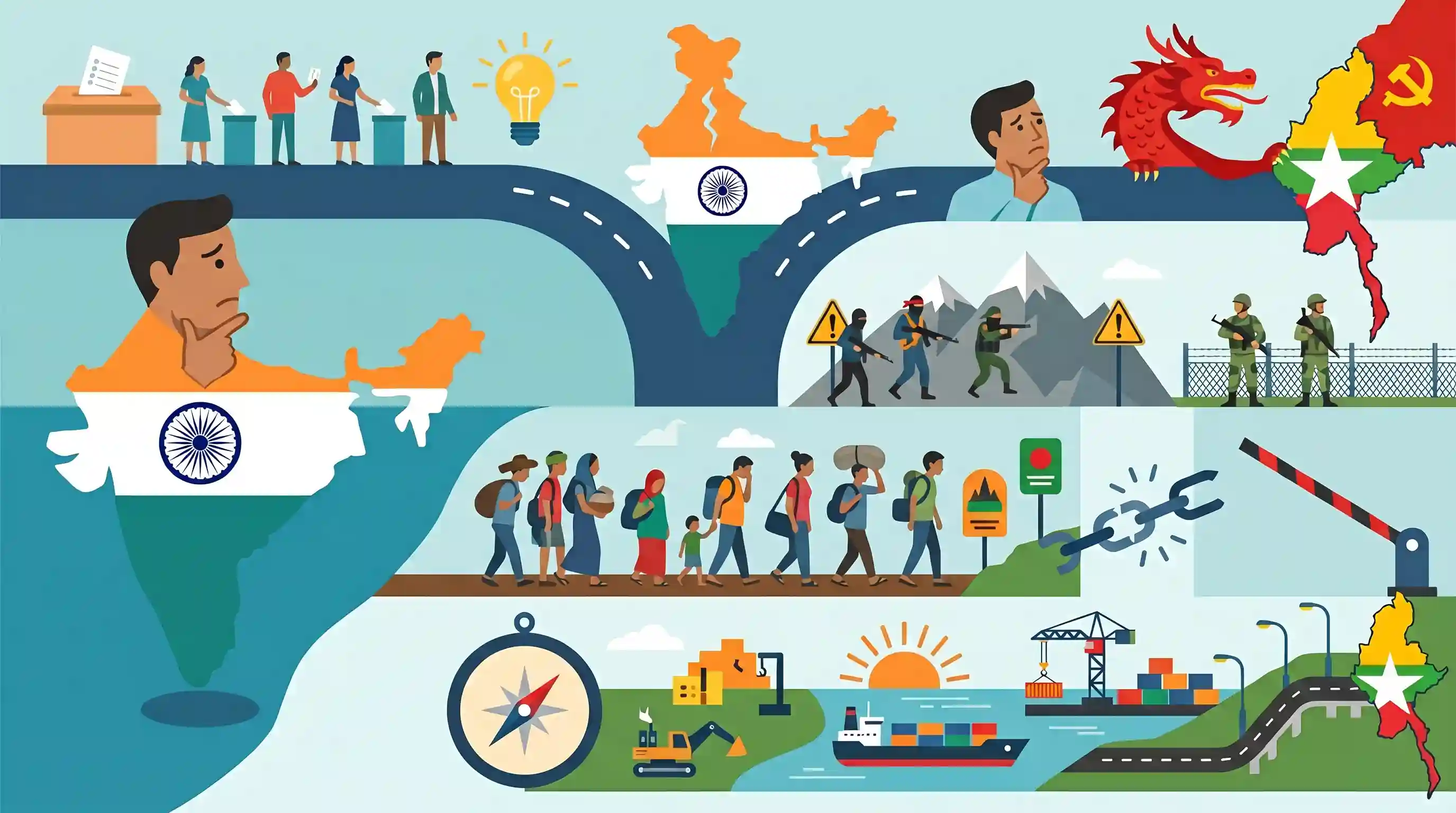
Myanmar acts as a land bridge to Southeast Asia and is critical for the stability of India's Northeast. The crisis tests India's 'Neighbourhood First' policy and its ability to balance democratic values with realpolitik to check Chinese influence and secure its borders.
Summary
The article examines India's strategic dilemma in responding to Myanmar's upcoming military-scripted elections. As the Tatmadaw attempts to legitimize its rule through a heavily controlled electoral process, New Delhi is forced to navigate a complex path between upholding democratic ideals and securing vital national interests. A complete disengagement from the junta risks driving Myanmar deeper into China's sphere of influence. Moreover, India relies on cooperation with Myanmar's authorities to manage border security challenges in the Northeast, including cross-border insurgency, ethnic refugee influxes into states like Manipur and Mizoram, and the suspension of the Free Movement Regime. Pragmatic engagement is also necessary to protect and advance key connectivity initiatives like the Kaladan project under India's Act East Policy.
Key Points
- Myanmar's military junta (Tatmadaw) is organizing scripted elections to secure domestic and international legitimacy after the 2021 coup.
- India faces a strategic bind, balancing its historical support for democracy against pragmatic geopolitical necessity.
- Alienating the junta could push Myanmar further into China's strategic orbit, which India seeks to avoid.
- Engagement with Myanmar's ruling authorities remains essential for India to counter cross-border insurgency, control illegal migration and refugee influx into the Northeast, and combat drug smuggling.
- Progress on critical connectivity infrastructure, like the Kaladan project, hinges on stability and cooperation from Naypyidaw.
Important Terms
Act East Policy (AEP)

Launched in 2014, it is a proactive strategy to strengthen economic, cultural, and strategic ties with Southeast Asia and the wider Indo-Pacific, focusing on connectivity through Northeast India.
UPSC context
GS Paper II: International Relations — regional groupings and connectivity-led development involving India.
Kaladan Multi-Modal Transit Transport Project
A project connecting Kolkata port with Sittwe port (Myanmar), then via the Kaladan river to Paletwa and road to Mizoram, bypassing the narrow Siliguri Corridor.
UPSC context
GS Paper III: Internal Security — infrastructure as a tool for border management and Northeast development.
Free Movement Regime (FMR)
A bilateral arrangement allowing tribes living within 16 km of the India-Myanmar border to cross without a visa; officially suspended by India in 2024 for security reasons.
UPSC context
GS Paper III: Border management — tests knowledge of cross-border ethnic ties and internal security threats.
Tatmadaw
The official name of Myanmar's armed forces, which has wielded significant political power since 1948 and currently governs the country following the 2021 coup.
UPSC context
GS Paper II: Neighborhood relations — impacts of political instability in adjacent states on India's interests.
Neighbourhood First Policy
India’s diplomatic priority of building stable, mutually beneficial relations with its immediate neighbours through physical, digital, and people-to-people connectivity.
UPSC context
GS Paper II: Foreign policy — India's strategic imperatives to maintain regional leadership and stability.
India-Myanmar-Thailand (IMT) Trilateral Highway
A 1,360 km under-construction highway connecting Moreh (India) to Mae Sot (Thailand) via Myanmar, aimed at enhancing land-based trade with ASEAN.
UPSC context
GS Paper II: International Relations — regional connectivity initiatives and economic diplomacy.
Prelims Trap
The Kaladan Multi-Modal project aims to connect Kolkata to Sittwe port, ultimately linking to the landlocked state of Manipur.
It links to Mizoram, not Manipur. UPSC frequently swaps Northeastern states in regional connectivity questions to test geographical precision.
Static Concepts Connected
What is the Free Movement Regime (FMR) on the India-Myanmar border?
- Historical Context: Formalized in 2018 to allow hill tribes along the border to travel up to 16 km visa-free, fostering people-to-people ties.
- Security Concerns: Exploited by insurgents for safe havens and by cartels trafficking narcotics from the Golden Triangle.
- Current Status: Suspended by the Indian government in 2024 to initiate advanced smart-fencing across the 1,643 km border and curb illegal migration.
What is the geographical routing of the Kaladan Multi-Modal Transit Transport Project?
- Maritime Leg: Connects the Kolkata seaport to the Sittwe seaport in Myanmar's Rakhine state via the Bay of Bengal.
- Inland Waterway: Travels up the Kaladan River from Sittwe port to the inland river terminal at Paletwa.
- Road Leg: Connects Paletwa to Zorinpui at the India-Myanmar border, eventually terminating in the Indian state of Mizoram.
Cross-Topic Patterns
Ethnic overlaps & internal security
The Kuki-Chin-Zo ethnic contiguity across the porous border links Myanmar's civil war directly to demographic anxieties and internal security crises in Manipur and Mizoram.
Golden Triangle & insurgent financing
Myanmar's instability strengthens the Golden Triangle's illicit drug economy, which acts as a primary funding mechanism for insurgent outfits operating in India's Northeast.

Mapping Kaladan and IMT Highway to their terminating NE states (Mizoram vs Manipur) paired with FMR suspension is highly likely in 2026.
Linked PYQs · 2
Linked PYQs · 2
- 2019MainsGS3
Cross-border movement of insurgents is only one of the several security challenges facing the policing of the border in North-East India. Examine the various challenges currently emanating across the India-Myanmar border. Also, discuss the steps to counter the challenges.
- 2014MainsGS3
How does illegal transborder migration pose a threat to India's security? Discuss the strategies to curb this, bringing out the factors which give impetus to such migration.
