Myanmar Rohingya Repatriation Verification and Regional Security
Source:The Hindu ↗
આ શા માટે મહત્વનું છે
The instability in Myanmar, the displacement of the Rohingya, and the dominance of ethnic armed groups like the Arakan Army directly impact regional security in South/Southeast Asia and have major security and humanitarian implications for India's border management in the Northeast.
સારાંશ
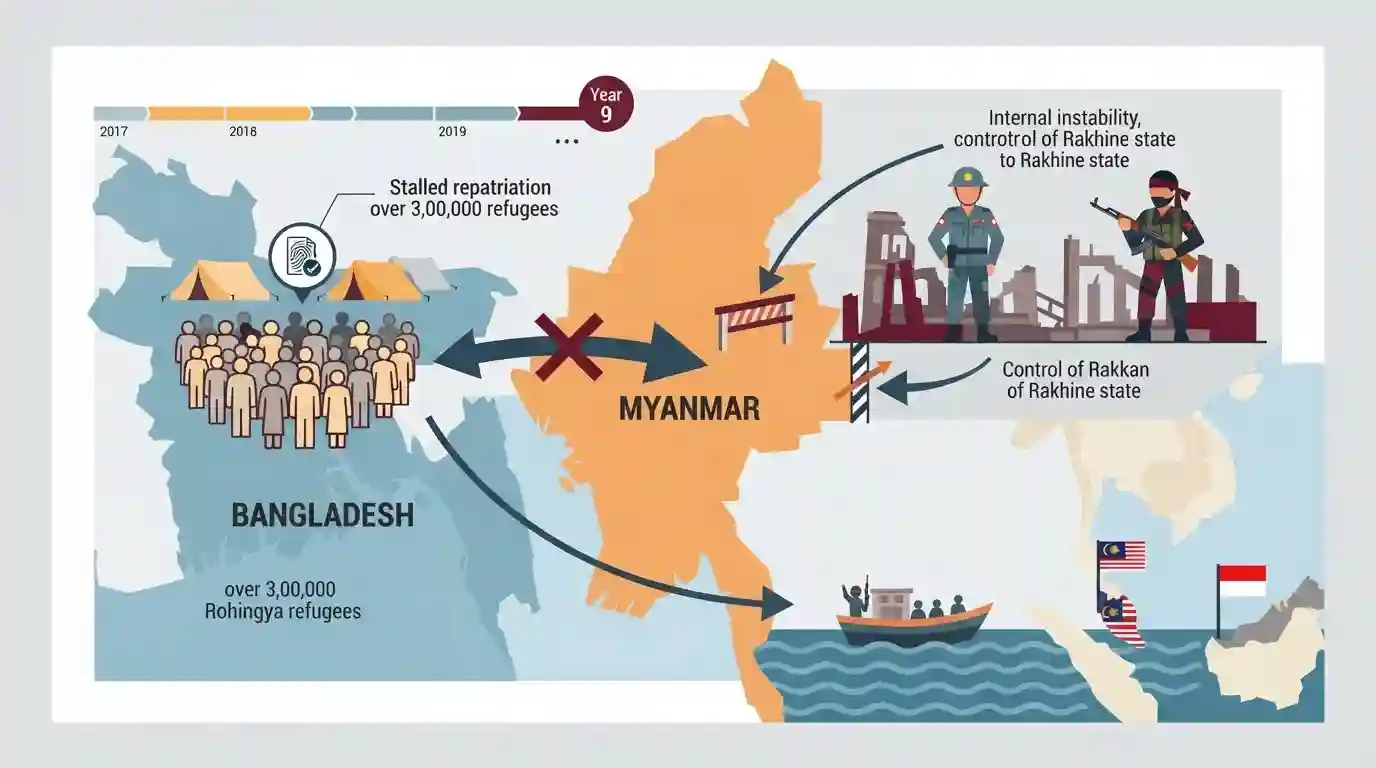
Myanmar's military-backed government has announced that over 3,00,000 Rohingya refugees in Bangladesh have been verified as former residents of Rakhine state and will be accepted for repatriation when security stabilizes. As the Rohingya crisis enters its ninth year (following the 2017 military crackdown), repatriation remains stalled due to Myanmar's internal instability. The situation has been exacerbated by the February 2021 military coup and severe fighting with the ethnic Arakan Army, which now controls much of Rakhine state. Desperate conditions have also driven refugees to attempt perilous sea voyages to Malaysia and Indonesia.
મુખ્ય મુદ્દા
- Myanmar\'s military-backed government has verified 3,08,797 Rohingya refugees (out of 4,26,545 verified from a list of 8,28,824 provided by Bangladesh) as former residents of Rakhine state, stating they will be accepted for repatriation once security conditions stabilize.
- The Rohingya refugee crisis enters its ninth year (since the August 2017 military crackdown), with hundreds of thousands of refugees still residing in temporary camps in Bangladesh.
- Myanmar officially refuses to recognize the Rohingya as one of its 135 lawful ethnic minorities, classifying them as 'Bengalis' to denote them as illegal immigrants from Bangladesh.
- Repatriation efforts have stalled repeatedly since a bilateral agreement in 2018, primarily due to the February 2021 military coup and the outbreak of heavy fighting in 2023 between the military and the ethnic insurgent group Arakan Army, which now controls a large portion of Rakhine state.
- Deteriorating camp conditions, lack of foreign aid, and insecurity have driven many refugees to seek dangerous maritime migration paths to Malaysia and Indonesia.
મહત્વપૂર્ણ શબ્દો
Arakan Army

An ethnic armed organization in Myanmar's Rakhine State fighting for self-determination, which currently controls substantial territory bordering India, impacting regional security.
UPSC context
GS Paper II & III (Neighborhood Relations / Internal Security). Tests regional stability impacts.
Principle of Non-Refoulement
A cornerstone principle of international customary law forbidding nations from expelling or returning asylum seekers or refugees to territories where they face serious persecution.
UPSC context
GS Paper II (International Relations). Tests understanding of global refugee rights.
1951 Refugee Convention
A key United Nations multilateral treaty defining who is a refugee, establishing their fundamental rights, and outlining the legal obligations of signatory states.
UPSC context
GS Paper II (International Relations). Tests knowledge of international humanitarian frameworks.
Foreigners Act, 1946
The primary Indian legislation regulating the entry, stay, and deportation of foreign nationals. It lacks a distinct definition or special status for refugees.
UPSC context
GS Paper II & III (Polity / Internal Security). Tests citizenship and migration regulations.
પ્રિલિમ્સ ટ્રેપ
India is a signatory to the 1951 UN Refugee Convention and therefore cannot deport Rohingya refugees.
India is NOT a signatory to the 1951 Convention or the 1967 Protocol. It treats refugees under the Foreigners Act, 1946, though the principle of non-refoulement applies as customary international law.
સંલગ્ન સ્થિર ખ્યાલો
How does India govern refugees without a dedicated national refugee law?
- Foreigners Act: Treats refugees as undocumented "foreigners" or "illegal migrants" under the Foreigners Act, 1946 and the Passport Act, 1920.
- Ad-hoc policies: Different refugee groups (Tibetans, Sri Lankan Tamils, Rohingya) are managed case-by-case via executive and administrative orders.
- Non-refoulement: Indian courts have interpreted Article 21 (Right to Life) to include non-refoulement, preventing deportation if a person's life is directly threatened.
What is the strategic significance of the Kaladan Multi-Modal Project?
- Connectivity route: Links Kolkata port to Sittwe port (Rakhine State, Myanmar), then via the Kaladan river and road to Mizoram.
- Siliguri bypass: Provides a crucial alternate access route to Northeast India, reducing reliance on the vulnerable Siliguri Corridor.
- Security risks: Its viability is heavily dependent on stability in Rakhine state, which is currently disrupted by the Arakan Army's insurgency against the Junta.
આંતર-વિષય પેટર્ન
Indo-Myanmar Border FMR suspension
The refugee influx and Myanmar's internal conflict pushed India to scrap the Free Movement Regime (FMR) and initiate border fencing, severely impacting cross-border tribal affiliations in Manipur and Mizoram.
Bay of Bengal smuggling routes
Perilous Rohingya sea migrations link human trafficking networks to the oceanography of the Andaman Sea, increasing maritime security burdens for India and ASEAN nations like Malaysia and Indonesia.

Mapping insurgent groups (Arakan Army, Chin National Army) to Myanmar, paired with India’s non-signatory status to 1951 Refugee Convention.
સંલગ્ન PYQ · 1
સંલગ્ન PYQ · 1
- 2019MainsGS3
Cross-border movement of insurgents is only one of the several security challenges facing the policing of the border in North-East India. Examine the various challenges currently emanating across the India-Myanmar border. Also, discuss the steps to counter the challenges.
