India Emphasizes Free and Fair Elections in Myanmar
Source:The Hindu ↗
Why It Matters
Myanmar is strategically vital to India's Act East and Neighborhood First policies. The ongoing political instability, civil war, and democratic backsliding directly impact India's regional geopolitical leverage and internal security, particularly in the North-Eastern states that share a porous border with Myanmar.
Summary
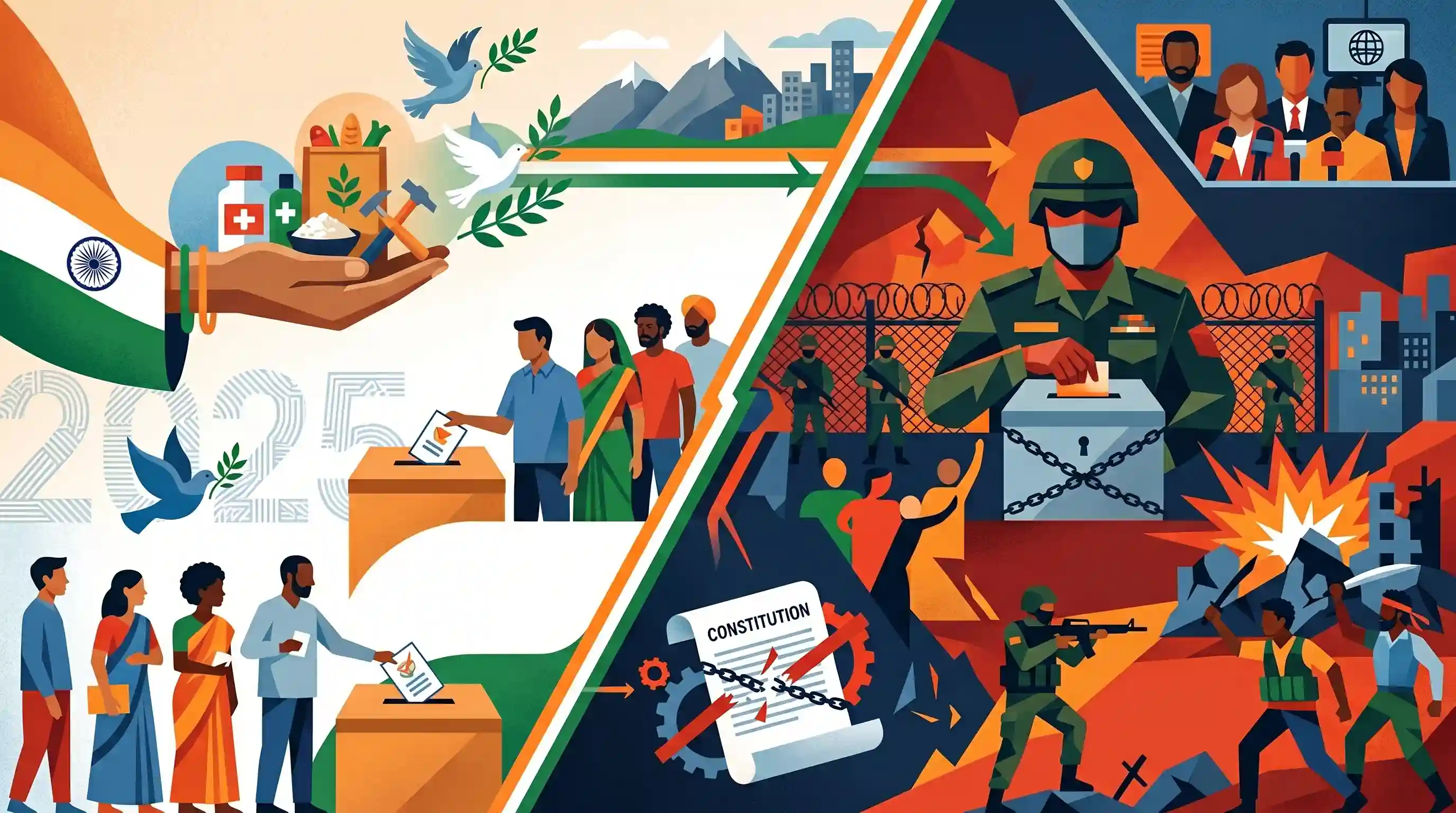
India has stated that Myanmar's upcoming 2025 elections must be "free, fair, and inclusive", stressing that the participation of all political stakeholders is essential for credible polls. The Ministry of External Affairs reaffirmed India's commitment to Myanmar's democratic transition and peaceful dialogue, alongside continuing developmental and humanitarian assistance. Conversely, exiled pro-democracy groups and independent news outlets like Mizzima have criticized the elections as a "sham." They argue that the military junta exercises absolute control over the process amid escalating civil conflict with Ethnic Armed Organisations (EAOs), rendering a legitimate electoral process impossible and violating the 2008 Constitution.
Key Points
- India advocated for "free, fair and inclusive" elections in Myanmar, emphasizing the need for the participation of all political stakeholders.
- The MEA reaffirmed India's support for Myanmar's democratic transition, peace, and dialogue.
- India continues to provide humanitarian aid and developmental assistance to Myanmar, such as relief during the March 2025 earthquake.
- Exiled pro-democracy groups and independent media term the upcoming elections a "sham" designed to legitimize the military junta's regime.
- Myanmar faces intense civil war and instability due to ongoing clashes between the military junta and various Ethnic Armed Organisations (EAOs).
Important Terms
2008 Constitution

Myanmar’s governing document that reserves 25% of parliamentary seats for the military and ensures its control over key ministries like Defense and Home Affairs.
UPSC context
GS Paper II: International Relations and Comparative Constitutions. Tests understanding of structural barriers to democracy in India's neighborhood.
Ethnic Armed Organisations (EAOs)
Non-state armed groups representing various ethnic minorities in Myanmar that have fought for autonomy and federalism for decades, currently opposing the military junta.
UPSC context
GS Paper III: Internal Security. Crucial for understanding border management, insurgency, and regional stability affecting India’s Northeast.
Ministry of External Affairs (MEA)
The Indian government department managing foreign relations. It formally called for "free, fair, and inclusive" 2025 elections in Myanmar to ensure stability.
UPSC context
GS Paper II: International Relations. Represents India's official diplomatic posture and its 'Neighborhood First' policy implementation.
Mizzima
An influential independent Myanmar news organization, operating in exile, known for reporting on pro-democracy movements and the civil conflict against the military regime.
UPSC context
GS Paper II: International Relations. Relevant for understanding the role of exiled civil society and media in monitoring democratic transitions.
Shan and Nationalities Democratic Party (SNDP)
An ethnic political party in Myanmar, colloquially known as the "White Tiger Party," representing Shan interests and participating in the military-led 2025 electoral process.
UPSC context
GS Paper II: International Relations. Tests knowledge of diverse political stakeholders and the fragmentation of opposition in Myanmar's politics.
Prelims Trap
The Kaladan Multi-Modal project connects Kolkata port directly to Manipur via Myanmar's Sittwe port.
It connects Kolkata to Mizoram, not Manipur. Aspirants frequently mix up the terminal North-Eastern state for major Act East connectivity projects.
Static Concepts Connected
What are the key geographical nodes of the Kaladan Multi-Modal Project?
- Sea Route: Connects Kolkata port to Sittwe port in the Rakhine state of Myanmar across the Bay of Bengal.
- Inland Waterway: Runs from Sittwe port to Paletwa along the Kaladan river in Myanmar.
- Road Route: Connects Paletwa in Myanmar to Zorinpui at the Mizoram border in India via a highway.
What was the Free Movement Regime (FMR) along the Indo-Myanmar border?
- Core Provision: Allowed hill tribes on either side to travel up to 16 km across the border without a visa.
- Border Geography: Applied to the highly porous 1,643 km border spanning Arunachal Pradesh, Nagaland, Manipur, and Mizoram.
- Recent Abolition: Recently scrapped by India to initiate fencing and curb insurgent cross-border movements, narcotic smuggling, and demographic spillover.
Cross-Topic Patterns
Dual-track diplomacy meets border security
India's normative push for democracy is heavily constrained by internal security needs in Manipur and Mizoram, forcing pragmatic engagement with the military junta and ethnic groups to manage the border.
CMEC expansion vs. Stalled Act East
While India's Kaladan project halts due to Arakan Army dominance in Rakhine, China leverages the instability to advance the China-Myanmar Economic Corridor, altering regional balance.

Expect a mixed geography-security question in 2026 mapping Myanmar's EAO-controlled states (Rakhine/Chin) to India's border states.
Linked PYQs · 2
Linked PYQs · 2
- 2019MainsGS3
Cross-border movement of insurgents is only one of the several security challenges facing the policing of the border in North-East India. Examine the various challenges currently emanating across the India-Myanmar border. Also, discuss the steps to counter the challenges.
- 2020MainsGS3
Analyze internal security threats and transborder crimes along Myanmar, Bangladesh and Pakistan borders including Line of Control (LoC). Also discuss the role played by various security forces in this regard.
