India Humanitarian Assistance and Disaster Relief in Myanmar
Source:Indian Express ↗
Why It Matters
The article highlights the intersection of disaster management and foreign policy, showing how India uses humanitarian aid strategically to maintain influence and manage border security challenges in a politically unstable neighboring country. This is highly relevant for GS2 (International Relations) and GS3 (Disaster Management).
Summary
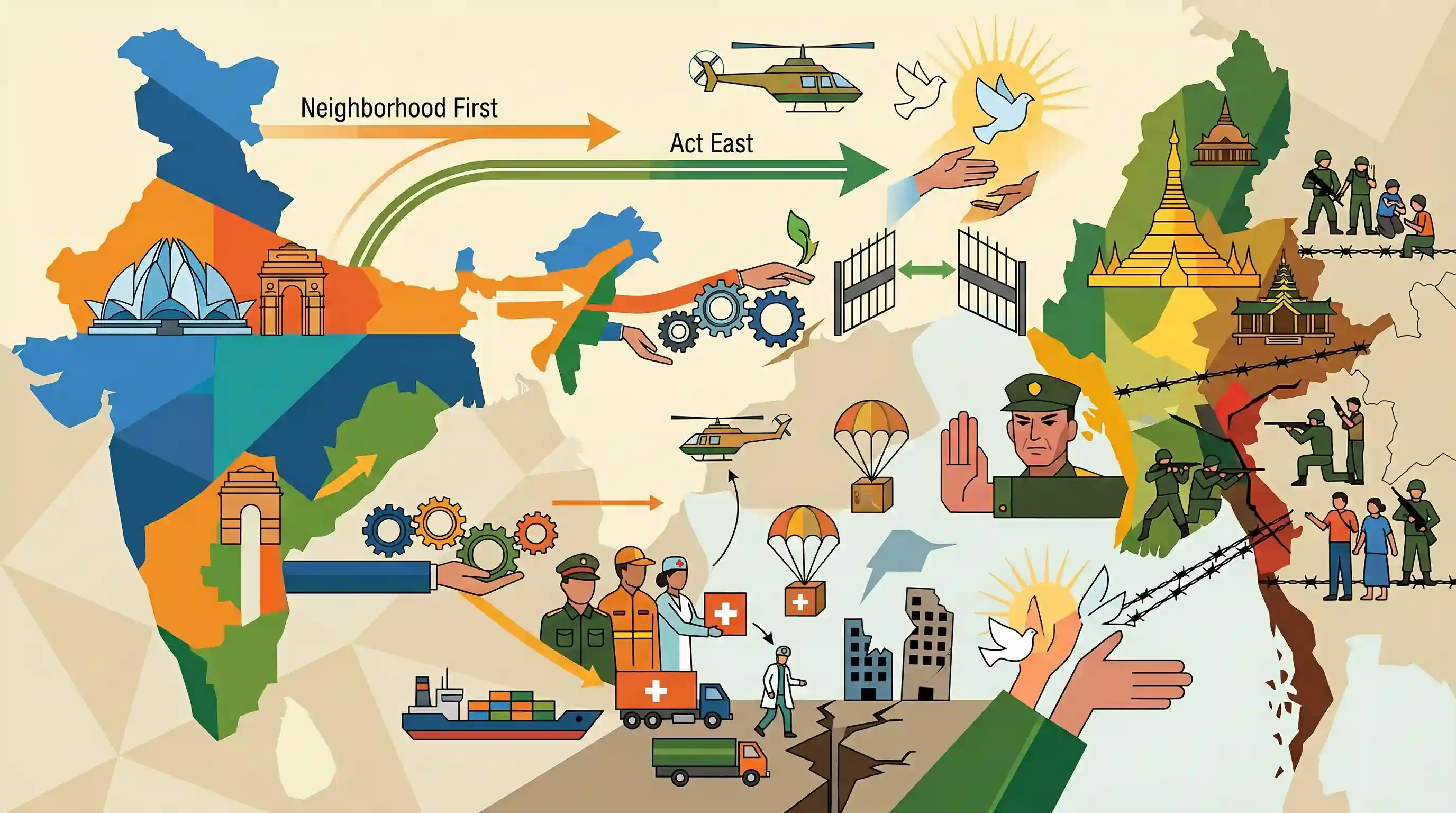
The article examines the strategic dimensions, possibilities, and limitations of India's humanitarian assistance and disaster relief (HADR) efforts in Myanmar following a recent earthquake. Operating within the frameworks of the Neighborhood First and Act East policies, India leverages humanitarian aid to project soft power, build goodwill, and stabilize its borders. However, delivering aid is complicated by Myanmar's internal political crises, civil conflict, and the ruling military junta, which constrain the long-term impact of India's humanitarian diplomacy in the region.
Key Points
- India utilizes Humanitarian Assistance and Disaster Relief (HADR) as a crucial diplomatic tool within its Neighborhood First and Act East policies.
- Providing humanitarian aid to Myanmar involves navigating the complexities of its ongoing internal conflicts and the military junta.
- HADR operations allow India to build strategic goodwill, maintain regional influence, and address security concerns along its porous borders.
- The effectiveness of India's humanitarianism in Myanmar is constrained by the prevailing political instability and civil strife, limiting long-term developmental impact.
Important Terms
Act East Policy

India's proactive strategy to deepen economic, strategic, and cultural ties with Southeast Asia and the Indo-Pacific, focusing on connectivity, commerce, and security (4 Cs) to bolster regional influence.
UPSC context
GS Paper II (IR); tests India's strategic shift from intent to implementation and connectivity via the Northeast to ASEAN.
Neighborhood First Policy
A diplomatic doctrine prioritizing relations with immediate neighbors to ensure regional stability, prosperity, and security through consultative, non-reciprocal engagement and improved physical and digital connectivity.
UPSC context
GS Paper II (IR); crucial for understanding bilateral ties and countering external regional influences.
Military Junta
A government led by a committee of military leaders. In Myanmar, the 'Tatmadaw' junta seized power in 2021, displacing the elected civilian government and causing regional instability.
UPSC context
GS Paper II (IR); represents the strategic dilemma between democratic values and national security interests in neighbor relations.
Humanitarian Assistance and Disaster Relief (HADR)
Coordinated civil-military operations to provide rapid relief (food, medicine, search-and-rescue) during natural or man-made disasters, often serving as a tool for international 'disaster diplomacy.'
UPSC context
GS Paper II (IR) and GS III (Disaster Management); tests India's role as a 'net security provider.'
Soft Power
The ability of a nation to influence others through attraction and persuasion—using culture, political values, and humanitarian aid—rather than military or economic coercion.
UPSC context
GS Paper II (IR); relevant for discussing India's global image and humanitarian diplomacy.
Prelims Trap
"Myanmar is a member state of SAARC and shares a land border with Tripura."
Myanmar is an ASEAN and BIMSTEC member, not SAARC. Also, it borders Arunachal Pradesh, Nagaland, Manipur, and Mizoram. Tripura borders Bangladesh.
Static Concepts Connected
Which Indian states share a land border with Myanmar?
- Arunachal Pradesh: Forms the northernmost part of the 1,643 km boundary, heavily militarized due to its proximity to China.
- Nagaland & Manipur: Central border states severely affected by cross-border insurgencies, drug trafficking, and ethnic kinships (e.g., Kuki-Zo).
- Mizoram: Shares the southernmost land border and has seen a massive influx of refugees fleeing the Myanmar military junta.
What are India's recent major HADR operations in the extended neighborhood?
- Operation Karuna (2023): Deployed Indian Naval ships to provide emergency humanitarian assistance to Myanmar following Cyclone Mocha.
- Operation Dost (2023): Search, rescue, and medical assistance dispatched to Turkey and Syria following devastating earthquakes.
- Operation Maitri (2015): Massive relief, rescue, and rebuilding operation launched in Nepal following the catastrophic 2015 earthquake.
Cross-Topic Patterns
Border geography + Internal Security
The influx of refugees fleeing Myanmar's junta has forced India to suspend the Free Movement Regime (FMR), directly linking IR soft-power limitations to Northeast internal security.
Kaladan Project + Junta Crisis
Geopolitical crises stall geo-economics. The Kaladan Multi-Modal project and Trilateral Highway remain paralyzed due to insurgent control of Myanmar's borderlands, severely constraining India's Act East ambitions.

Expect a multi-statement question linking India-Myanmar border geography, BIMSTEC/ASEAN membership, and the Free Movement Regime.
Linked PYQs · 3
Linked PYQs · 3
- 2016MainsGS2
Evaluate the economic and strategic dimensions of India's Look East Policy in the context of the post Cold War international scenario.
- 2020MainsGS3
Discuss the recent measures initiated in disaster management by the Government of India departing from the earlier reactive approach.
- 2024PrelimsGS1
Operations undertaken by the Army towards upliftment of the local population in remote areas to include addressing of their basic needs is called:
