Post Conflict Elections and Political Crisis Dynamics in Myanmar
Source:Indian Express ↗
Why It Matters
Understanding the political crisis in Myanmar is crucial for UPSC aspirants as it directly affects India's 'Neighborhood First' and 'Act East' policies. The situation also raises vital questions for internal security regarding the porous India-Myanmar border, cross-border insurgency, and refugee management in the Northeast. Additionally, analyzing the role of elections in post-conflict states provides necessary depth for GS2 topics related to democracy and governance.
Summary
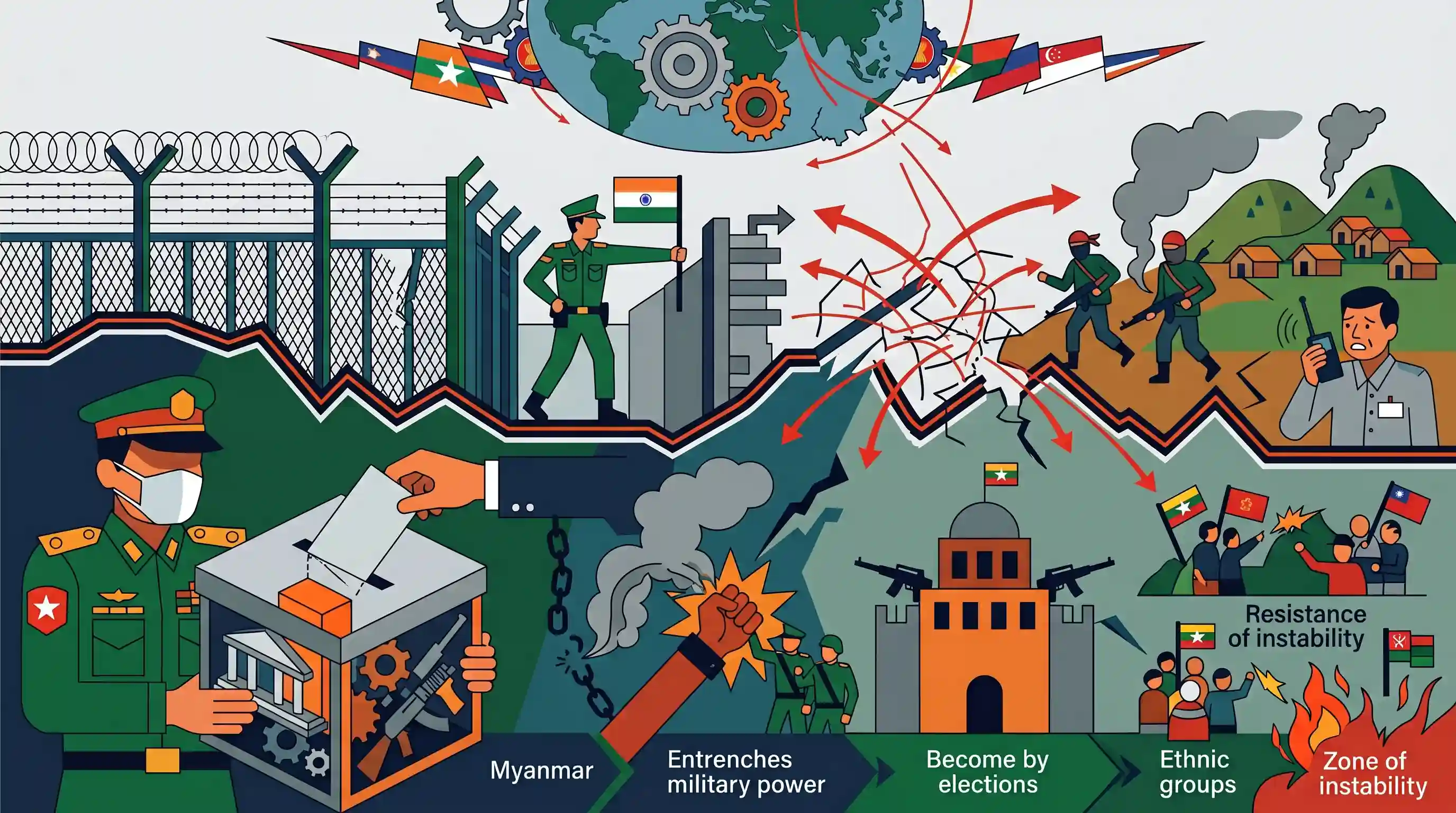
The article critically examines the complex dynamics of holding elections in post-conflict and conflict-ridden states, focusing prominently on the ongoing crisis in Myanmar. It highlights how the Myanmar military junta intends to use proposed elections as a facade to legitimize its authoritarian rule, a move strongly opposed by the National Unity Government (NUG) and ethnic resistance groups. The piece argues that conducting elections prematurely, without a foundation of peace, inclusivity, and fundamental rights, often worsens instability and entrenches military power. This internal turmoil has significant spillover effects, heavily impacting regional stability, ASEAN's diplomatic efforts, and India's security concerns—particularly border management and insurgent activities in its Northeast region.
Key Points
- In post-conflict or conflict-ridden states like Myanmar, elections are often proposed by authoritarian regimes or military juntas to secure international legitimacy rather than to transition to a true democracy.
- The Myanmar military junta's planned elections are widely opposed and boycotted by the National Unity Government (NUG), Ethnic Armed Organizations (EAOs), and civil resistance groups, illustrating a deep lack of national consensus.
- Premature elections held without fundamental prerequisites—such as a nationwide ceasefire, freedom of speech, and inclusive political dialogue—can exacerbate existing divisions and prolong civil conflict instead of resolving it.
- The ongoing instability in Myanmar poses severe strategic and security challenges for India, particularly concerning the influx of refugees into Northeast India, border management, and cross-border activities of insurgent groups.
- Regional blocs like ASEAN face difficulties in enforcing the 'Five-Point Consensus' and must navigate the dilemma of whether to recognize elections orchestrated under military rule.
Important Terms
ASEAN Five-Point Consensus

A peace plan adopted in 2021 calling for cessation of violence, constructive dialogue among all parties, appointment of a special envoy, humanitarian assistance, and a delegation visit to Myanmar.
UPSC context
GS Paper II (International Relations); evaluates regional diplomatic efforts and their effectiveness in stabilizing India's volatile neighborhood.
National Unity Government (NUG)
A parallel Myanmar government-in-exile formed by ousted lawmakers and ethnic leaders following the 2021 coup. It seeks to restore democracy and opposes the military junta's legitimacy.
UPSC context
GS Paper II (IR); concerns democratic legitimacy and India's dual-track diplomacy with both the junta and pro-democracy forces.
Ethnic Armed Organizations (EAOs)
Non-state militant groups representing Myanmar's ethnic minorities (e.g., Kachin, Karen, Arakan) that have fought for regional autonomy for decades and currently lead the armed resistance against the military.
UPSC context
GS Paper III (Internal Security); critical for border management and checking insurgent spillover into India's Northeast states.
Tatmadaw (Myanmar Military)
The official name of Myanmar's armed forces, which has historically dominated politics, seized power in the 2021 coup, and operates as a powerful 'state within a state'.
UPSC context
GS Paper II (IR); tests understanding of the political-military complex in a key neighbor and its impact on India's Act East policy.
ASEAN
A 10-member regional organization promoting economic and security cooperation in Southeast Asia. It follows the 'ASEAN Way' principle of non-interference in the internal affairs of member states.
UPSC context
GS Paper II (IR); essential for questions on regional groupings, multilateralism, and India's strategic partnership with Southeast Asia.
Prelims Trap
India officially supports the NUG and has suspended all diplomatic ties with the Myanmar military junta.
India has not severed ties with the junta. It maintains a dual-track approach, engaging the military for border security/realpolitik interests while officially advocating for a democratic transition.
Static Concepts Connected
What is the 'ASEAN Way' and its role in resolving crises?
- Non-interference: Core structural principle prohibiting member states from intervening in the internal affairs of one another.
- Consensus-building: Decisions are made through strict consultation and unanimity, which often delays rapid responses to crises like the Myanmar coup.
- Five-Point Consensus: A rare, collective diplomatic framework adopted in 2021 specifically demanding an immediate cessation of violence in Myanmar.
What are the key features of India-Myanmar border management?
- Guarding Force: The Assam Rifles is the designated Central Armed Police Force (CAPF) responsible for guarding the highly porous Indo-Myanmar border.
- Free Movement Regime: A historical arrangement allowing tribes to travel 16 km across the border without visas, which India recently decided to scrap due to security concerns.
- Porous Terrain: The un-demarcated border runs through dense forests, severely complicating enforcement and enabling insurgent safe-havens in Myanmar.
Cross-Topic Patterns
Myanmar crisis and India's Act East
Instability in Myanmar directly threatens vital connectivity initiatives like the Kaladan Multi-Modal Project and the Trilateral Highway, stalling the economic integration envisioned under India's Act East Policy.
Refugee influx and border state demography
The influx of Chin and Rohingya refugees tests India’s ad-hoc refugee framework (as a non-signatory to the 1951 Convention) and complicates ethnic fault lines in Mizoram and Manipur.

Myanmar's junta-EAO conflict, the Kaladan project's status, and India's FMR suspension will likely merge in a 2026 border security Q.
Linked PYQs · 3
Linked PYQs · 3
- 2023PrelimsGS1
Consider the following pairs: Area of conflict mentioned in news Country where it is located 1. Donbas : Syria 2. Kachin : Ethiopia 3. Tigray : North Yemen How many of the above pairs are correctly matched?
- 2019MainsGS3
Cross-border movement of insurgents is only one of the several security challenges facing the policing of the border in North-East India. Examine the various challenges currently emanating across the India-Myanmar border. Also, discuss the steps to counter the challenges.
- 2020MainsGS3
Analyze internal security threats and transborder crimes along Myanmar, Bangladesh and Pakistan borders including Line of Control (LoC). Also discuss the role played by various security forces in this regard.
