Hospital Fire Incident and Disaster Management Norms in Bihar
Source:The Hindu ↗
Why It Matters
This event is highly relevant for BPSC Prelims under disaster management policies, state executive roles, and Bihar's district geography. It underscores fire safety compliance standards (NBC 2016) in public-use institutional buildings and the administrative response of the state during tragedies.
Summary
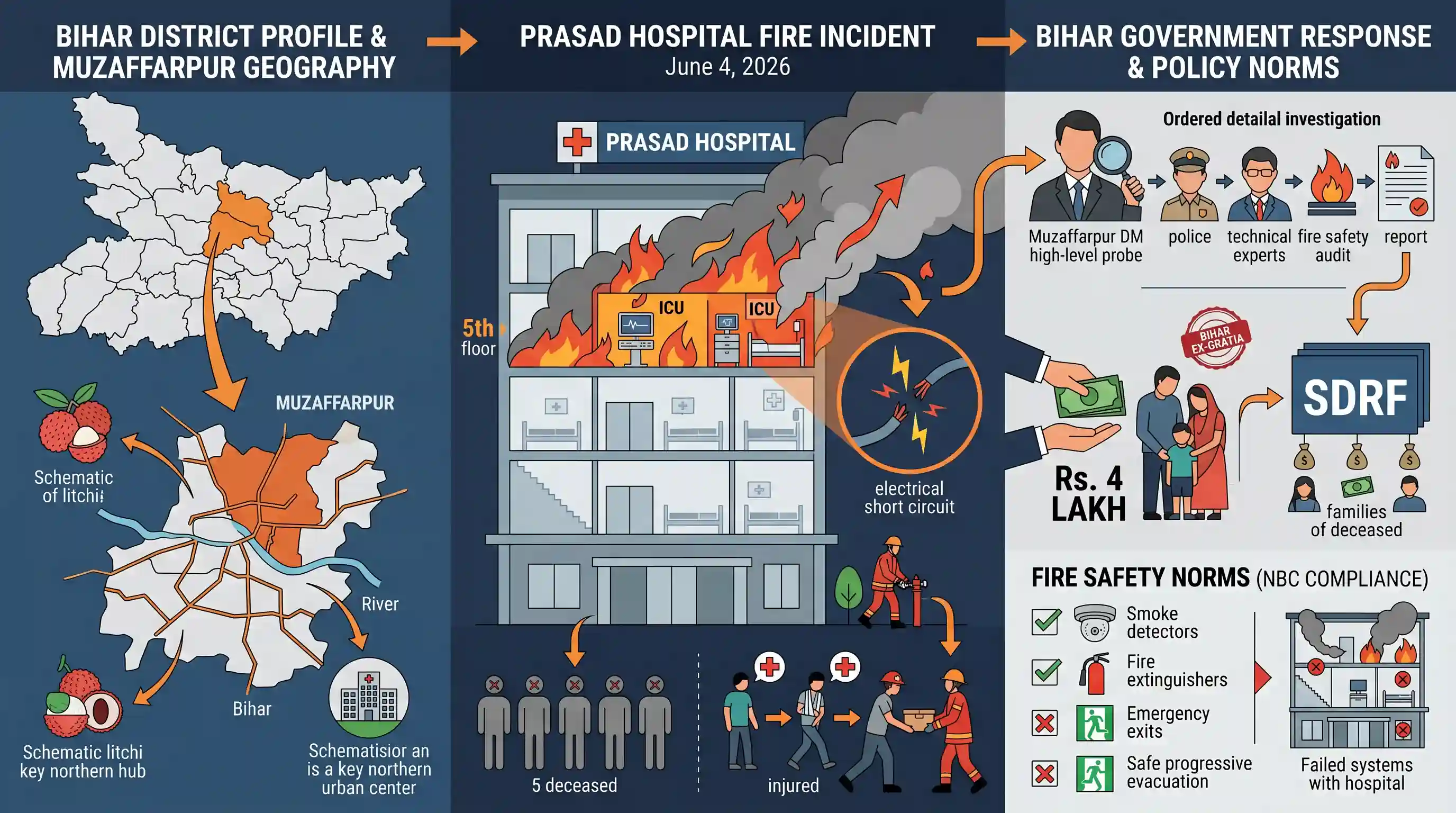
On June 4, 2026, a major fire broke out in the ICU of Prasad Hospital in Muzaffarpur, Bihar, claiming at least five lives and injuring several others. The incident, suspected to have been caused by an electrical short circuit, prompted the Bihar government to announce an ex-gratia of Rs. 4 lakh for the deceased's families. A high-level probe was ordered by the Muzaffarpur DM. The event underscores critical policy issues surrounding fire safety compliance under the National Building Code (NBC) and the state's disaster relief mechanisms.
Key Points
- A massive fire broke out in the ICU of Prasad Hospital (a private hospital) in the Brahmpuran area of Muzaffarpur district, Bihar, resulting in the death of at least five patients.
- The fire started on the fifth floor of the hospital, with preliminary investigation suggesting a short circuit as the cause.
- Victims identified were from Muzaffarpur and neighboring Sheohar district. Sheohar is Bihar's smallest district by geographical area.
- Chief Minister Samrat Choudhary announced an ex-gratia of Rs. 4 lakh to the families of each deceased victim, which aligns with standard relief policies under the State Disaster Response Fund (SDRF).
- State Health Minister Nishant Kumar coordinated with the District Magistrate (DM) of Muzaffarpur, Subrat Kumar Sen, who has ordered an inquiry to fix accountability.
- The incident highlights the critical need for compliance with the National Building Code (NBC) of India 2016, where hospitals are classified under 'Group C-1 Institutional Buildings' requiring stringent fire-safety standards.
Important Terms
Disaster Management Act, 2005

Landmark Indian legislation establishing a comprehensive legal and institutional framework for disaster risk reduction, preparedness, and coordinated response across national, state, and district levels.
UPSC context
GS Paper III: Disaster Management. Tests knowledge of statutory governance, legal provisions, and crisis response frameworks.
National Building Code of India (NBC) 2016
A comprehensive national instrument published by the Bureau of Indian Standards (BIS) that provides guidelines for regulating building construction, structural design, and fire safety.
UPSC context
GS Paper III: Infrastructure and Disaster Management. Tests understanding of structural compliance, public safety norms, and urban fire risks.
State Disaster Response Fund (SDRF)
The primary financial resource available to state governments, constituted under the DM Act 2005, to provide immediate relief to victims of notified disasters.
UPSC context
GS Paper III: Disaster Management. Tests knowledge of disaster relief financing, fiscal federalism, and guidelines for immediate relief funding.
Bihar State Disaster Management Authority (BSDMA)
A statutory state-level body in Bihar, chaired by the Chief Minister, responsible for formulating policies, coordinating risk mitigation, and executing disaster response plans.
UPSC context
GS Paper III & State PSCs: Disaster Management. Tests knowledge of state-level institutional frameworks, regional vulnerability, and decentralized governance.
Prelims Trap
The National Building Code of India is a statutory central law directly binding on all hospitals and healthcare facilities.
The NBC is prepared by the Bureau of Indian Standards (BIS) and acts as an advisory model code. It is not an automatically enforceable federal statute.
Static Concepts Connected
What is the National Building Code (NBC) of India 2016?
- BIS Publication: Published by the Bureau of Indian Standards (BIS) as a model code to guide building construction nationwide.
- Legal Status: Serves as an advisory document until adopted into state building bye-laws or municipal regulations, which makes it legally binding.
- Fire Safety Focus: Part 4 explicitly outlines fire and life safety requirements, classifying buildings from Group A to J (omitting Group I).
What is the structure of the State Disaster Response Fund (SDRF)?
- Statutory Basis: Constituted under Section 48(1)(a) of the Disaster Management Act, 2005, to meet immediate relief expenses for notified disasters.
- Funding Ratio: Central government contributes 75% for general category states and 90% for special category states (NE and Himalayan).
- Oversight & Audit: Allocations are recommended by the Finance Commission; audits are conducted annually by the CAG of India.
Cross-Topic Patterns
Urban Local Bodies and Fire Safety
Connects GS-2 municipal governance with GS-3 disaster management, showing how weak local enforcement of building bye-laws compromises public health infrastructure safety.
Disaster Relief and Fiscal Federalism
Bridges state financial autonomy under GS-2 with SDRF guidelines under GS-3, highlighting how state ex-gratia payments depend on central-state allocation formulas.

Prelims 2026 may feature multi-statement questions testing the advisory nature of NBC 2016 versus local municipal enforcement powers.
Linked PYQs · 2
Linked PYQs · 2
- 2024-IBPSC_PRELIMSGS1
In which district of Bihar, Lichi production is maximum?
- 2024-IBPSC_PRELIMSGS1
In which district of Bihar, Maize production is maximum?
