Muzaffarnagar Riots Case Withdrawal and Legal Precedents in UP
Source:The Hindu ↗
Why It Matters
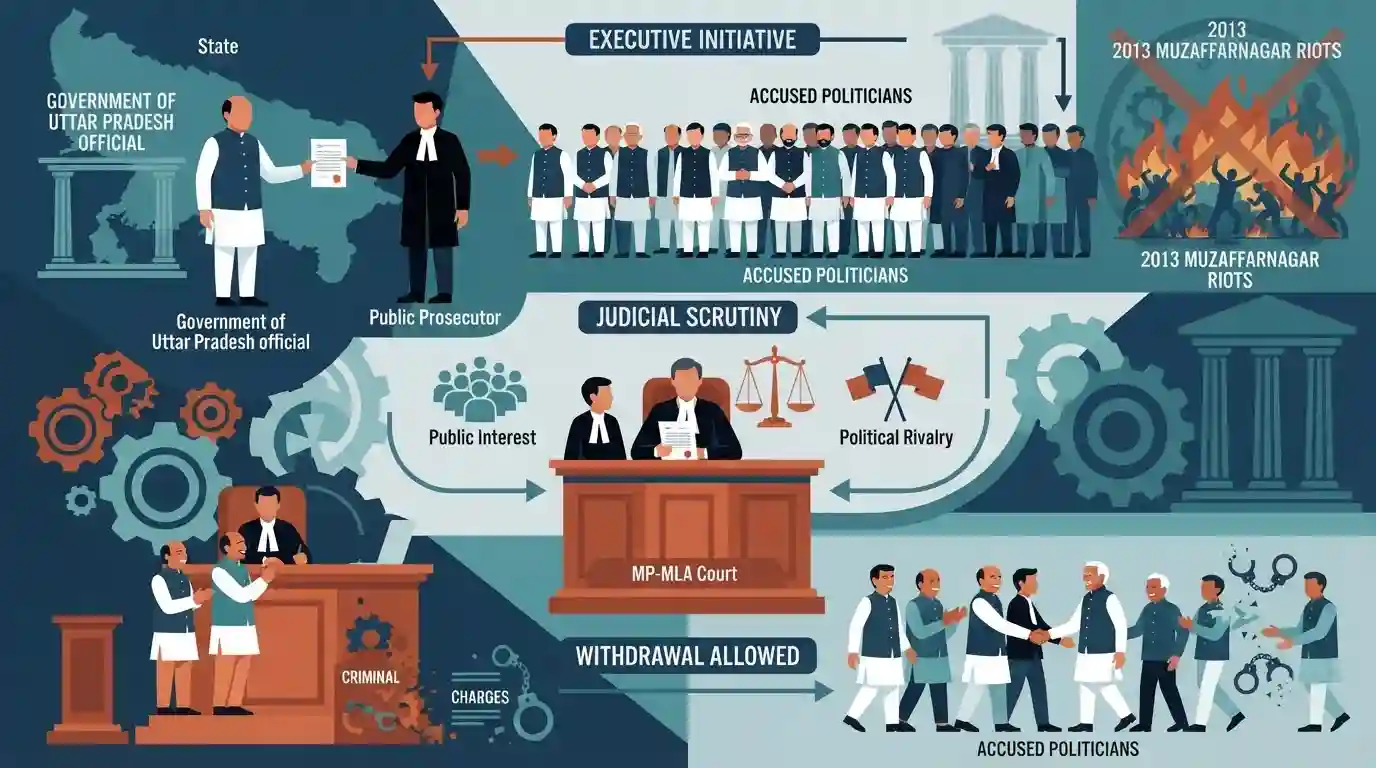
Illustrates the practical application of the state's power to withdraw criminal prosecutions in the 'public interest', highlighting the interplay between the executive and judiciary, and the role of special MP-MLA courts in addressing politically sensitive cases.
Summary
A special MP-MLA court in Uttar Pradesh allowed the withdrawal of criminal charges against 25 individuals, including several prominent BJP leaders, connected to the 2013 Muzaffarnagar riots. The prosecution argued for the withdrawal on the grounds of "larger public interest," noting that the charges arose from political rivalry and crowd agitation rather than personal enmity. This highlights the executive and judicial dynamics surrounding the withdrawal from prosecution under criminal laws, particularly in cases linked to historical communal violence and political actors.
Key Points
- A special MP-MLA court in Muzaffarnagar allowed the withdrawal of a criminal case against 25 people, including former Union Minister Sanjeev Balyan and other BJP leaders, related to the 2013 Muzaffarnagar riots.
- The case originated from an August 2013 FIR alleging unauthorized assembly, criminal intimidation, and wrongful restraint at a panchayat meeting amid communal tensions.
- The prosecution sought withdrawal arguing that continuing the case would not serve the public interest, as it stemmed from political rivalry and crowd agitation rather than personal disputes.
- The court referenced Supreme Court precedents indicating that withdrawing cases linked to political or communal agitation can be justified to maintain peace and harmony.
- The 2013 Muzaffarnagar riots were historically significant communal clashes that resulted in over 60 deaths and massive displacement.
Important Terms
MP-MLA Court

Special fast-track courts established across India under Supreme Court directives to exclusively and rapidly try criminal cases pending against sitting and former legislators.
UPSC context
GS-2 (Representation of People's Act). Crucial for curbing the criminalisation of politics and ensuring timely convictions and disqualifications.
Criminal Procedure Code (CrPC)
The foundational statute for criminal procedure in India. Its Section 321 (now BNSS Section 360) notably allows public prosecutors to withdraw charges with court consent, often sparking debate in political cases.
UPSC context
GS-2 (Polity). Highlights debates on executive discretion, potential misuse of prosecution withdrawals, and maintaining the rule of law.
Criminalisation of Politics
The growing participation and election of individuals facing serious criminal charges to legislative bodies, deeply undermining constitutional morality and democratic governance.
UPSC context
GS-2 (Elections/RPA). A major focus for electoral reforms, questioning the impact of money, muscle power, and delayed justice.
Supreme Court
India's apex judicial authority. In the context of political criminalisation, it actively intervenes by mandating fast-track lawmaker trials and setting strict guidelines for state withdrawal of criminal cases.
UPSC context
GS-2 (Judiciary). Tests the concept of judicial activism and the Court's role as a guardian of constitutional morality and electoral probity.
Prelims Trap
State governments can unilaterally withdraw criminal cases against MPs and MLAs in the larger public interest.
The Supreme Court mandated (Ashwini Upadhyay case) that States cannot withdraw criminal cases against sitting or former legislators without prior permission from the respective High Court.
Static Concepts Connected
How is withdrawal of prosecution governed under the new BNSS?
- Legal provision: Under Section 360 of the Bharatiya Nagarik Suraksha Sanhita (BNSS), a Public Prosecutor can withdraw a case before judgment is pronounced.
- Independent application: The trial court must consent. The Prosecutor must apply an independent mind and not merely act on state government directives (Sheonandan Paswan case).
- Victim's right: BNSS introduces a crucial new safeguard mandating that the court cannot permit withdrawal without giving the victim an opportunity to be heard.
What are Special MP/MLA Courts and their oversight rules?
- SC Directive: These courts were set up across states following the Supreme Court's directive in Ashwini Upadhyay v. Union of India to fast-track legislator trials.
- High Court oversight: The Supreme Court ruled that state governments cannot arbitrarily withdraw criminal cases against sitting or former MPs and MLAs without prior High Court approval.
Cross-Topic Patterns
Criminalization + RPA Disqualifications
Withdrawal of cases links directly to Section 8 of the RPA 1951, where dropping charges preempts potential conviction and subsequent disqualification of sitting legislators.
Victim-centric jurisprudence in BNSS
The transition from CrPC Section 321 to BNSS Section 360 highlights a structural shift, embedding victim participation as a mandatory check on the executive's power to withdraw prosecutions.

A 2026 Prelims question will likely test the new BNSS Sec 360 victim-hearing safeguard and HC consent for MP/MLA case withdrawals.
Linked PYQs · 2
Linked PYQs · 2
- 2021UPPSC_PRELIMSGS1
Which one of the following is NOT correctly matched? (Subject — Related Article)
- 2025UPPSC_PRELIMSGS1
Given below are two statements, one is labelled as Assertion (A) and the other as Reason (R). Assertion (A): Public Interest Litigation in India is essential for the rule of law. Reason (R): Public Interest Litigation provides effective access of Justice to socially and economically weaker sections. Select the correct answer from the code given below:
