Delhi High Court rules personal laws cannot override POCSO
Source:The Hindu ↗
কেন এটি গুরুত্বপূর্ণ
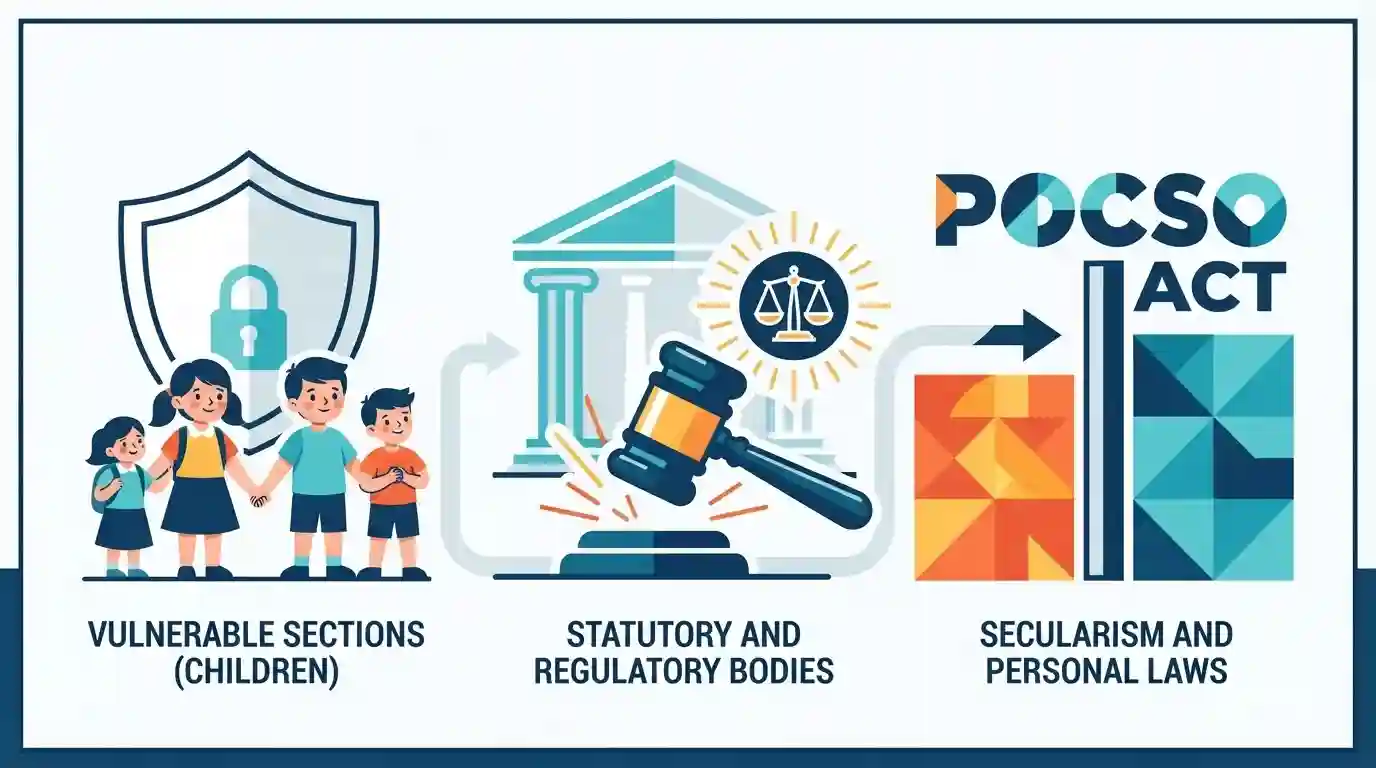
This judgment addresses the critical intersection between personal laws and secular criminal legislation, reinforcing child protection rights over customary or religious marriage practices for minors.
সারসংক্ষেপ
The Delhi High Court has ruled that personal law provisions concerning Muslim marriages cannot override the Protection of Children from Sexual Offences (POCSO) Act, reiterating that criminal laws protecting children from sexual abuse apply universally regardless of personal law permissions.
মূল বিষয়
- The Delhi High Court ruled that a Muslim marriage (Nikah) solemnised under personal law cannot override the provisions of the Protection of Children from Sexual Offences (POCSO) Act.
- The court emphasized that secular criminal legislation enacted for child protection takes precedence over conflicting personal laws.
- The ruling reinforces that sexual relations with a minor, even within the framework of personal law marriages, constitute an offense under the POCSO Act.
গুরুত্বপূর্ণ শব্দ
Protection of Children from Sexual Offences (POCSO) Act

A landmark 2012 Indian secular legislation enacted to protect individuals under 18 years from sexual abuse, sexual assault, and pornography, ensuring child-friendly trial procedures and overriding conflicting personal laws.
UPSC context
UPSC Mains GS Paper II: Vulnerable sections (Children) and statutory protections against sexual crimes. Tests the primacy of child protection laws.
Prohibition of Child Marriage Act (PCMA)
A 2006 secular enactment penalizing and prohibiting child marriages in India, setting the legal marriage age at 18 for women and 21 for men, applying universally across religions.
UPSC context
UPSC Mains GS Paper II: Social justice, vulnerable sections, and challenges in implementing secular child rights laws over customary practices.
Delhi High Court
A constitutional court having jurisdiction over the National Capital Territory of Delhi, empowered to interpret criminal and personal laws regarding child protection and statutory supremacy.
UPSC context
UPSC Mains GS Paper II: Structure, organization, and functioning of the Judiciary and judicial review of legislative versus personal laws.
প্রিলিমস ফাঁদ
Personal law permissions for marriage create a valid exception to the age of consent under the POCSO Act.
Aspirants often assume that valid solemnization under personal law confers immunity from criminal prosecution under penal statutes like POCSO.
সংযুক্ত স্থির ধারণা
What is the statutory age of consent under the POCSO Act and its interplay with personal laws?
- Age Limit: Absolute threshold set at 18 years for all individuals without exception.
- Statutory Overriding: Secular criminal legislation overrides religious personal laws on matters of child sexual abuse.
- Marital Exception: No marital exemption exists under POCSO when a spouse is below 18 years of age.
আন্তঃবিষয় প্যাটার্ন
Personal Law vs. Secular Criminal Statutes
The clash between religious personal laws and secular penal statutes highlights the ongoing debate around a Uniform Civil Code under Article 44.
POCSO and Child Marriage Jurisprudence
Child marriage prohibition intersects with juvenile justice, right to education, and reproductive rights of minor mothers.

POCSO consent threshold (18 years) overriding personal law provisions is high-yield for both Prelims statements and Mains ethics/polity.
সংযুক্ত PYQ · 1
সংযুক্ত PYQ · 1
- 2024MainsGS2
Discuss India as a secular state and compare with the secular principles of the US constitution.
