Uttarakhand Madrasa Grants Discontinuation Faces Minority Opposition
Source:millattimes ↗
Why It Matters
Highlights the ongoing discourse around state regulation of minority educational institutions and constitutional safeguards (Article 30). Crucial for Polity and Governance, specifically concerning fundamental rights and educational autonomy in Uttarakhand.
Summary
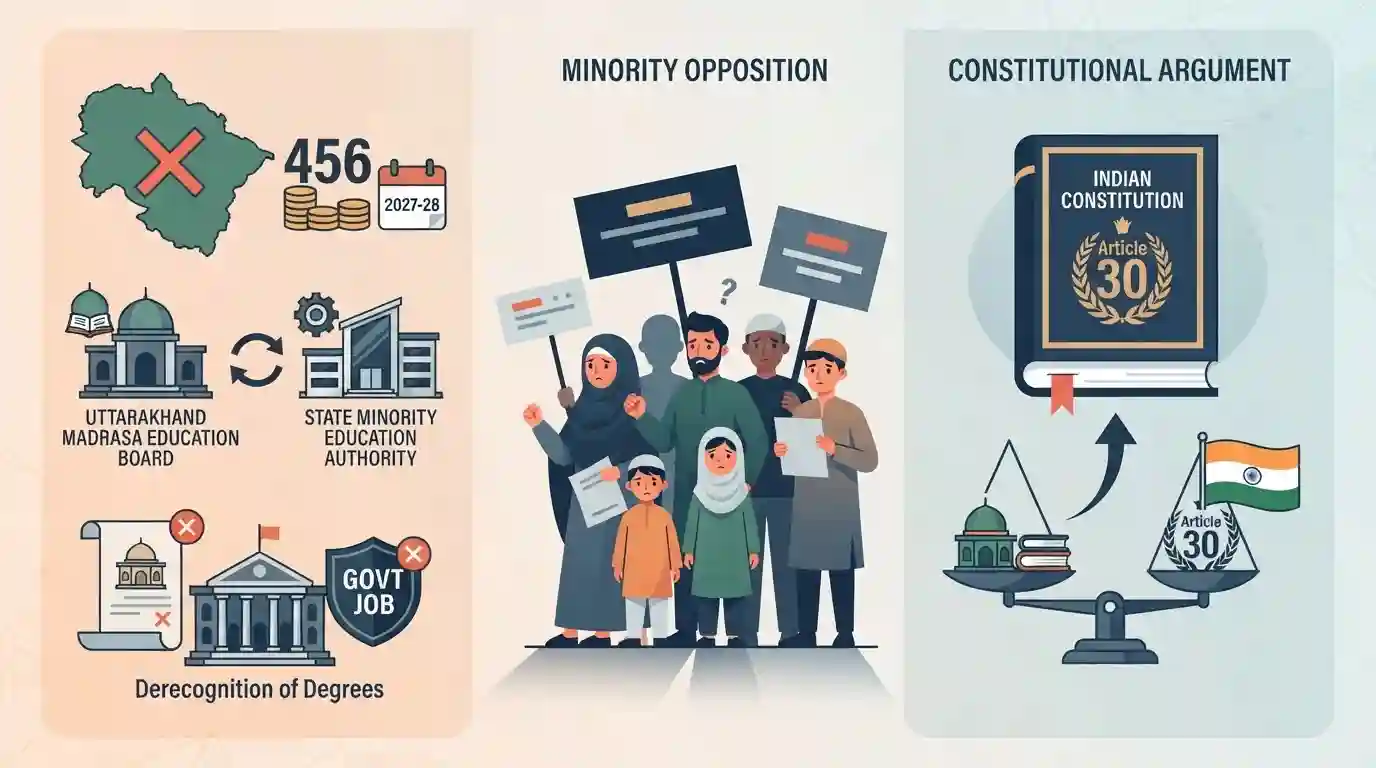
The Uttarakhand government has decided to discontinue grants for 456 madrasas beginning in 2027-28. This move coincides with the abolition of the Uttarakhand Madrasa Education Board, now replaced by the State Minority Education Authority, and the derecognition of traditional madrasa degrees for government jobs. Minority groups strongly oppose the move, claiming it infringes upon the educational rights guaranteed to minorities under Article 30 of the Indian Constitution.
Key Points
- The Uttarakhand government plans to end grants for 456 madrasas starting from the 2027-28 financial year.
- This follows the abolition of the Uttarakhand Madrasa Education Board, which was replaced by the Uttarakhand State Minority Education Authority.
- Traditional madrasa qualifications such as Maulvi, Alim, and Munsi are no longer recognised for state government jobs.
- Muslim groups argue that these decisions violate Article 30 of the Indian Constitution, which guarantees religious minorities the right to establish and administer educational institutions.
Important Terms
Article 30 of the Indian Constitution

A Fundamental Right guaranteeing religious and linguistic minorities the right to establish and administer educational institutions of their choice, while prohibiting state discrimination in providing educational grants.
UPSC context
GS Paper 2 (Indian Polity). Crucial for analyzing the balance between minority educational autonomy, constitutional protections, and state regulation.
Uttarakhand Madrasa Education Board
A former state regulatory body responsible for overseeing and granting recognition to registered madrasas in Uttarakhand. It was abolished in 2026 and replaced by a unified minority education framework to integrate modern schooling.
UPSC context
GS Paper 2 (Government Policies). Relevant for understanding state interventions in minority education and the modernization of traditional religious institutions.
Uttarakhand State Minority Education Authority
A new regulatory body in Uttarakhand tasked with overseeing educational institutions run by all six notified minority communities. It replaces community-specific boards to mandate uniform standards, accountability, and modern academics.
UPSC context
GS Paper 2 (Minority Rights/State Policies). Tests knowledge of administrative reforms impacting minority educational frameworks and the secularization of education.
Prelims Trap
"Article 30 guarantees minority educational institutions the fundamental right to receive government grants-in-aid."
The Supreme Court ruled that receiving state grants is NOT a fundamental right. Article 30(2) only prohibits the State from discriminating against minority institutions when distributing aid.
Static Concepts Connected
What is the scope of Article 30 regarding minority educational institutions?
- Establishment & Administration: Religious and linguistic minorities have the fundamental right to establish and administer educational institutions of their choice.
- Non-Discrimination in Aid: The State cannot discriminate against any educational institution in granting aid simply because it is managed by a minority community (Article 30(2)).
- State Regulatory Power: The right is not absolute. The State can impose reasonable regulations regarding academic standards, syllabus, health, and sanitation to ensure secular competency.
How do protections under Article 29 differ from those under Article 30?
- Beneficiaries: Article 29 protects 'any section of citizens' (which can include the majority), whereas Article 30 is exclusively restricted to religious and linguistic minorities.
- Scope of Protection: Article 29 focuses on conserving distinct language, script, or culture, while Article 30 focuses specifically on the establishment and administration of educational institutions.
Cross-Topic Patterns
UCC implementation + Minority Educational Autonomy
Uttarakhand's parallel moves to implement a Uniform Civil Code and replace specific Madrasa Boards with unified minority frameworks highlight the growing state push for standardization over distinct community-specific regulations.
RTE Act exemptions + Secular Competency
State efforts to derecognize traditional degrees connect to the broader debate on RTE Act exemptions for minority schools, probing the boundary between secular educational competency and religious instruction.

Expect a Prelims question on Article 30 testing the distinction between 'non-discrimination in aid' and the 'right to receive aid'.
Linked PYQs · 2
Linked PYQs · 2
- 2025UKPSC_PRELIMSGS1
Consider the following statements about 'Right to Education' and choose the correct answer : 1. It try to achieve the aim of 'Education for All'. 2. Earlier a provision of free and compulsory education was provided in Part IV of the Constitution. 3. It became Fundamental Right after 91ˢᵗ Constitutional Amendment.
- 2025UKPSC_PRELIMSGS1
Which of the following records is not maintained by the Panchayats in Uttarakhand?
