AI integration in US administration sparks severe conflict of interest
Source:The Hindu ↗
Why It Matters
The scenario serves as a profound contemporary case study for GS-4 (Ethics) regarding conflict of interest, self-dealing, and the ethical dilemmas of integrating private corporate interests with public administration. It also intersects with GS-2 and GS-3 topics concerning data privacy, AI surveillance, and the changing dynamics of an impartial civil service.
Summary
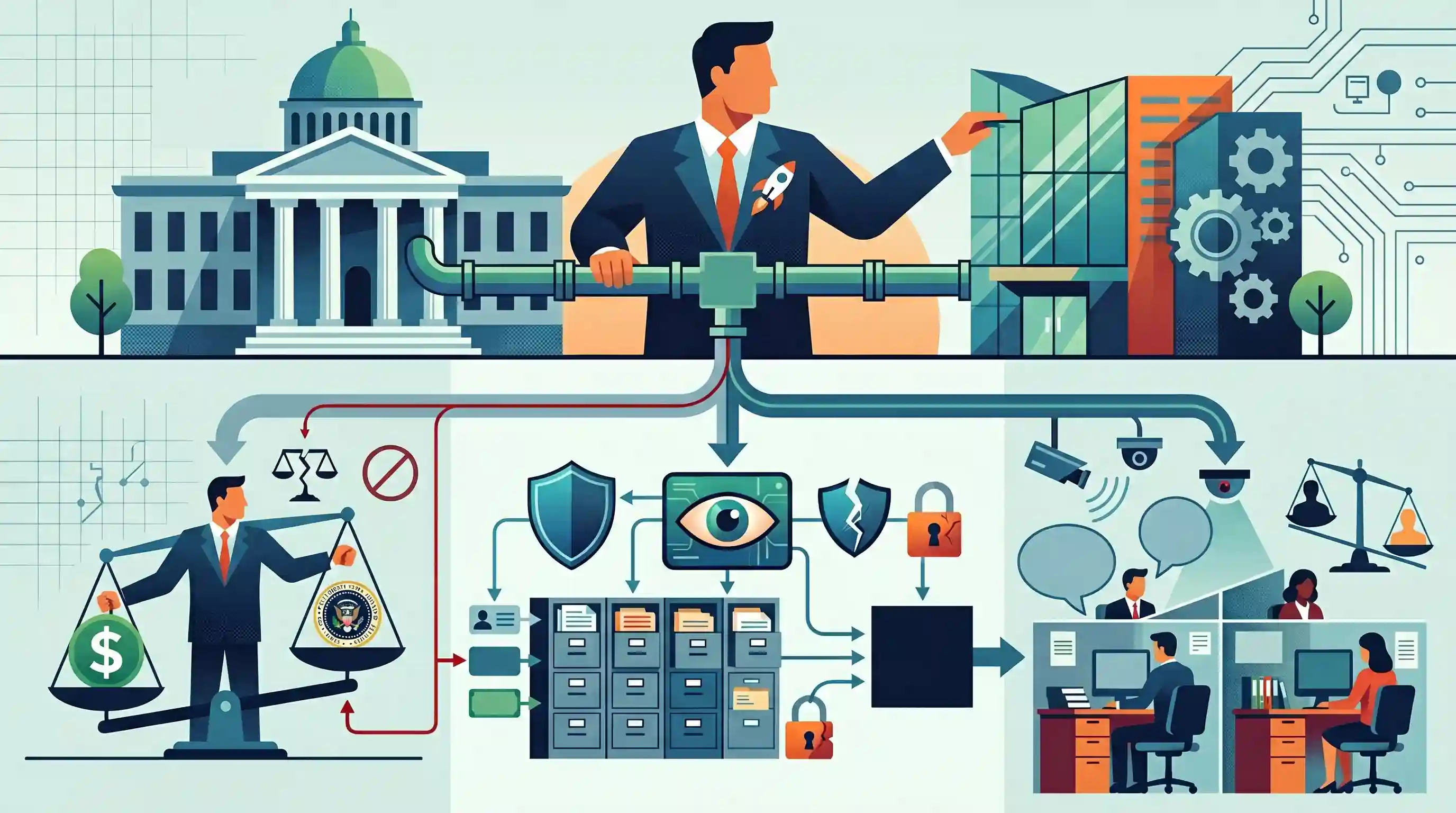
Elon Musk's Department of Government Efficiency (DOGE) is controversially spearheading the integration of Grok AI—developed by Musk's private startup, xAI—across United States federal agencies. The initiative aims to analyze vast government datasets, monitor the communications of civil servants, and streamline bureaucratic operations. However, this deployment circumvents traditional competitive bidding, sparking intense scrutiny over an apparent conflict of interest and violations of government ethics. Critics and watchdog organizations warn of severe risks related to data privacy, as the AI system accesses sensitive records of millions of Americans, and the use of technology to monitor employee loyalty undermines civil service protections and neutrality.
Key Points
- The Department of Government Efficiency (DOGE), co-led by Elon Musk, is integrating his private company's Grok AI into US federal government operations to process data and identify cost-cutting opportunities.
- The deployment of Grok AI bypasses standard competitive procurement procedures, raising significant concerns about the 'appearance of self-dealing' and ethics violations.
- This integration poses a massive conflict of interest, as Musk serves in an advisory role for the government while actively enriching his private enterprise, xAI.
- There are critical apprehensions regarding data privacy and cybersecurity, as Grok is granted sweeping access to federal databases containing sensitive information on millions of citizens.
- The initiative also explores utilizing AI for surveillance to monitor civil servants' communications and gauge political loyalty, threatening the principle of an impartial and politically neutral bureaucracy.
Important Terms
Department of Government Efficiency (DOGE)

A U.S. federal initiative (est. 2025) led by Elon Musk to modernize technology, slash regulations, and cut government spending, often bypassing traditional bureaucratic oversight.
UPSC context
GS II (Governance) & GS IV (Ethics). Tests administrative reform models and the ethics of privatized government oversight.
xAI
Elon Musk's private AI startup that developed Grok; it provides "Grok for Government" tools to federal agencies via multi-million dollar contracts.
UPSC context
GS III (Science & Tech). Relevant for private sector influence in sovereign AI infrastructure and e-governance.
Citizens for Responsibility and Ethics in Washington (CREW)
A nonpartisan nonprofit watchdog that uses legal action and research to hold government officials accountable for ethics violations and corruption.
UPSC context
GS II (Governance). Relevant for the role of pressure groups and NGOs in maintaining democratic accountability.
Conflict of Interest
An ethical situation where an official's personal interests (financial or professional) clash with their public duties, undermining impartiality and eroding public trust.
UPSC context
GS IV (Ethics). Fundamental concept for theoretical questions and case studies regarding integrity in public administration.
Civil Service Neutrality
A foundational administrative value requiring civil servants to remain politically impartial and serve the government of the day without ideological bias.
UPSC context
GS II & GS IV. Core to discussions on bureaucratic independence and the impact of political patronage.
Grok AI
The generative AI chatbot developed by xAI, currently integrated into U.S. federal systems to analyze data and monitor communications.
UPSC context
GS III (S&T) & GS IV (Ethics). Concerns algorithmic bias, data privacy, and ethical AI deployment in public service.
X (formerly Twitter)
The social media platform owned by Musk, serving as a primary data source for Grok AI and a tool for official communications.
UPSC context
GS II (Communication/E-Governance). Relevant for the role of social media in public policy and administrative transparency.
Public Procurement Ethics
The set of moral principles governing the acquisition of goods and services by government agencies, emphasizing fairness, competition, and transparency.
UPSC context
GS IV (Ethics). Crucial for questions on corruption, transparency, and the "corporate-state nexus" in governance.
Prelims Trap
Advisory positions are immune from conflict of interest rules as they lack executive decision-making power.
False. Ethical frameworks and administrative norms dictate that even advisory roles must avoid the "appearance of self-dealing" to preserve public trust and impartiality.
Static Concepts Connected
What constitutes a Conflict of Interest in public administration?
- Definition: A situation where personal interests (financial, commercial, or familial) could improperly influence the objective performance of official public duties.
- Types: It can be actual, potential, or perceived. Even the 'appearance of self-dealing' undermines institutional credibility.
- Mitigation: Standard administrative practices require disclosure, recusal, or divestment to resolve the conflict and maintain public trust.
What are the core principles of public procurement?
- Transparency: Mandating open, competitive bidding (e.g., via GeM portal in India) to ensure a level playing field and prevent nepotism.
- Economy & Efficiency: Securing the best value for public money without compromising on quality or efficiency.
- Fairness: Ensuring equitable treatment of all bidders to prevent monopolies and mitigate corruption risks.
Cross-Topic Patterns
AI surveillance & Civil Service Neutrality
Using AI to monitor bureaucratic communications for political loyalty directly threatens the Weberian ideals of an anonymous, politically neutral, and permanent civil service.
Private AI models processing state data
Integrating proprietary AI into government networks raises severe data privacy and state-secrecy concerns, mirroring Indian debates around the DPDP Act and state data sovereignty.
Advisory capture & bypass of public procurement
Appointing industry titans to state 'efficiency' commissions that bypass standard public bidding procedures illustrates a modern, tech-driven form of regulatory capture.

Expect a GS4 case study in 2026 involving a tech executive advising government while deploying their proprietary AI without open bidding.
Linked PYQs · 3
Linked PYQs · 3
- 2022MainsGS4
Discuss the significance of 'Conflict of interest' in the context of public administration.
- 2017MainsGS4
Conflict of interest in the public sector arises when official duties, public interest, and personal interest are taking priority one above the other. How can this conflict in administration be resolved? Describe with an example.
- 2023MainsGS3
Introduce the concept of Artificial Intelligence (AI). How does Al help clinical diagnosis? Do you perceive any threat to privacy of the individual in the use of Al in healthcare?
