Elon Musk Plans New America Party Bloc
Source:Indian Express ↗
Why It Matters
The article offers a real-world case study for UPSC aspirants on comparative party systems, specifically how third-party swing blocs can hold leverage in deeply divided legislatures. It also highlights the growing influence of ultra-wealthy individuals functioning as pressure groups, and underscores the global economic challenge of managing massive public expenditure and national debt.
Summary
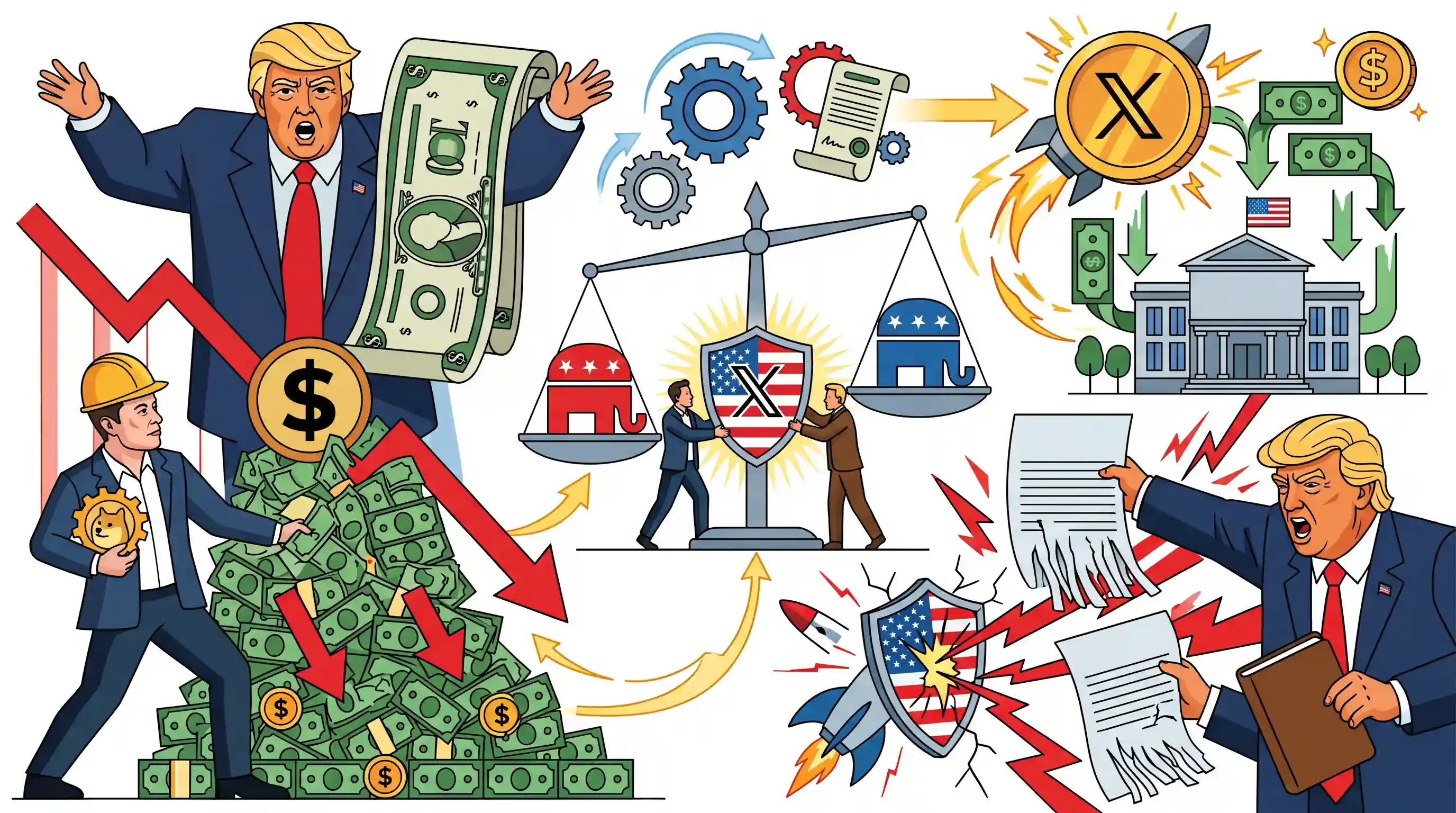
Elon Musk has unveiled plans for a new 'America Party' designed to serve as a pivotal swing bloc in the US Congress. The decision follows a fallout with President Donald Trump over a sweeping legislative package dubbed the 'One, Big, Beautiful Bill,' which increased the US national debt by $3.3 trillion. Musk, who had been leading the Department of Government Efficiency (DOGE), opposed the massive spending and intends to use his new party to exert leverage over future legislation. The clash has escalated into severe executive retaliation, with Trump threatening to cancel federal contracts for Musk's companies and even revoke his citizenship.
Key Points
- Elon Musk intends to form the 'America Party' specifically to capture a few crucial US Senate and House seats, aiming to act as a swing bloc with legislative leverage over contentious laws.
- The political rupture stems from President Trump's 'One, Big, Beautiful Bill', a spending package that increased the US national debt by $3.3 trillion and narrowly passed the Senate via a tie-breaking vote by JD Vance.
- Musk previously headed the Department of Government Efficiency (DOGE) and vehemently opposed the massive spending bill, viewing his new party as a vehicle to enforce fiscal restraint.
- In response, Trump has threatened to cancel federal contracts for Musk's businesses and suggested revoking his citizenship, highlighting the conflict between corporate influence, money power, and the executive branch.
Important Terms
One Big Beautiful Bill Act (OBBBA)

A 2025 US legislative package (OBBBA) combining permanent tax cuts, a $5 trillion debt ceiling increase, and social spending reductions.
UPSC context
GS-2/GS-3: Comparative politics and public finance; tests understanding of fiscal policy impact and executive-legislative relations.
America Party
A political party launched by Elon Musk (2025) to challenge the US two-party system by acting as a legislative swing bloc.
UPSC context
GS-2: Role of pressure groups and billionaire-led political movements in shaping democratic party systems.
Department of Government Efficiency (DOGE)
A Trump-era initiative led by Elon Musk (early 2025) aimed at reducing federal bureaucracy and government spending through aggressive efficiency audits.
UPSC context
GS-2: Comparative public expenditure management and the legal limits of executive-led administrative reform.
US Congress
The bicameral legislature of the United States, consisting of the Senate and the House of Representatives.
UPSC context
GS-2: Comparative Constitution (India vs. US) and the functioning of legislative bodies.
US Senate
The upper house of the US Congress; in 2025, it narrowly passed the OBBBA with a 51-50 vote.
UPSC context
GS-2: Comparative analysis of the upper house's role in the federal legislative process.
Prelims Trap
"The Vice President of India casts a regular vote on all bills in the Rajya Sabha."
Under Article 100(1), the VP (Chairman) does not vote in the first instance. They only have a "casting vote" to break a tie.
Static Concepts Connected
How does the casting vote of the Rajya Sabha Chairman work under the Constitution?
- Article 100(1): The Chairman or Speaker shall not vote in the first instance during standard legislative proceedings.
- Resolving Deadlocks: A "casting vote" is exclusively exercised to break a tie when there is an equality of votes on a bill.
- US Comparison: This is constitutionally analogous to the US Vice President's role as President of the Senate, who casts tie-breaking votes.
How has India regulated corporate influence in political funding?
- Electoral Bonds Ruling: The Supreme Court struck down the Electoral Bonds scheme in 2024 to curb opaque "Big Money" in democratic elections.
- Companies Act: The ruling restored restrictions on unlimited corporate donations, emphasizing transparency and the voter's right to information.
- Democratic Equality: Direct corporate influence over legislation creates a conflict between money power and the principle of democratic equality.
Cross-Topic Patterns
Corporate wealth vs Electoral Bonds
Musk's direct deployment of corporate wealth into politics parallels Indian debates over "Big Money", highlighting the Supreme Court's rationale for striking down unlimited corporate funding via Electoral Bonds.
Swing blocs and veto players
The attempt to form a third-party swing bloc in the US mirrors coalition-era veto dynamics in India, contrasting strict two-party structures with transitional multi-party democracies.
Deficit financing vs Fiscal discipline
The clash over a $3.3 trillion spending bill mirrors FRBM Act debates in India, illustrating the universal tension between populist expenditure and institutional debt sustainability.

Expect comparative polity questions linking US/India VP casting votes, or the transition of corporate pressure groups into political parties.
Linked PYQs · 3
Linked PYQs · 3
- 2016MainsGS2
The Indian party system is passing through a phase of transition which looks to be full of contradictions and paradoxes." Discuss.
- 2021MainsGS2
“Pressure groups play a vital role in influencing public policy making in India.” Explain how the business associations contribute to public policies.
- 2019MainsGS3
The public expenditure management is a challenge to the Government of India in the context of budget making during the post-liberalization period. Clarify it.
