Rajasthan Urban Civic Body Elections Phased Polling Dates
Source:thestatesman ↗
Why It Matters
The functioning of the State Election Commission and the structure of urban local bodies (Municipalities) are core syllabus topics under Rajasthan Polity and Governance. Understanding the constitutional mandate (Article 243K and 243ZA) and administrative framework of these elections is crucial for RPSC RAS Prelims.
Summary
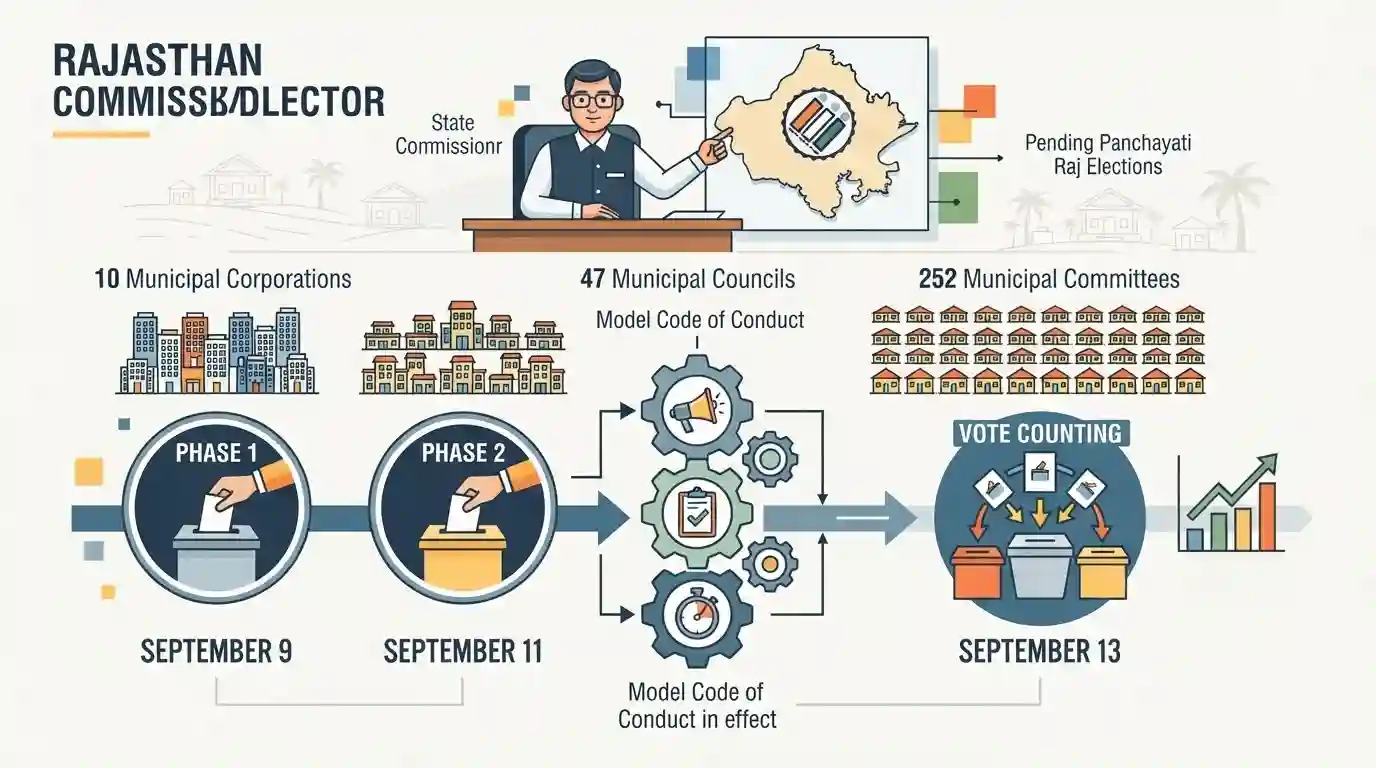
The Rajasthan State Election Commission has announced the schedule for the upcoming municipal elections in the state. The polls, encompassing 309 civic bodies (10 municipal corporations, 47 municipal councils, and 252 municipal committees), will be conducted in two phases on September 9 and 11. State Election Commissioner Rajeshwar Singh declared the immediate implementation of the model code of conduct. The vote counting is scheduled for September 13, amidst pending elections for the state's Panchayati Raj institutions.
Key Points
- The Rajasthan municipal polls are scheduled to take place in two phases on September 9 and September 11.
- A total of 309 civic bodies are going to polls, which include 10 municipal corporations, 47 municipal councils, and 252 municipal committees/boards.
- State Election Commissioner Rajeshwar Singh announced that the model code of conduct has come into force immediately.
- The counting of votes for the municipal elections will be held on September 13.
- Elections for the Panchayati Raj institutions in the state are also pending.
Important Terms
State Election Commission

An independent constitutional body established under Articles 243K and 243ZA, responsible for directing, supervising, and conducting elections for Panchayati Raj Institutions and Urban Local Bodies in Rajasthan.
UPSC context
RPSC Polity; tests constitutional articles, structural independence, and its distinction from the Election Commission of India.
Urban Local Bodies (ULBs)
Constitutionally recognized institutions of urban self-governance under Part IX-A (74th Amendment), comprising municipal corporations, councils, and municipalities to manage civic amenities and city development.
UPSC context
RPSC Polity; tests the 74th Amendment, 12th Schedule functional items, and the overarching urban governance framework.
Municipal Corporation (Nagar Nigam)
The highest tier of urban local governance in Rajasthan, governing large cities with populations typically over 5 lakhs. Rajasthan currently has 10 municipal corporations across seven major cities.
UPSC context
RPSC Local Government; often tests demographic thresholds, specific city names, and total corporation count.
Municipal Council (Nagar Parishad)
The middle tier of Rajasthan's urban local government system, established for smaller urban areas or mid-sized towns generally having a population between 1 lakh and 5 lakhs.
UPSC context
RPSC Local Government; tests structural hierarchy, body types, and population criteria for municipal classifications.
Municipality (Nagar Palika)
The base tier of urban local bodies in Rajasthan, designated for transitional areas or small towns with a population up to 1 lakh, facilitating grassroots urban administration.
UPSC context
RPSC Local Government; tests the three-tier classification of municipalities under the Constitution.
Prelims Trap
"The State Election Commissioner is appointed by the Governor and holds office during the pleasure of the Governor."
While appointed by the Governor, the SEC does NOT hold office during their pleasure. They are removed by the President in the same manner as a High Court judge.
Static Concepts Connected
What constitutional provisions govern the State Election Commission (SEC)?
- Article 243K: Vests the superintendence, direction, and control of electoral rolls and conduct of Panchayat elections in the SEC.
- Article 243ZA: Extends the SEC's authority to conduct and supervise elections for Municipalities (Urban Local Bodies).
- Removal Process: Ensures independence; the SEC can only be removed on like grounds and in a like manner as a Judge of a High Court.
How are Urban Local Bodies (ULBs) structured in Rajasthan?
- Three-Tier System: Includes Municipal Corporations (larger urban areas), Municipal Councils (smaller areas), and Municipal Boards (transitional areas).
- Minimum Wards: Under the Rajasthan Municipalities Act 2009, the minimum number of wards required to constitute a municipality is 13.
Cross-Topic Patterns
MCC enforcement in Local Polls
The Model Code of Conduct comes into force immediately upon the SEC's announcement. RPSC often tests the nuances of MCC enforcement in local polls versus general elections.
Constitutional mandate for timely elections
Articles 243E and 243U mandate elections before the 5-year term expires. The pending Panchayati Raj elections in Rajasthan highlight constitutional compliance issues, a frequent theme in Mains.

Expect multi-statement questions testing Articles 243K/243ZA alongside the specific removal process of the State Election Commissioner.
Linked PYQs · 3
Linked PYQs · 3
- 2016RPSC_PRELIMSGS1
The State Election Commission of Rajasthan is
- 2023RPSC_PRELIMSGS1
Consider the following statements regarding the State Election Commission of Rajasthan: (i) It was constituted in July 1994 under Article 243 T of the Constitution of India. (ii) It is a one-member commission headed by the State Election Commissioner.
- 2021RPSC_PRELIMSGS1
According to the provisions of the Rajasthan Municipal Act, 2009, what is the maximum number of persons that the State Government can nominate in a Municipal Council?
