Urban local bodies autonomy and municipal governance in Maharashtra
Source:orfonline ↗
Why It Matters
Crucial for understanding the realities of urban local governance, decentralization challenges, and state-local fiscal relations in Maharashtra.
Summary
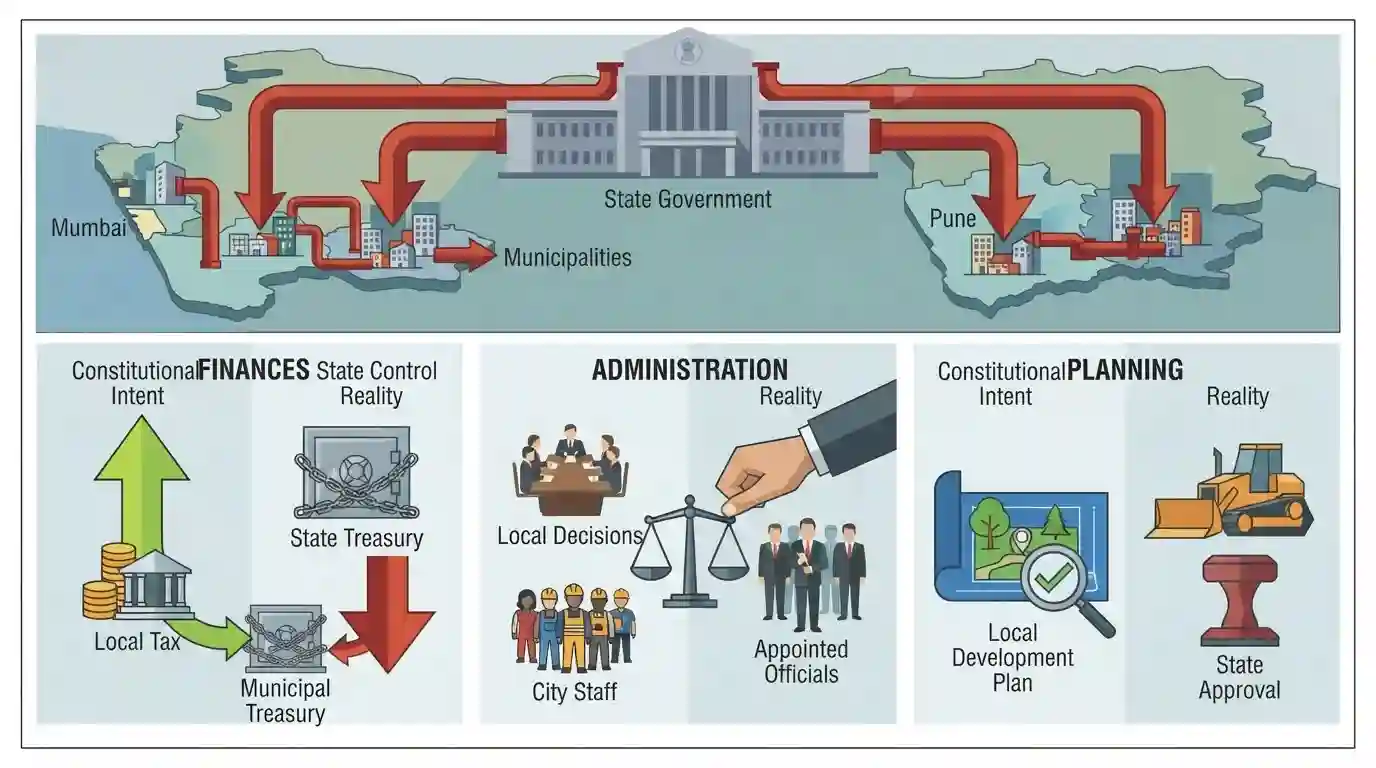
The article analyses municipal governance in Maharashtra, highlighting the persistent gap between the constitutional intent of urban local autonomy under the 74th Constitutional Amendment Act and the heavy control exerted by the state government over local finances, administration, and planning.
Key Points
- Urban local bodies and municipal corporations in Maharashtra face structural limitations on true administrative and fiscal autonomy despite the 74th Constitutional Amendment Act.
- State governments retain extensive control over municipal governance, urban planning, and revenue streams, undermining decentralized self-governance.
- Delayed municipal elections and state bureaucratic oversight hinder grassroots democratic representation in urban centers of Maharashtra.
Important Terms
74th Constitutional Amendment Act

A landmark 1992 constitutional amendment adding Part IXA and the 12th Schedule to India’s Constitution, granting formal constitutional status to urban local bodies to ensure decentralization and local self-government.
UPSC context
Crucial for MPSC General Studies Paper II (Polity and Governance), testing knowledge of decentralization, local self-government, and constitutional provisions.
Maharashtra State Government
The executive and legislative governing body of the state of Maharashtra, which holds overriding control over municipal administration, finances, and planning under various state municipal acts.
UPSC context
Important for MPSC Polity and Maharashtra Administration, evaluating centre-state-local fiscal relations and state-level devolution of powers.
Municipal Corporations
Local government bodies established for the administration of larger urban areas in Maharashtra, governed under specific state legislations like the Mumbai Municipal Corporation Act and Maharashtra Municipal Corporation Act.
UPSC context
Tested in MPSC Polity and Governance papers regarding urban governance structures, municipal finance, and administrative autonomy.
Static Concepts Connected
What are the key constitutional provisions and structures under the 74th Amendment Act, 1992?
- Part IXA: Introduced Part IXA (Articles 243P to 243ZG) to institutionalize urban local bodies across India.
- Types of ULBs: Classifies ULBs into Nagar Panchayats, Municipal Councils, and Municipal Corporations based on population size.
- Planning Committees: Mandates constitution of Wards Committees and Metropolitan Planning Committees (Article 243ZE) for mega-cities.
- Twelfth Schedule: Lists 18 functional items in the Twelfth Schedule intended for devolution to urban bodies.
Cross-Topic Patterns
Urban Planning vs State Parastatals
The 74th Amendment mandates Metropolitan Planning Committees (Article 243ZE), yet state-level parastatals often bypass elected mayors, mirroring federal-state tensions in statutory devolution.

Expect a statement-based MPSC question on Article 243ZE (Metropolitan Planning Committees) and Twelfth Schedule functions versus actual devolution.
Linked PYQs · 2
Linked PYQs · 2
- 2025MPSC_PRELIMSGS1
Which of the following Constitution Amendment Acts provided for the formation of the 'Metropolitan Planning Committee' ?
- 2021MPSC_PRELIMSGS1
According to the 74th amendment act, 1992 of the Indian Constitution there are ______ types of Municipalities in urban India.
