Jaishankar Discusses Peace Efforts with Ukrainian Minister
Source:The Hindu ↗
Why It Matters
This development is important for UPSC aspirants as it underscores India's evolving role as a potential mediator or constructive actor in global conflicts, particularly the Russia-Ukraine war. It also highlights the significance of the Munich Security Conference as a platform for critical geopolitical dialogues.
Summary
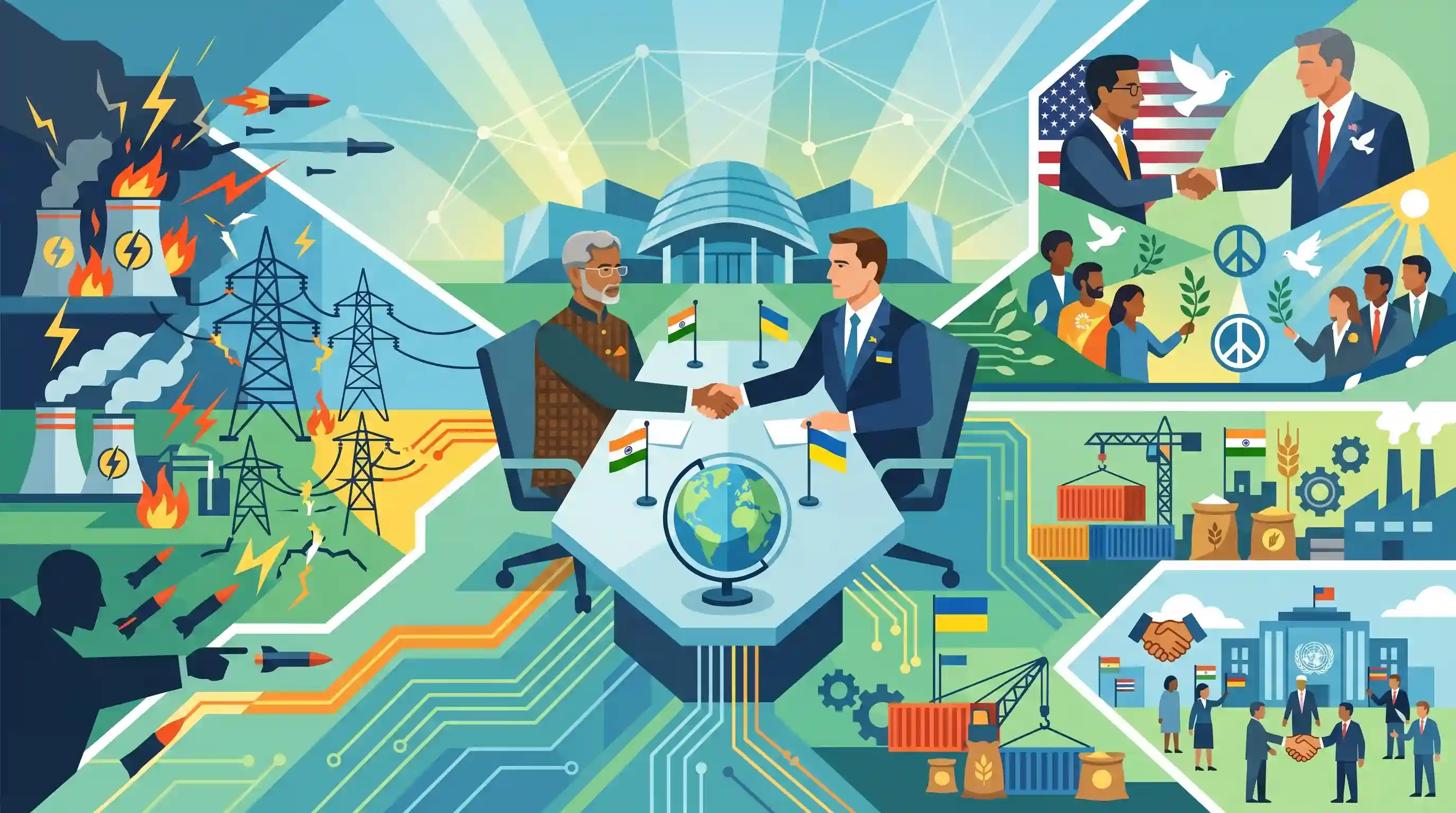
External Affairs Minister S. Jaishankar met Ukrainian Foreign Minister Andrii Sybiha on the sidelines of the Munich Security Conference. The bilateral talks focused on the ongoing Russia-Ukraine conflict, particularly Russian attacks on Ukraine's energy infrastructure, and the progress of US-led peace negotiations. Jaishankar emphasized India's continued willingness to constructively contribute to international peace efforts. The two leaders also discussed strengthening bilateral ties through expanded trade and enhanced cooperation in international organizations.
Key Points
- External Affairs Minister S. Jaishankar met Ukrainian counterpart Andrii Sybiha at the Munich Security Conference.
- Discussions covered the on-ground situation in Ukraine and Russian strikes targeting Ukraine's energy systems.
- They deliberated on ongoing US-led negotiations aimed at ending the Russia-Ukraine conflict.
- Jaishankar reiterated India's commitment to constructively engaging in international peace efforts.
- The leaders also discussed deepening bilateral ties, expanding trade, and cooperating within international organizations.
Important Terms
Munich Security Conference

An annual high-level global forum held in Germany (since 1963) for debating international security policy, bringing together world leaders and experts to address urgent global security threats.
UPSC context
GS Paper 2 (International Relations). Tests knowledge of major multilateral platforms where India articulates its strategic stance on global conflicts.
Strategic Autonomy
A nation's capacity to pursue its national interests and make sovereign foreign policy decisions without being constrained by external pressures, alliances, or bloc politics.
UPSC context
GS Paper 2 (Foreign Policy). Fundamental to understanding India's "middle path" and refusal to join sanctions during the Russia-Ukraine war.
India-Ukraine Bilateral Relations
Diplomatic ties established in 1992, covering defense, education, and trade. Ukraine is a critical supplier of military components and was home to thousands of Indian students before the 2022 conflict.
UPSC context
GS Paper 2 (Bilateral Groupings). Focuses on India's evolving diplomatic balance and its role in humanitarian and post-war reconstruction efforts.
Energy Security
The uninterrupted availability of energy sources at affordable prices. In the Ukraine context, it involves protecting critical infrastructure from systematic military attacks to prevent regional blackouts.
UPSC context
GS Paper 2 & 3 (IR/Energy). Relevant to global supply chain stability and India's pragmatic energy procurement policies.
International Peace Initiatives
The diplomatic act of a neutral third party facilitating peace talks between conflicting states. India is increasingly seen as an "interlocutor" capable of engaging both Moscow and Kyiv.
UPSC context
GS Paper 2 (International Relations). Examines India's potential transition from a passive observer to an active mediator in global conflicts.
Prelims Trap
The Munich Security Conference is an official intergovernmental summit organized by NATO.
MSC is an independent, non-governmental forum established in 1963 to debate international security. It is not an official treaty-based organization or organ of NATO/UN.
Static Concepts Connected
What distinguishes India's 'Strategic Autonomy' from traditional 'Non-Alignment'?
- Core Philosophy: While Non-Alignment focused on avoiding Cold War military blocs, Strategic Autonomy emphasizes issue-based multi-alignment to actively maximize national interests.
- Current Application: Simultaneously maintaining deep defense/energy ties with Russia while actively participating in the Quad and offering to mediate peace in Ukraine.
How do the Geneva Conventions protect civilian infrastructure during conflict?
- Indispensable Objects: Additional Protocol I (1977) explicitly prohibits attacking, destroying, or removing objects indispensable to the survival of the civilian population.
- Dual-Use Dilemma: Attacking energy infrastructure is a war crime unless it provides direct military support and its destruction offers a definite, proportional military advantage.
Cross-Topic Patterns
Geopolitics of Edible Oils
Disruptions to Ukrainian sunflower oil imports expose India's vulnerabilities, directly linking the Russia-Ukraine conflict to domestic agricultural policies like the National Mission on Edible Oils - Oil Palm (NMEO-OP).
Voice of the Global South
India leverages its neutral stance to position itself as a credible peace-broker, representing developing nations (Global South) that are disproportionately affected by the conflict's food, fuel, and fertilizer inflation.

Expect a 2026 Prelims question testing the independent, non-governmental nature of the Munich Security Conference against official UN forums.
Linked PYQs · 2
Linked PYQs · 2
- 2023MainsGS2
‘Virus of Conflict is affecting the functioning of the SCO’ In the light of the above statement point out the role of India in mitigating the problems.
- 2017PrelimsGS1
Consider the following statements: 1. The Nuclear Security Summits are periodically held under the aegis of the United Nations. 2. The International Panel on Fissile Materials is an organ of International Atomic Energy Agency. Which of the statements given above is/are correct?
