India Ukraine Diplomatic Engagement at Munich Security Conference
Source:The Hindu ↗
Why It Matters
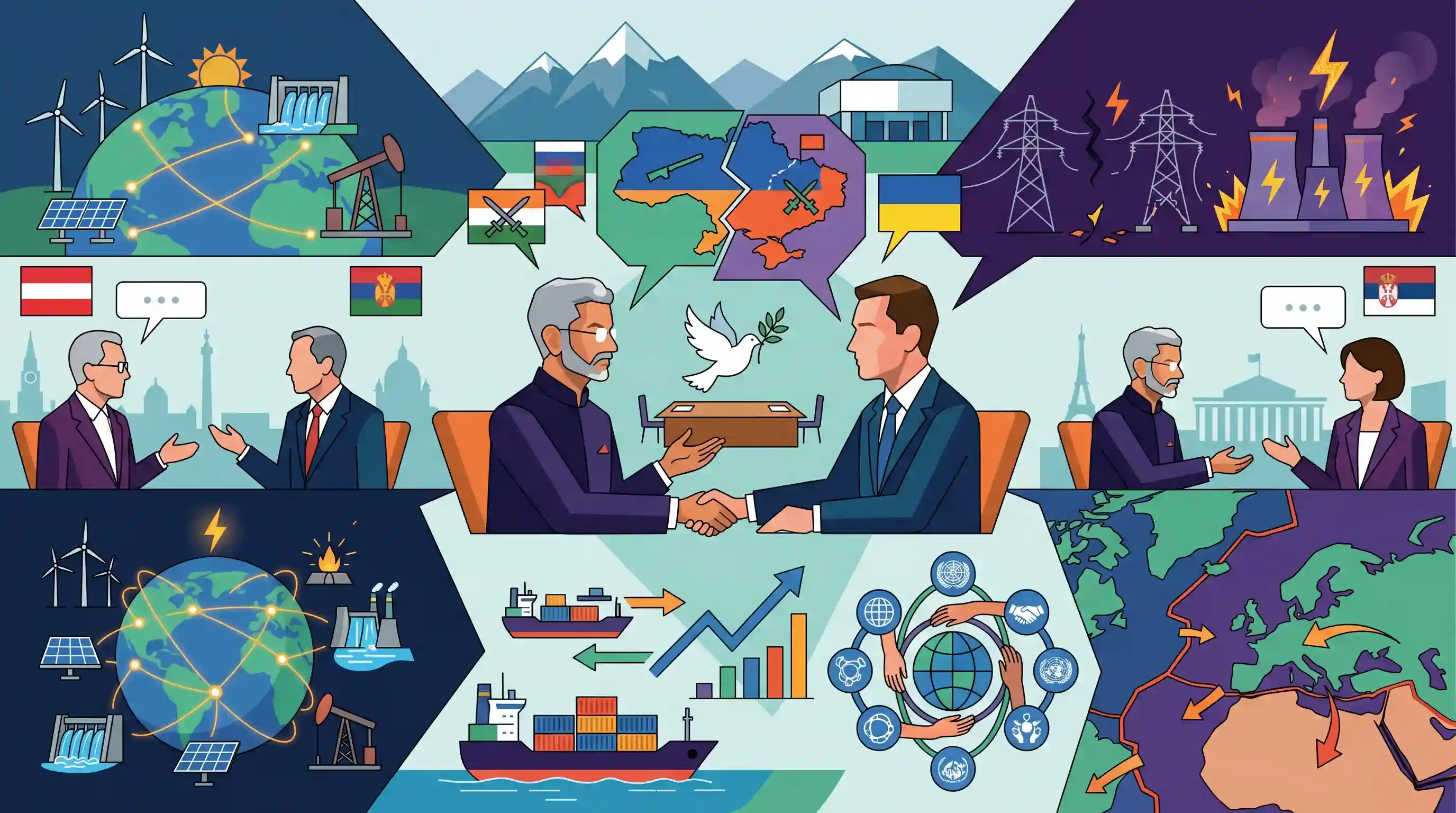
This interaction demonstrates India's active diplomatic engagement and strategic balancing act regarding the Russia-Ukraine conflict. It reflects India's interest in shaping a peaceful resolution through dialogue while securing its own interests amidst changing European geopolitics and global energy uncertainties.
Summary
External Affairs Minister S. Jaishankar held a bilateral meeting with Ukrainian Foreign Minister Andrii Sybiha at the Munich Security Conference 2026. Their talks centered on the ongoing Russia-Ukraine conflict, specifically the progress of US-led peace negotiations, and the severe impact of Russian attacks on Ukraine's energy grid. Beyond the conflict, both diplomats underscored the need to expand bilateral trade and enhance cooperation in international forums. Jaishankar’s diplomatic outreach in Munich also included productive talks with the foreign ministers of Austria and Serbia, focusing on broader issues of global energy security and shifting geopolitical alignments in Europe.
Key Points
- EAM S. Jaishankar met Ukrainian Foreign Minister Andrii Sybiha on the sidelines of the Munich Security Conference.
- Discussions heavily focused on the current status of the US-led peace negotiations concerning the Russia-Ukraine conflict.
- The impact of Russian strikes on Ukraine's energy systems and infrastructure was a key concern discussed.
- Both nations aim to deepen ties, expand bilateral trade, and cooperate within multilateral international organisations.
- Jaishankar also held bilateral meetings with Austrian and Serbian counterparts, discussing global energy flows and regional cooperation.
Important Terms
Munich Security Conference (MSC)

The world's leading forum for debating international security policy, held annually in Germany. It serves as a 'marketplace of ideas' for high-level diplomatic and security strategies.
UPSC context
GS Paper II: Important for understanding multilateral security dialogues and India's positioning as a 'stabilizing force' in global conflicts.
Strategic Autonomy
India's core foreign policy principle of making independent decisions based on national interest, balancing relations with competing global powers without joining formal military alliances.
UPSC context
GS Paper II: A recurring theme in India's balancing act between the West (USA/EU) and Russia.
Global Energy Security
The assured, uninterrupted availability of energy resources at affordable prices. It involves protecting infrastructure and diversifying supply chains to ensure national economic stability.
UPSC context
GS Paper III: Vital for understanding how international conflicts (like Russia-Ukraine) impact India's energy imports and inflation.
Geopolitical Alignments
The strategic positioning and alliances of nations based on shared interests or security concerns, which often shift during major regional conflicts.
UPSC context
GS Paper II: Analyzes the fragmentation of global trade and supply chains based on strategic rather than economic efficiency.
Bilateral Relations
The conduct of political, economic, or cultural relations between two sovereign states, such as the growing cooperation between India and Ukraine in trade and defense.
UPSC context
GS Paper II: Fundamental to India's foreign policy; tests knowledge of specific agreements and strategic partnerships.
United States (US)
A primary global power and key mediator in the Russia-Ukraine conflict. Its shifting domestic policies toward isolationism or engagement significantly impact transatlantic security.
UPSC context
GS Paper II: Focuses on the effect of US policies on India's strategic interests and global peace frameworks.
Prelims Trap
"The Munich Security Conference is a UN-mandated intergovernmental organization."
The MSC is an independent, non-governmental forum (often dubbed the 'Davos of Defense'). It is not a UN body and passes no binding resolutions.
Static Concepts Connected
What is the mandate and nature of the Munich Security Conference?
- Independent forum: Serves as an independent, non-governmental platform for informal global security dialogue, lacking binding treaty powers.
- Historical origins: Established in 1963 during the Cold War to address Western security; now a global diplomatic platform.
- 'Davos of Defense': Facilitates high-level sideline diplomacy and off-the-record discussions among state and non-state actors without formal resolutions.
What defines India's strategy of 'Multi-alignment' in modern conflicts?
- Issue-based partnerships: Maintaining concurrent, robust partnerships across rival power centers (e.g., US, Russia, Europe) without exclusive alliance commitments.
- Strategic Autonomy: Prioritizing vital domestic interests, such as energy and defense procurement, while advocating for dialogue and diplomacy.
Cross-Topic Patterns
Energy Security + Strategic Autonomy
India's navigation of European energy disruptions bridges international relations strategy with domestic macroeconomic stability, emphasizing supply-chain diversification amidst sanctions.
NAM Legacy + Modern Diplomacy
Engaging Serbia leverages historic Non-Aligned Movement capital (India-Yugoslavia ties) to secure modern defense, agriculture, and emerging technology cooperation.

MSC's non-governmental nature may be tested in 2026 Prelims as a paired-matching question alongside Shangri-La Dialogue & Raisina Dialogue.
Linked PYQs · 2
Linked PYQs · 2
- 2023MainsGS2
‘The expansion and strengthening of NATO and a stronger US-Europe strategic partnership works well for India.’ What is your opinion about this statement ? Give reasons and examples to support your answer.
- 2024MainsGS2
‘The West is fostering India as an alternative to reduce dependence on China's supply chain and as a strategic ally to counter China's political and economic dominance.’ Explain this statement with examples.
