India Strategic Posture and Global Security Architecture Role
Source:Indian Express ↗
কেন এটি গুরুত্বপূর্ণ
This article offers key external insights into how international institutions and Western policy leaders view India's strategic posture, multi-alignment strategy, and growing proactive role in global security architecture.
সারসংক্ষেপ
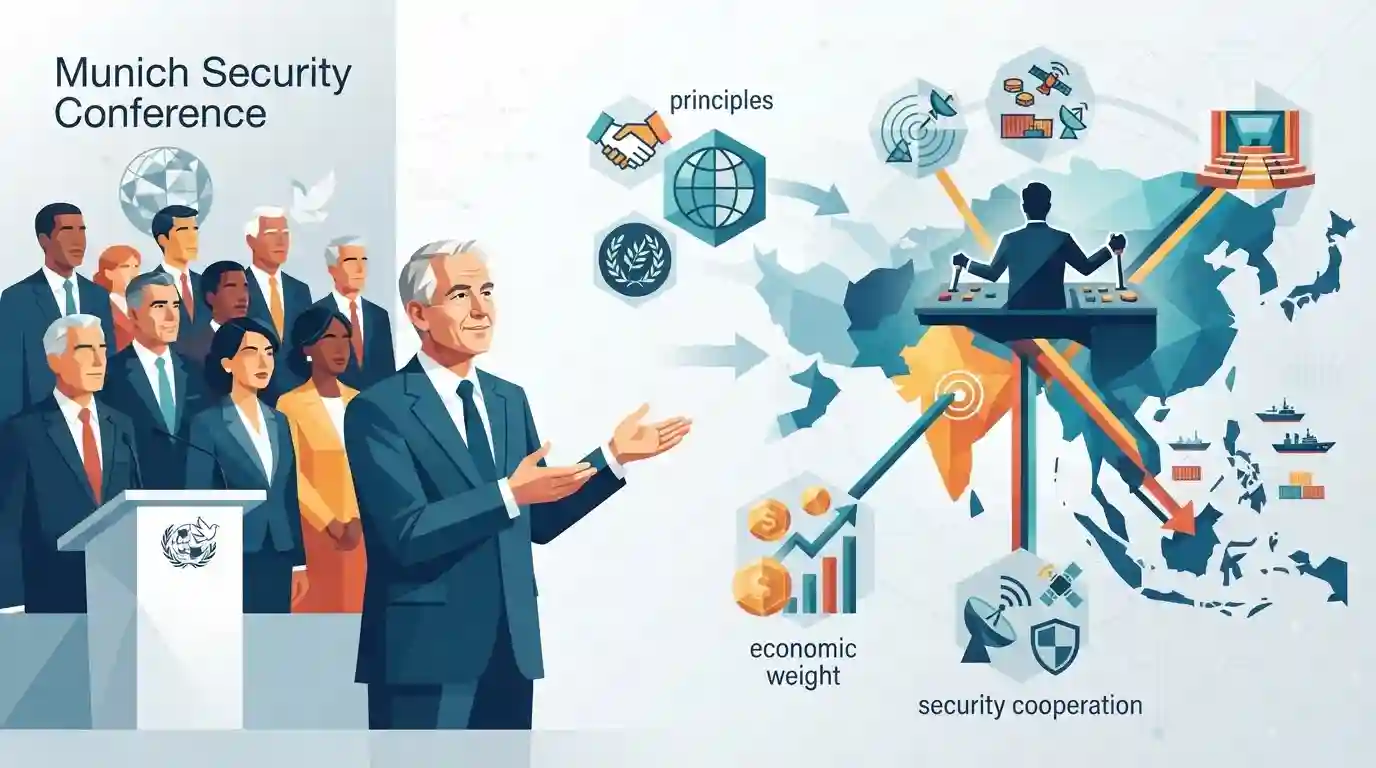
Munich Security Conference CEO Benedikt Franke praised India's evolving global diplomatic stance, stating that India is shifting from merely stating correct diplomatic principles to actively leveraging its diplomatic and economic weight on the global stage, particularly in security and Indo-Pacific geopolitics.
মূল বিষয়
- Munich Security Conference CEO Benedikt Franke noted that India is increasingly 'walking the talk' in international geopolitics rather than just articulating correct positions.
- India's role is viewed as vital by Western and European partners for stabilizing global supply chains and acting as a balancer in the Indo-Pacific.
- The shift reflects a growing convergence between India and Western security architectures amid evolving multi-polar dynamics.
গুরুত্বপূর্ণ শব্দ
Munich Security Conference

An annual high-level international conference dedicated to promoting conflict resolution, global security cooperation, and strategic dialogue, held in Munich, Germany.
UPSC context
UPSC GS Paper II (International Relations): Important international institutions, forums, and their mandate regarding global peace and security.
সংযুক্ত স্থির ধারণা
What are the core tenets and evolution of India’s policy of Strategic Autonomy?
- Historical Roots: Rooted in the Non-Aligned Movement (NAM), ensuring independent judgment on global issues without entering formal military alliances.
- Multi-alignment Shift: Transitioned from passive non-alignment to active multi-alignment, engaging competing major powers (US, Russia, Quad, BRICS) to maximize national interest.
- Modern Pragmatism: Prioritizes national security, strategic supply chain resilience, and maritime security in the Indo-Pacific without compromising diplomatic freedom.
আন্তঃবিষয় প্যাটার্ন
Strategic Autonomy vs. Western Alliance Systems
Strategic autonomy is frequently contrasted with traditional Western alliance systems, yet converging security imperatives in the Indo-Pacific are creating flexible minilateral partnerships like the Quad and AUKUS-adjacent dialogues.
Indo-Pacific Geopolitics and Supply Chain Resilience
India’s emphasis on secure supply chains and plurilateral infrastructure corridors (e.g., IMEC) directly bridges foreign policy diplomacy with domestic economic security and manufacturing goals.

Expect a statement-based question examining whether strategic autonomy precludes minilateral security cooperation like the Quad.
সংযুক্ত PYQ · 2
সংযুক্ত PYQ · 2
- 2024MainsGS2
‘The West is fostering India as an alternative to reduce dependence on China's supply chain and as a strategic ally to counter China's political and economic dominance.’ Explain this statement with examples.
- 2023MainsGS2
‘The expansion and strengthening of NATO and a stronger US-Europe strategic partnership works well for India.’ What is your opinion about this statement ? Give reasons and examples to support your answer.
