Mumbai municipal hospitals account for high civic power consumption
Source:Indian Express ↗
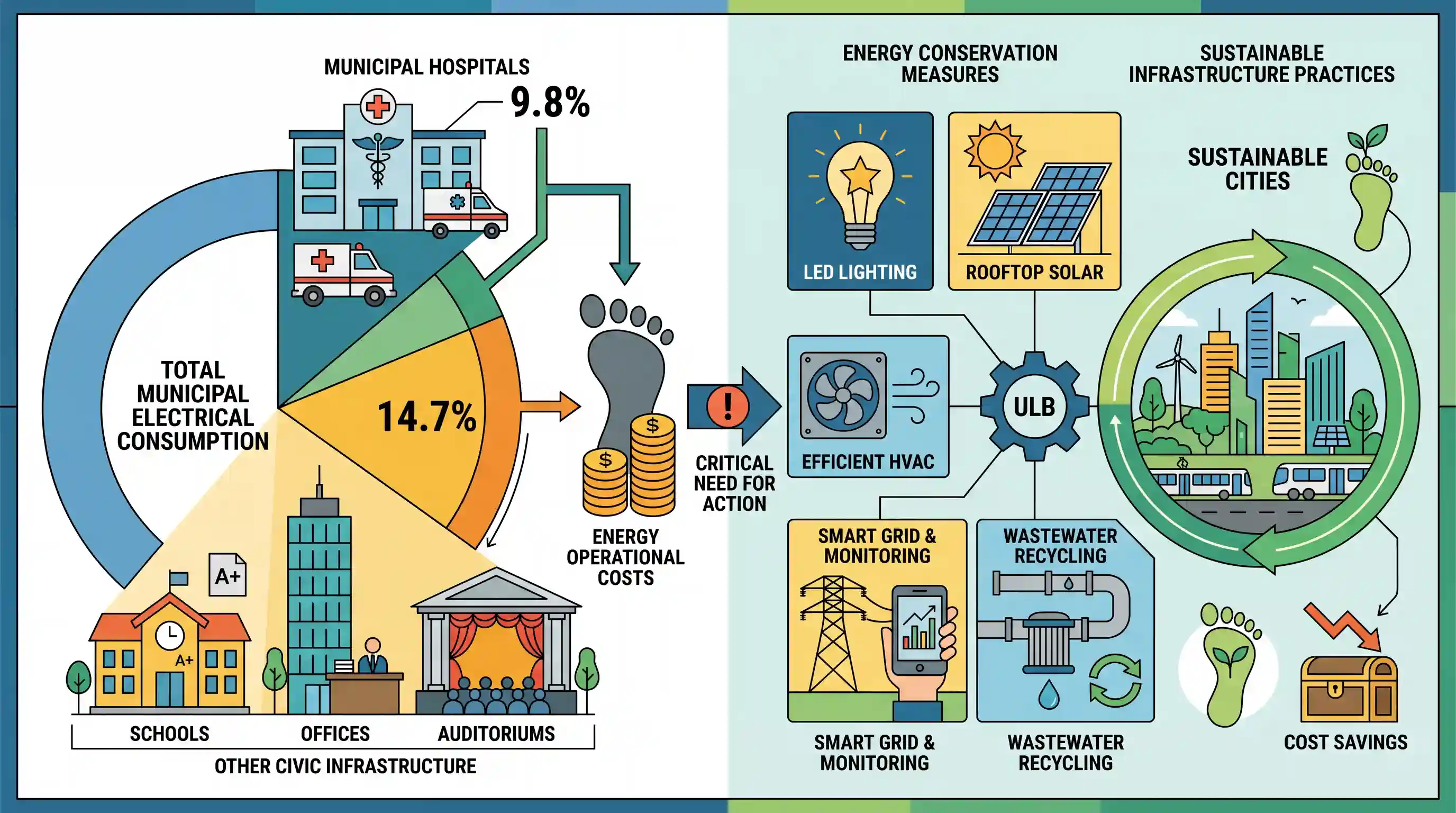
Why It Matters
Demonstrates the high resource and financial cost of running municipal infrastructure. Understanding the energy consumption patterns of civic bodies is vital for answering questions on the financial health of Urban Local Bodies (GS2) and the need for energy efficiency and sustainable infrastructure in urban planning (GS3 / GS1).
Summary
Mumbai's municipal hospitals account for 9.8% of the Brihanmumbai Municipal Corporation's (BMC) total electrical consumption, with overall civic infrastructure like schools, offices, and auditoriums contributing 14.7%. This highlights the substantial energy footprint and operational costs associated with urban public service delivery, emphasizing the critical need for Urban Local Bodies (ULBs) to adopt energy conservation measures and sustainable infrastructure practices.
Key Points
- Municipal hospitals in Mumbai account for 9.8% of the BMC's total electrical consumption.
- Civic infrastructure including schools, offices, hospitals, and auditoriums combined account for 14.7% of the corporation's electricity usage.
- The data highlights the significant operational and financial burden of energy consumption on urban local bodies.
- Underscores the need for integrating energy efficiency, green building standards, and renewable energy adoption within municipal infrastructure to promote sustainable urban governance.
Important Terms
Brihanmumbai Municipal Corporation (BMC)

India's richest civic body, responsible for Mumbai's administration. It operates a massive public infrastructure, including four medical college hospitals and 16 general hospitals, serving millions.
UPSC context
GS Paper II (Governance); highlights urban governance challenges and the scale of public service delivery in metropolitan areas.
Urban Local Bodies (ULBs)
Local self-government institutions in cities and towns, categorized as Municipal Corporations, Municipal Councils, or Nagar Panchayats based on population size and transition.
UPSC context
GS Paper II (Polity); essential for understanding democratic decentralization and the 'third tier' of Indian federalism.
74th Constitutional Amendment Act, 1992
A landmark 1992 legislation that granted constitutional status to ULBs, inserting Part IX-A and the Twelfth Schedule to strengthen urban local self-government.
UPSC context
GS Paper II (Polity); a core topic regarding constitutional provisions for decentralization and municipal powers.
Twelfth Schedule
A list of 18 functional items (e.g., public health, sanitation, urban planning) over which municipalities have jurisdiction, added by the 74th Amendment.
UPSC context
GS Paper II (Polity); defines the functional domain and service delivery responsibilities of urban governance bodies.
Energy Audit
A systematic assessment of energy use within a facility to identify inefficiencies and recommend conservation measures, aimed at reducing costs and carbon footprints.
UPSC context
GS Paper III (Environment & Economy); critical for sustainable infrastructure and fiscal management in public utilities.
SDG 11 (Sustainable Cities and Communities)
A global target to make cities inclusive, safe, resilient, and sustainable by 2030, focusing on affordable housing, public transport, and reduced environmental impact.
UPSC context
GS Paper III (Environment); provides the international framework for urban planning and resource conservation policies.
Prelims Trap
The Energy Conservation Building Code (ECBC) is mandatory for all municipal and residential buildings in India.
ECBC applies specifically to commercial buildings (including large municipal hospitals) with a connected load of 100 kW or more, not universally.
Static Concepts Connected
What is the Municipal Demand Side Management (MuDSM) programme?
- Nodal Agency: Initiated and implemented by the Bureau of Energy Efficiency (BEE) under the Ministry of Power.
- Core Objective: Aims to improve energy efficiency of urban public infrastructure, specifically targeting street lighting and municipal water pumping systems.
- Financial Impact: Reduces huge electricity bills of revenue-starved ULBs, freeing up capital for essential socio-economic and core infrastructure projects.
What are the primary sources of revenue for Urban Local Bodies (ULBs)?
- Own Source Revenue: Taxes (property, professional) and non-taxes (user charges, fees). This typically constitutes less than 40% of their total revenue.
- Grants & Devolution: Devolution of funds recommended by State Finance Commissions (SFCs) and grants-in-aid from the Central Finance Commission.
- Borrowings: Market borrowings such as issuing municipal bonds, though highly restricted and dependent on strict credit ratings.
Cross-Topic Patterns
Energy transition meets Municipal Finance
High energy OpEx severely strains ULBs' limited own-source revenues. Issuing green municipal bonds to solarize civic infrastructure directly links climate goals with urban financial autonomy.
Smart Cities & ECBC compliance
India's Smart Cities Mission increasingly relies on adopting the Energy Conservation Building Code (ECBC) to reduce the operational carbon footprint of urban public service delivery.

Expect a multi-statement question linking ULB financial autonomy (74th CAA) with BEE's municipal energy-saving schemes (MuDSM) in 2026.
Linked PYQs · 4
Linked PYQs · 4
- 2023MainsGS2
“The states in India seem reluctant to empower urban local bodies both functionally as well as financially.” Comment.
- 2024MainsGS2
Analyse the role of local bodies in providing good governance at local level and bring out the pros and cons merging the rural local bodies with the urban local bodies.
- 2021PrelimsGS1
The 'Common Carbon Metric', supported by UNEP, has been developed for
- 2025MainsGS1
How does smart city in India, address the issues of urban poverty and distributive justice?
