Railway Infrastructure Maintenance and Public Accountability
Source:Indian Express ↗
Why It Matters
Railway safety is a vital component of India's transport infrastructure (GS-3). The judicial intervention holding authorities accountable for negligence highlights governance deficits and emphasizes the need for institutional responsibility and proactive maintenance (GS-2).
Summary
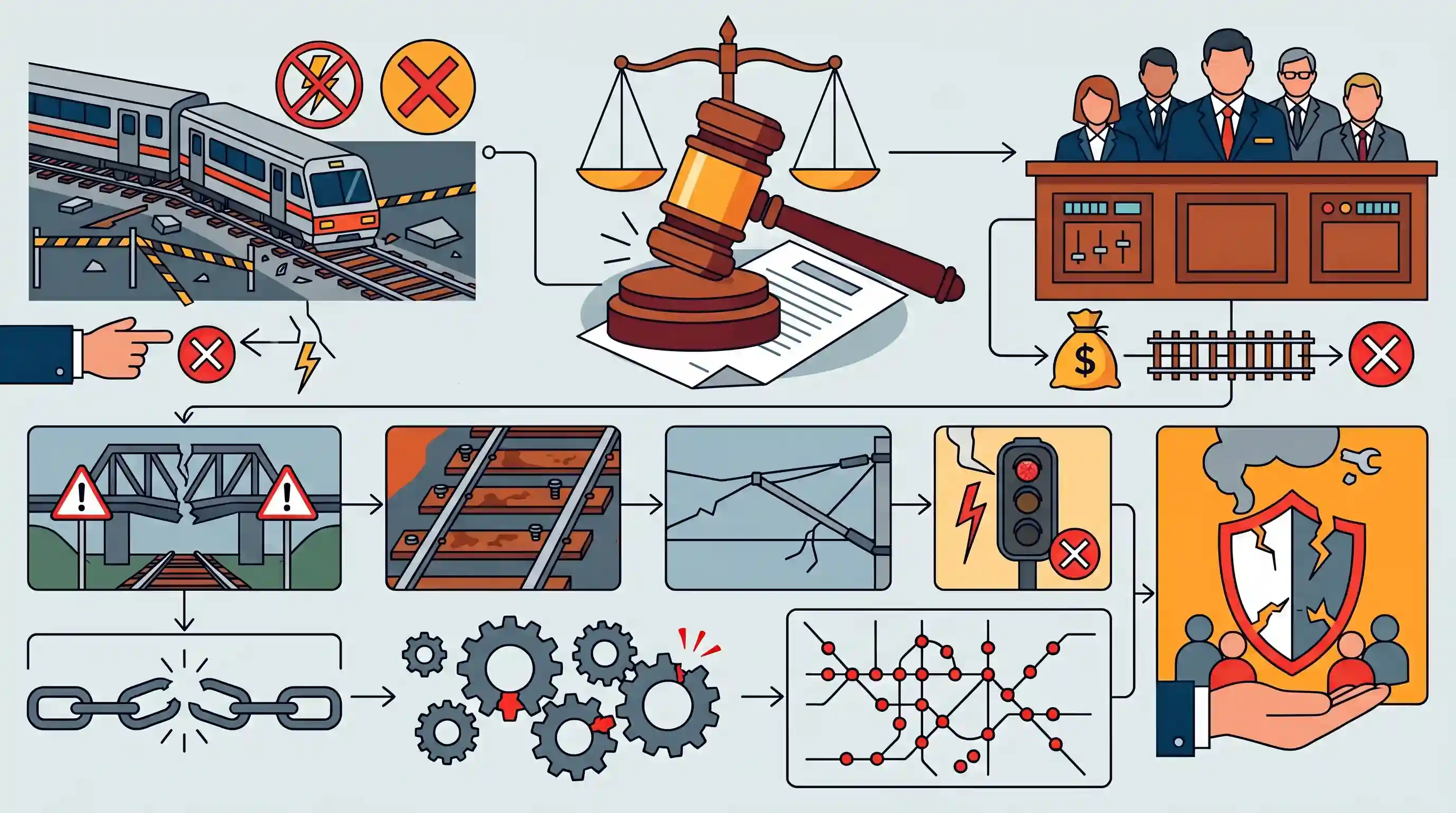
A court has ruled that a train incident in Mumbra was not just a mere accident but an avoidable tragedy caused by the failure of Railway authorities to carry out essential infrastructural work. By holding the authorities accountable, the ruling highlights the responsibility of public utilities to ensure passenger safety and points out systemic deficits in railway maintenance and infrastructure management.
Key Points
- A court ruled that the Mumbra train incident was an avoidable tragedy, not a mere accident.
- The incident resulted from the failure of Railway authorities to carry out essential maintenance and infrastructure work.
- The ruling emphasizes the legal accountability of public utility services in ensuring passenger safety.
- It underscores the critical need for systemic upgrades and regular maintenance in India's railway infrastructure to prevent avoidable casualties.
Important Terms
Indian Railways

India's state-owned national railway system, operated by the Ministry of Railways. It is the world's fourth-largest network and a vital public utility for socio-economic connectivity.
UPSC context
GS Paper III: Infrastructure and GS Paper II: Governance (Public Utilities). Tests knowledge of state-led infrastructure management.
Railway Authorities
The administrative and engineering bodies (e.g., General Managers, Divisional Engineers) responsible for the operation, maintenance, and safety of railway zones and divisions under the Ministry of Railways.
UPSC context
GS Paper IV: Ethics (Accountability) and GS Paper II: Statutory Bodies. Tests understanding of executive responsibility and administrative negligence.
Railway Claims Tribunal (RCT)
A quasi-judicial body established to adjudicate claims for compensation against the Railway Administration for loss, damage, or personal injury/death resulting from railway accidents or untoward incidents.
UPSC context
GS Paper II: Dispute Redressal Mechanisms and Quasi-judicial bodies. Tests knowledge of specialized legal forums for citizen relief.
Vicarious Liability
A legal principle where an employer or principal is held responsible for the negligent acts or omissions of their employees/agents committed during the course of employment.
UPSC context
GS Paper II: Constitutional/Administrative Law. Crucial for understanding the state’s liability for the tortious acts of its servants.
Railways Act, 1989
The primary legislation governing rail transport in India, detailing the powers of the railway administration, passenger rights, and the legal framework for compensation in case of accidents.
UPSC context
GS Paper II: Important Acts/Legislation. Tests understanding of the statutory basis for public transport safety and liability.
Culpable Homicide
An offense where a person causes death through acts done with the intention or knowledge that they are likely to cause death, but without the malice required for murder.
UPSC context
GS Paper II: Criminal Justice System. Relevant when negligence by public officials leads to loss of life (e.g., under BNS Section 105).
Prelims Trap
"The Commission of Railway Safety (CRS) is a statutory body operating under the Ministry of Railways."
To ensure independent safety oversight and prevent conflicts of interest, the CRS operates under the Ministry of Civil Aviation, not Railways.
Static Concepts Connected
What is the Constitutional Tort doctrine under Indian Public Law?
- Strict Liability: The State is held strictly liable to pay compensation when actions of its public servants violate a citizen's fundamental Right to Life (Article 21).
- Public Law Remedy: It acts as a public law remedy granted by constitutional courts, distinct from private civil tort claims, focusing on systemic governance failures.
- Sovereign Immunity Exception: It restricts the State's ability to claim "sovereign immunity" as a defense when fundamental rights are breached due to negligence.
What are the core technical components of the Kavach system?
- Indigenous ATP: It is a Safety Integrity Level-4 (SIL-4) certified Automatic Train Protection (ATP) system.
- RFID & Radio Communication: It uses RFID tags on tracks and radio communication to track train movement and proximity.
- Automatic Braking: It automatically applies brakes if a pilot overspeeds or passes a Signal at Danger (SPAD), preventing collisions.
Cross-Topic Patterns
CAG reports on dedicated safety funds
The CAG's findings on the underutilization and diversion of the Rashtriya Rail Sanraksha Kosh (RRSK) link financial accountability (GS-2) directly to infrastructural disasters and disaster management (GS-3).
Judicial push for systemic accountability
Courts holding authorities accountable for "avoidable tragedies" connects to the expanding scope of Article 21, moving from mere post-disaster compensation to mandating systemic governance upgrades through constitutional torts.

Expect a mixed Prelims question linking independent safety oversight (CRS under Civil Aviation) with RRSK fund underutilization in 2026.
Linked PYQs · 3
Linked PYQs · 3
- 2022MainsGS3
Why is Public Private Partnership (PPP) required in infrastructural projects ? Examine the role of PPP model in the redevelopment of Railway Stations in India.
- 2021MainsGS3
“Investment in infrastructure is essential for more rapid and inclusive economic growth.” Discuss in the light of India's experience.
- 2024MainsGS2
“The duty of the Comptroller and Auditor General is not merely to ensure the legality of expenditure but also its propriety.” Comment.
