Mumbai road tunnel project beneath Sanjay Gandhi National Park
Source:Indian Express ↗
Why It Matters
Provides a compelling case study on the conflict and synergy between mega-infrastructure projects and environmental conservation. It is highly relevant for GS3 questions on Environmental Impact Assessments (EIA), urban transport planning, and the sustainable development of cities containing ecologically sensitive zones.
Summary
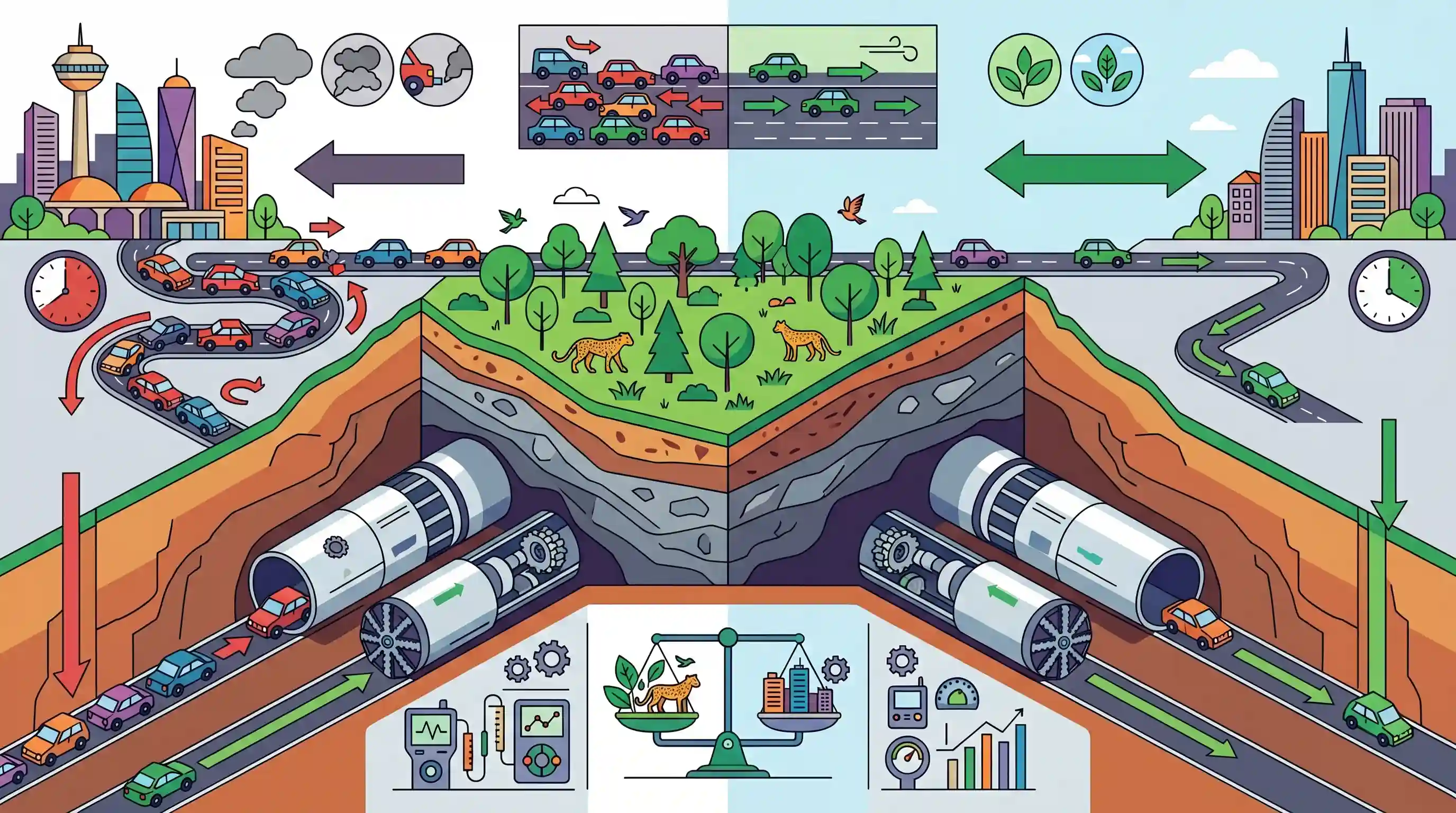
The Mumbai Metropolitan Region Development Authority (MMRDA) is set to commence drilling for Mumbai's longest twin road tunnels beneath the Sanjay Gandhi National Park (SGNP), connecting Thane and Borivali. The 11.8 km subterranean infrastructure project aims to dramatically reduce travel time between the two hubs from over an hour to roughly 20 minutes, thereby cutting carbon emissions and alleviating surface traffic congestion. By employing advanced Tunnel Boring Machines (TBMs) deep below the surface, the state authorities aim to minimize the environmental impact on SGNP, attempting to balance crucial urban mobility requirements with the preservation of a protected ecological zone.
Key Points
- The ambitious twin-tunnel project will connect Thane and Borivali, slashing travel time from over 60 minutes to approximately 15-20 minutes.
- At roughly 11.8 kilometers in length, it is slated to become Mumbai’s longest road tunnel.
- The route will be carved entirely beneath the ecologically sensitive Sanjay Gandhi National Park (SGNP), a unique protected forest located within city limits.
- Executed by the MMRDA, the project will utilize Tunnel Boring Machines (TBMs) deep underground to prevent surface-level disruption to the park's rich biodiversity and wildlife.
- The infrastructure upgrade is expected to ease massive traffic congestion on the Ghodbunder Road and significantly reduce vehicular emissions.
Important Terms
MMRDA (Mumbai Metropolitan Region Development Authority)

A statutory body established in 1975 responsible for long-term planning, infrastructure development, and coordinating investments within the Mumbai Metropolitan Region.
UPSC context
GS Paper 2: Statutory and regulatory bodies; GS Paper 3: Infrastructure and urban planning.
Sanjay Gandhi National Park (SGNP)
A 103 sq km protected area in Mumbai, unique for being a large national park situated within metropolitan limits, housing diverse biodiversity and ancient Kanheri Caves.
UPSC context
GS Paper 3: Conservation, environmental pollution, and degradation; protected area management.
Environmental Impact Assessment (EIA)
A statutory process under the Environment (Protection) Act, 1986, used to evaluate the potential environmental, social, and economic impacts of a proposed developmental project.
UPSC context
GS Paper 3: Environment; mandatory for large-scale infrastructure projects to balance development and conservation.
National Board for Wildlife (NBWL)
A statutory body constituted under the Wildlife (Protection) Act, 1972, that reviews and approves projects involving forest land in and around protected areas.
UPSC context
GS Paper 2: Statutory bodies; GS Paper 3: Wildlife conservation and legal frameworks.
Tunnel Boring Machine (TBM)
A massive excavation machine used to bore tunnels with a circular cross-section through various strata, minimizing surface vibration and disruption in sensitive urban or ecological zones.
UPSC context
GS Paper 3: Infrastructure (Roads/Railways) and scientific advancements in engineering.
Urban Mobility
The strategic movement of people within cities using diverse transport modes, focusing on efficiency, sustainability, and reducing carbon footprints in rapidly expanding urban centers.
UPSC context
GS Paper 3: Infrastructure and Economic Development; challenges of urbanization and sustainable transport.
Prelims Trap
Subterranean projects beneath National Parks are exempt from NBWL clearance as they do not alter the surface forest.
False. Under the Wildlife (Protection) Act, 1972, any alteration, including underground tunneling through a Protected Area, mandates strict clearance from the National Board for Wildlife (NBWL).
Static Concepts Connected
What are the key ecological and historical features of Sanjay Gandhi National Park?
- Unique Location: It is one of the few national parks globally situated entirely within metropolis limits. It forms a crucial part of the Western Ghats biodiversity network.
- Urban Watershed: Acts as a catchment area for Vihar and Tulsi lakes; it is the origin point for Mumbai's rivers, including Dahisar, Mithi, Poisar, and Oshiwara.
- Heritage (Kanheri Caves): The park houses the ancient Buddhist Kanheri Caves, featuring rock-cut monuments and inscriptions dating from the 1st century BCE to the 10th century CE.
What is the regulatory framework for infrastructure projects inside National Parks?
- Wildlife Protection Act, 1972: Section 35(6) prohibits destruction or removal of wildlife/habitat without State government permission, which is granted only after consulting the National Board for Wildlife (NBWL).
- Supreme Court Mandate: Following historical rulings, any non-forest or commercial activity within a National Park or Wildlife Sanctuary requires prior approval from the Supreme Court of India.
- Environment (Protection) Act, 1986: Developmental activities in the immediate periphery of National Parks are regulated through Eco-Sensitive Zone (ESZ) notifications under this Act.
Cross-Topic Patterns
Eco-tunnels & Wildlife Corridors
Like the NH-44 animal underpasses in Pench, the SGNP TBM tunnel showcases modern mitigation strategies balancing mega-infrastructure with habitat contiguity in Protected Areas.
Urban watersheds & Mithi river flooding
SGNP gives rise to the Mithi river. Ecological disruptions here connect directly to UPSC's recurring disaster-management theme of Mumbai/Chennai urban flooding and wetland loss.

Expect a multi-statement question on SGNP's geography (Kanheri caves, Vihar lake, Mithi river) paired with wildlife clearance frameworks.
Linked PYQs · 4
Linked PYQs · 4
- 2014MainsGS3
Environmental Impact Assessment studies are increasingly undertaken before a project is cleared by the Government. Discuss the environmental impacts of coal-fired thermal plants located at coal pitheads.
- 2024MainsGS3
What role do environmental NGOs and activists play in influencing Environmental Impact Assessment (EIA) outcomes for major projects in India? Cite four examples with all important details.
- 2014MainsGS3
National Urban Transport Policy emphasises on 'moving people' instead of 'moving vehicles'. Discuss critically the success of the various strategies of the Government in this regard.
- 2021MainsGS3
“Investment in infrastructure is essential for more rapid and inclusive economic growth.” Discuss in the light of India's experience.
