Mumbai Water Cut and Pre Monsoon Urban Flood Preparedness
Source:The Hindu ↗
Why It Matters
Highlights the compound urban governance challenges of ensuring water security amid climate phenomena like El Niño, managing urban flood risks, and leveraging technology for civic grievance redressal.
Summary
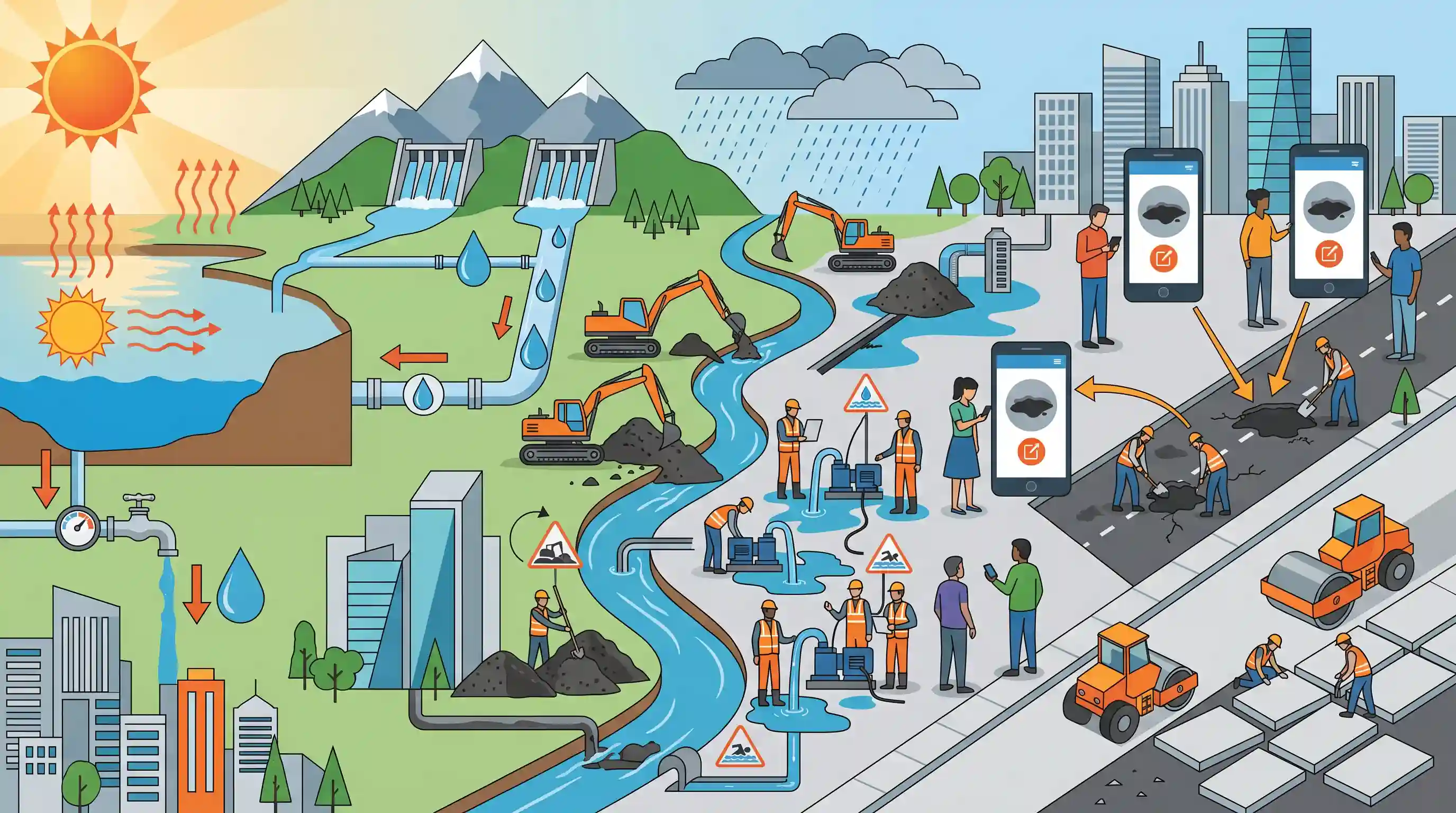
The Brihanmumbai Municipal Corporation (BMC) has announced a 10% water cut in Mumbai starting May 15 to safeguard water reserves against rising temperatures and the El Niño effect, while seeking additional supply from the Bhatsa and Vaitarna dams. Concurrently, the BMC is advancing pre-monsoon disaster preparedness by desilting drains and the flood-prone Mithi River, and deploying hundreds of dewatering pumps across 93 waterlogging hotspots. To address urban infrastructure issues, the civic body has launched the 'Pothole QuickFix' app for citizen-led reporting, complementing ongoing road concretisation projects.
Key Points
- Mumbai will face a 10% water cut starting May 15 to conserve water amid rising temperatures and the El Niño effect.
- The BMC has requested the Maharashtra government to allocate additional water reserves from the Bhatsa and Vaitarna dams.
- Pre-monsoon preparedness involves cleaning drains and the Mithi River, though current completion rates lag behind targets.
- To combat urban flooding, the civic body will deploy 547 portable and 10 mobile dewatering pumps across 93 waterlogging hotspots.
- The 'Pothole QuickFix' app has been launched to enable citizens to report road damage, complementing the ongoing concretisation of city roads.
Important Terms
Brihanmumbai Municipal Corporation (BMC)

India’s richest municipal body, established under the Mumbai Municipal Corporation Act 1888, responsible for civic administration and infrastructure in Mumbai.
UPSC context
GS Paper 2: Urban Local Bodies (74th Amendment), municipal governance, and fiscal autonomy of local institutions.
Urban Flooding
The overflow of water in built-up areas caused by intense rainfall or inadequate drainage, leading to severe socio-economic disruption in cities like Mumbai.
UPSC context
GS Paper 3: Disaster Management; tests understanding of anthropogenic causes and mitigation strategies for urban disasters.
Mithi River
An 18km-long seasonal river in Mumbai that serves as a critical storm-water drain; its clogging is a major factor in the city's recurrent flooding.
UPSC context
GS Paper 3: Environment and Disaster Management; tests knowledge of urban drainage systems and river restoration.
El Niño
A climatic phenomenon involving the warming of surface waters in the eastern Pacific Ocean, which frequently leads to suppressed monsoon rainfall in India.
UPSC context
GS Paper 1: Physical Geography; tests global climatic phenomena and their impact on Indian agriculture and water security.
E-Governance
The application of information technology by the government to provide services, exchange information, and facilitate transactions, exemplified by the BMC's 'Pothole QuickFix' app.
UPSC context
GS Paper 2: Governance; tests digital initiatives for transparency, accountability, and citizen-centric service delivery.
Water Security
The reliable availability of an adequate quantity and quality of water for livelihoods and health, managed through reservoirs like Bhatsa and Vaitarna dams.
UPSC context
GS Paper 3: Resources and Environment; tests inter-agency coordination and sustainable urban resource management.
Prelims Trap
The Mithi River originates in the Western Ghats and is a major tributary of the Godavari system.
The Mithi is an urban river originating from the overflow of Vihar and Powai lakes on Salsette Island, Mumbai. It drains directly into the Arabian Sea.
Static Concepts Connected
What is the geographical significance of the Bhatsa, Vaitarna, and Mithi rivers?
- Vaitarna River: A west-flowing river originating in the Trimbakeshwar hills, serving as a critical water supply lifeline for Mumbai via the Vaitarna Dam.
- Bhatsa River: A major tributary of the Ulhas River system; the Bhatsa Dam provides a substantial portion of the municipal water requirement for the Mumbai Metropolitan Region.
- Mithi River: An estuarine river on Salsette Island serving as a natural stormwater drain; severely compromised by urban encroachment, leading to perennial flooding.
What are the core NDMA guidelines for mitigating urban flooding?
- Drainage Desilting: Mandatory pre-monsoon cleaning and desilting of primary, secondary, and tertiary stormwater drains to maintain flood-carrying capacity.
- Wetland Conservation: Strict protection of urban lakes, floodplains, and estuarine ecosystems which act as natural sponges absorbing excess monsoon runoff.
- Pumping Infrastructure: Strategic mapping of waterlogging hotspots and deployment of mobile/portable dewatering pumps for immediate relief during extreme rainfall.
Cross-Topic Patterns
Macro climate phenomena driving local municipal stress
UPSC increasingly connects macro climate events like El Niño to localized urban realities, testing how global warming forces municipal bodies into proactive water rationing and crisis management.
Participatory e-governance in civic administration
Apps like 'Pothole QuickFix' demonstrate a shift from passive backend digitization to active, citizen-led accountability, aligning directly with 2nd ARC recommendations for urban governance.

Expect a 2026 Mains question linking macro climate anomalies (El Niño) directly to urban flooding and municipal water security challenges.
Linked PYQs · 5
Linked PYQs · 5
- 2024MainsGS3
Flooding in urban areas is an emerging climate-induced disaster. Discuss the causes of this disaster. Mention the features of two such major floods in the last two decades in India. Describe the policies and frameworks in India that aim at tackling such floods.
- 2018MainsGS1
The ideal solution of depleting ground water resources in India is water harvesting system." How can it be made effective in urban areas?
- 2014MainsGS1
Most of the unusual climatic happenings are explained as an outcome of the El-Nino effect. Do you agree?
- 2024MainsGS2
e-governance is not just about the routine application of digital technology in service delivery process. It is as much about multifarious interactions for ensuring transparency and accountability. In this context evaluate the role of the 'Interactive Service Model' of e-governance.
- 2025MainsGS2
e-governance projects have a built-in bias towards technology and back-end integration than user-centric designs. Examine.
