Expressway Landslide Risks and Infrastructure Resilience
Source:Indian Express ↗
Why It Matters
This incident highlights the delicate intersection of mega-infrastructure development, climate-induced natural hazards, and ecological conservation in the highly fragile Western Ghats. It provides an excellent case study for analyzing the limitations of engineering interventions against landslides, the governance challenges of project accountability, and the regulatory dilemmas of balancing safety with forest conservation.
Summary
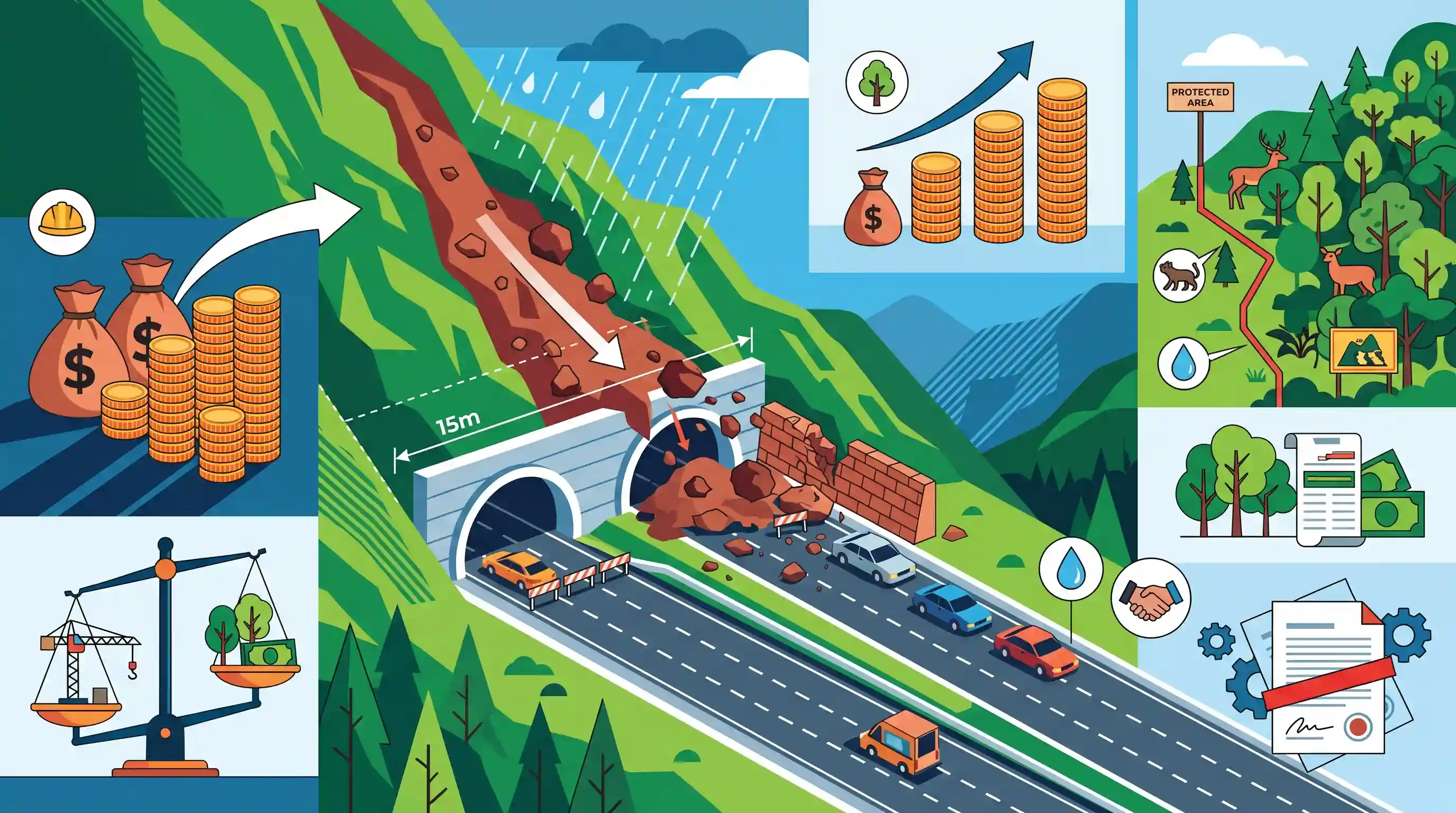
A monsoon-triggered landslide on the newly inaugurated Rs 6,695-crore Mumbai-Pune Expressway 'missing link' project damaged a retaining wall and a tunnel's false frame, disrupting traffic. The Maharashtra State Road Development Corporation (MSRDC) defended the construction quality, attributing the incident to an 'act of God' and noting that while local engineering measures (vetted by IIT-Bombay) successfully slowed down the boulders, the landslide originated far above the 15-meter protected zone. Expanding safety measures further up the slope presents significant financial costs and ecological challenges, as it would require working within protected forest land in the Western Ghats.
Key Points
- On July 6, 2026, a landslide occurred at the mouth of tunnel 2 on the newly opened Rs 6,695-crore Mumbai-Pune Expressway 'missing link' project, damaging a retaining wall and the external false frame, and halting traffic.
- The MSRDC characterized the intense monsoon rainfall and landslide as an 'act of God' rather than a construction or contractor flaw, emphasizing that the primary tunnel structure remained structurally safe.
- While rock-fall protection measures (rock bolting and steel mesh vetted by IIT-Bombay) were intact up to 15 meters above the tunnel entrance, the landslide originated 150 meters higher on the slope, exposing the limits of localized engineering in rugged terrain.
- Although existing protective barriers successfully slowed down the falling boulders and averted a major tragedy on the highway, expanding protection further up the slope poses a major dilemma, as it would require significant expenditure and intrusive engineering on protected forest land.
- Coming just nine weeks after the project's inauguration, the incident sparked intense political debate regarding the quality, safety, and accountability of public infrastructure projects in ecologically sensitive mountainous regions.
Important Terms
National Landslide Risk Management Strategy

A 2019 policy framework by the National Disaster Management Authority (NDMA) implementing a holistic approach to landslide risk reduction through hazard mapping, early warnings, and capacity building.
UPSC context
GS Paper III (Disaster Management); tests proactive risk-mitigation frameworks and national guidelines for natural disasters.
Maharashtra State Road Development Corporation (MSRDC)
A fully owned public sector undertaking of the Government of Maharashtra established to design, construct, and manage major expressways and road infrastructure in the state.
UPSC context
GS Paper III (Infrastructure); tests state-level public infrastructure planning, project execution, and structural accountability.
Western Ghats Ecology
A highly fragile, globally recognized biodiversity hotspot spanning six Indian states that faces ecological threats and high landslide susceptibility from linear infrastructure development.
UPSC context
GS Paper I (Geography) & GS Paper III (Environment); tests developmental challenges versus conservation in sensitive biomes.
Landslide Hazard Zonation (LHZ)
The scientific process of mapping a landscape into zones of varying landslide susceptibility based on factors like slope, geology, and rainfall to guide safe construction planning.
UPSC context
GS Paper I (Physical Geography) & GS Paper III (Disaster Management); tests spatial risk-mapping and planning tools.
IIT-Bombay
A premier public engineering and research institute in India that provides academic expertise, structural vetting, and technical audits for major national infrastructure.
UPSC context
GS Paper III (Science & Tech); tests integration of academic expertise and technical vetting in major state projects.
Navayuga Engineering Company
A private Indian infrastructure company contracted for building complex, large-scale civil engineering projects such as tunnels, ports, and expressways.
UPSC context
GS Paper III (Infrastructure); tests private contractor execution, quality assurance, and accountability in public works.
Prelims Trap
Landslides in both the Himalayas and the Western Ghats are fundamentally driven by active tectonic deformation and high seismicity.
Western Ghats are a passive continental margin (not a young fold mountain range) and are seismically stable. Their landslides are climate-driven (rainfall) rather than tectonically driven.
Static Concepts Connected
How do landslide dynamics differ between the Himalayas and the Western Ghats?
- Geological Age & Tectonics: Himalayas are seismically active, young fold mountains with unstable, fragile sedimentary rocks; Western Ghats are ancient, seismically stable Deccan basalt block mountains.
- Triggering Mechanisms: Himalayan slides occur in both dry and wet seasons due to tectonic shear; Western Ghats slides are strictly rainfall-induced, triggered by intense monsoon precipitation saturating weathered soil.
- Slope Instability Factors: Himalayan slopes suffer from natural structural fragility; Western Ghats slopes are generally stable until destabilized by steep anthropogenic cuts for roads and railways.
What are the key differences between the Gadgil and Kasturirangan reports on the Western Ghats?
- ESA Coverage Area: Gadgil recommended 64% of the Western Ghats as Ecologically Sensitive Area (ESA); Kasturirangan reduced this to 37% (natural landscape only), excluding cultural/agricultural areas.
- Governance Approach: Gadgil advocated a strict, bottom-up model empowering local Gram Sabhas; Kasturirangan favored a top-down bureaucratic framework permitting non-polluting development.
- Developmental Permissions: Gadgil recommended a complete ban on mining and large dams across ESZ-1; Kasturirangan allowed some developmental activities but banned highly polluting 'Red-category' industries.
Cross-Topic Patterns
Linear Infrastructure vs. ESA Regulations
Examines how mega-infrastructure projects in the Himalayas and Western Ghats bypass or challenge the regulatory thresholds of Ecologically Sensitive Areas (ESAs) under the EPA 1986.
Climate Hazards + Infrastructure Liability
Connects the rising frequency of extreme precipitation events to force majeure ('Act of God') legal defenses, shifting financial risks of disaster damages from contractors to the state.

Mains 2026 may contrast the geological triggers of Himalayan landslides with climate-induced slope failures in the Western Ghats.
Linked PYQs · 3
Linked PYQs · 3
- 2021MainsGS1
Differentiate the causes of landslides in the Himalayan region and Western Ghats.
- 2021MainsGS3
Describe the various causes and the effects of landslides. Mention the important components of the National Landslide Risk Management Strategy.
- 2019MainsGS3
Disaster preparedness is the first step in any disaster management process. Explain how hazard zonation mapping will help disaster mitigation in the case of landslides.
