Custody Suicide Prevention Measures and Mumbai Police Uniform Reforms
Source:Indian Express ↗
Why It Matters
Custodial deaths and suicides are persistent human rights issues in India's criminal justice system. This article provides a concrete example of an administrative reform aimed at safeguarding detainees, useful for GS2 (Governance/Human Rights) and GS4 (Administrative Ethics and empathy towards vulnerable groups).
Summary
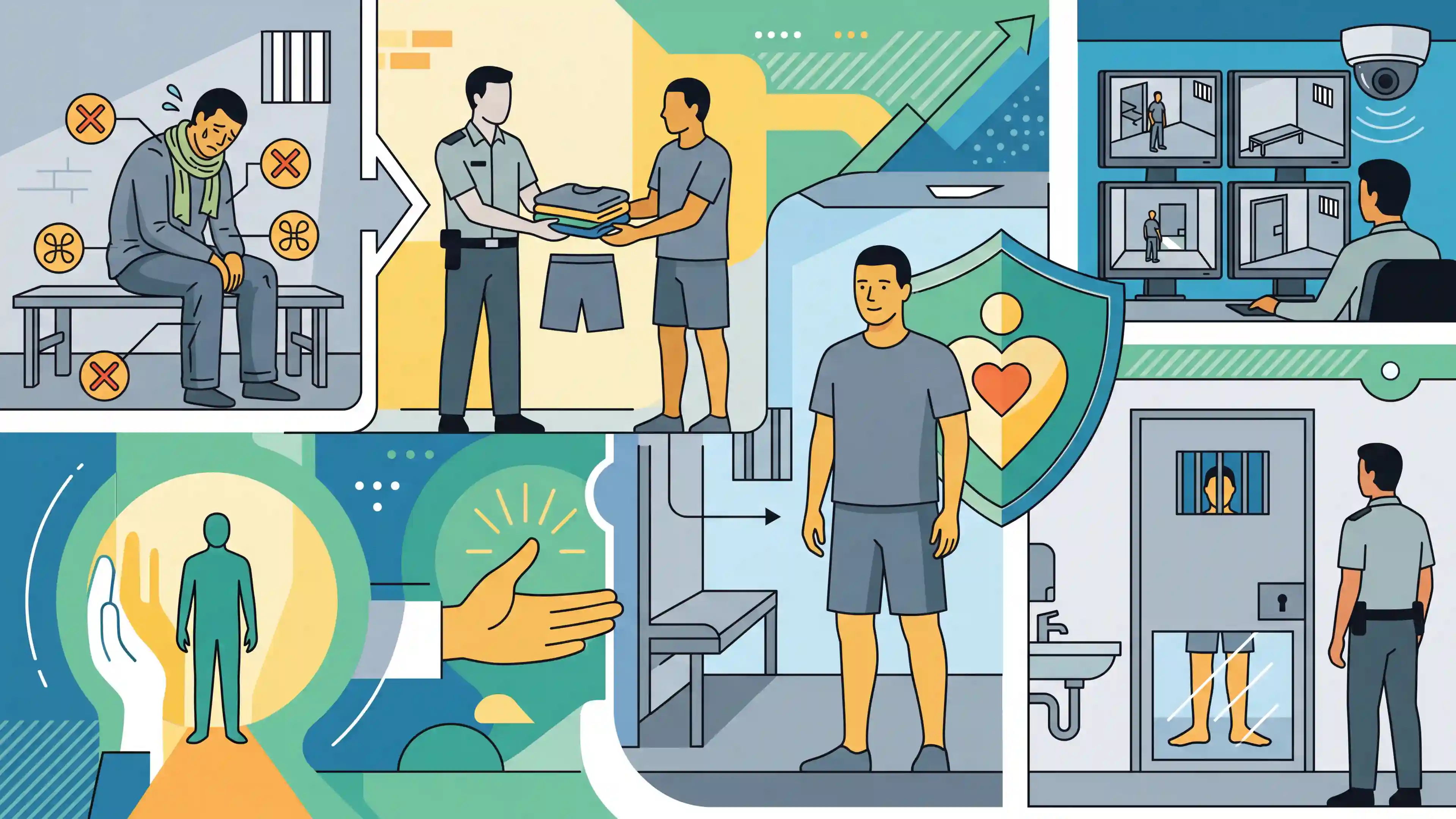
To address the alarming number of custodial suicides, the Mumbai Police has mandated a new lock-up uniform (T-shirts and shorts) for detainees, replacing personal clothing that can be used to make nooses. This initiative, combined with infrastructural modifications like trimmed bathroom doors and enhanced CCTV surveillance, serves as an innovative police reform to protect the right to life of undertrials and prevent custodial deaths in Maharashtra.
Key Points
- Mumbai Police has introduced a specific uniform consisting of a short-sleeved T-shirt and shorts for detainees in police lock-ups to curb custodial suicides.
- The new uniform removes long sleeves, pant legs, and dupattas, which are often used by detainees to fashion nooses for suicide.
- Between 2020 and 2023, Maharashtra recorded 54 deaths in police custody, often citing suicide as the cause, prompting this preventive measure.
- Additional infrastructural changes include CCTV surveillance and trimming bathroom doors to ensure continuous monitoring.
- While the Model Prison Manual 2016 prescribes uniforms only for convicted prisoners and allows undertrials their own clothes, this measure specifically applies to pre-trial detainees in police lock-ups for safety.
Important Terms
Custodial Death

The death of a person while in the custody of law enforcement or the judiciary, resulting from natural causes, suicide, or state-inflicted violence.
UPSC context
GS Paper 2 (Governance/Human Rights); tests understanding of custodial violence, state liability, and the Fundamental Right to Life (Article 21).
Model Prison Manual 2016
A benchmark framework issued by the Ministry of Home Affairs to standardize prison administration, emphasizing security, safety, and the basic rights of inmates across Indian states.
UPSC context
GS Paper 2 (Governance); crucial for questions on prison reforms, prisoner rehabilitation, and administrative guidelines for detention facilities.
National Crime Records Bureau (NCRB)
An Indian government agency that collects and publishes comprehensive data on crime and prisons, including the 'Prison Statistics India' report.
UPSC context
GS Paper 2 & 3; provides the empirical basis for analyzing crime trends, police efficiency, and the scale of custodial incidents.
D.K. Basu Guidelines
Eleven mandatory procedural requirements established by the Supreme Court (1996) to be followed by police during arrest and detention to prevent custodial torture.
UPSC context
GS Paper 2 (Polity/Judiciary); fundamental for answers regarding the rights of the accused and judicial oversight of police conduct.
Police Reforms
Structural and procedural transformations intended to modernize the police, enhance professional accountability, and align law enforcement with human rights standards.
UPSC context
GS Paper 2 & 3 (Internal Security); involves the implementation of committee recommendations (e.g., Prakash Singh) and institutional transparency.
Undertrial Prisoner
A person held in custody during the investigation, inquiry, or trial of an offense, but who has not been convicted by a court.
UPSC context
GS Paper 2 (Governance/Social Justice); central to discussions on prison overcrowding, legal aid, and the right to a speedy trial.
Prelims Trap
The Model Prison Manual 2016 mandates standardized uniforms for both undertrials and convicted prisoners across all Indian states.
The Manual prescribes uniforms ONLY for convicted prisoners, allowing undertrials to wear personal clothes. Mumbai's uniform is a localized safety exception for police lock-ups, not a national statutory mandate.
Static Concepts Connected
What are the key Supreme Court directives to prevent custodial violence?
- D.K. Basu Guidelines: Arresting officers must wear accurate, visible identification and inform a designated relative about the arrest immediately.
- Paramvir Singh Saini (2020): Mandated the installation of CCTV cameras with audio-video recording capabilities across all police stations and lock-ups.
- Medical Examination: The detainee must undergo a medical examination by a trained doctor every 48 hours during police custody.
What is the institutional framework for investigating custodial deaths in India?
- 24-Hour NHRC Reporting: State authorities must report any instance of custodial death or rape to the NHRC within 24 hours.
- Magisterial Inquiry: Section 176(1A) of the CrPC (and its BNSS equivalent) mandates an inquiry by a Judicial Magistrate, not just an executive magistrate.
- Autopsy Videography: The post-mortem must be videographed and conducted by a panel of two or more doctors to ensure transparency.
Cross-Topic Patterns
Prison Suicides + Mental Healthcare Act
Custodial suicides highlight the intersection of prison conditions and mental health. The Mental Healthcare Act 2017 mandates psychological support, extending the right to mental healthcare to prisoners and undertrials.
Infrastructure Design + Smart Policing
Physical changes like mandatory CCTVs and trimmed doors reflect a shift towards structural 'Smart Policing', where infrastructure design supplements behavioral reforms to ensure institutional accountability.

A 2026 Prelims statement will likely test the legal distinction between the rights of undertrials and convicts under prison manuals.
Linked PYQs · 2
Linked PYQs · 2
- 2021MainsGS2
Though the Human Rights Commissions have contributed immensely to the protection of human rights in India, yet they have failed to assert themselves against the mighty and powerful. Analyzing their structural and practical limitations, suggest remedial measures.
- 2014MainsGS2
National Human Rights Commission (NHRC) in India can be most effective when its tasks are adequately supported by other mechanisms that ensure the accountability of a government. In light of the above observation assess the role of NHRC as an effective complement to the judiciary and other institutions in promoting and protecting human rights standards.
