Maharashtra Permits MMRDA International Borrowing for Metro Projects
Source:Indian Express ↗
Why It Matters
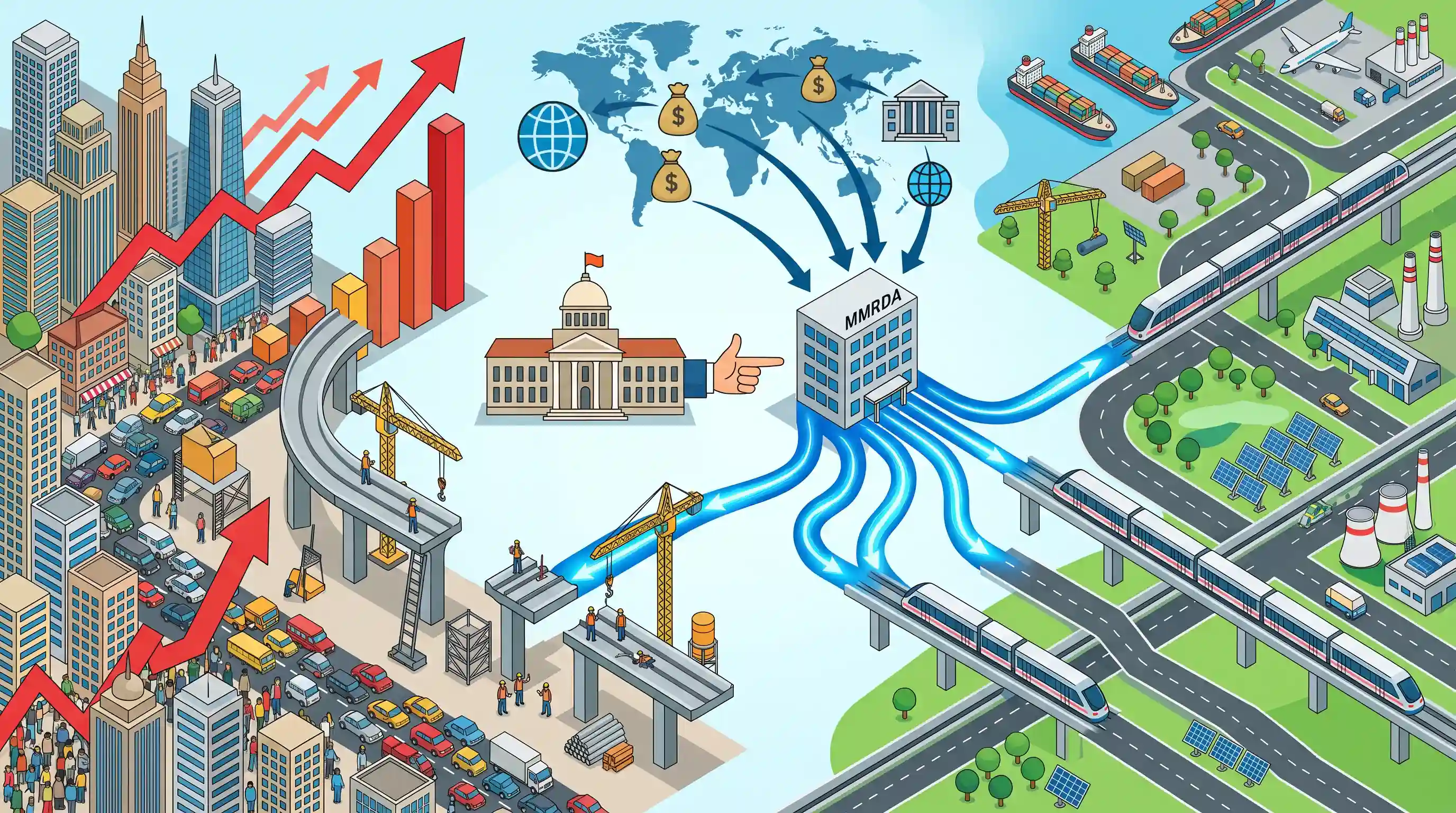
Highlights alternative financing mechanisms for critical urban infrastructure projects, specifically showcasing state-level parastatals utilizing international borrowing to fund mass rapid transit systems.
Summary
The Maharashtra State Government has permitted the Mumbai Metropolitan Region Development Authority (MMRDA) to raise international loans to finance six under-construction Mumbai Metro corridors. This move is aimed at securing long-term, lower-cost capital to meet the escalating funding requirements of urban mass transit projects. It reflects a growing trend of state parastatals exploring external financing avenues, such as multilateral agency loans and external commercial borrowings (ECBs), to bridge infrastructure financing gaps. For UPSC aspirants, this highlights key themes in urban transport development, alternative infrastructure financing models, and the evolving dynamics of sub-national entities accessing global capital markets.
Key Points
- The Maharashtra Government has permitted the Mumbai Metropolitan Region Development Authority (MMRDA) to borrow international loans to fund six under-construction Metro rail corridors.
- Sourcing international loans helps secure long-term capital at potentially lower interest rates, which is crucial for highly capital-intensive, long-gestation infrastructure projects.
- This highlights the importance of exploring alternative and innovative infrastructure financing models by state parastatals to bridge funding gaps in urban transport.
- The move underscores the role of foreign capital in enhancing urban mass transit systems, addressing sustainable urban mobility challenges in rapidly growing mega-cities.
Important Terms
Mumbai Metropolitan Region Development Authority (MMRDA)

A statutory body (est. 1975) responsible for planning, coordinating, and supervising infrastructure development within the Mumbai Metropolitan Region. It is chaired by the Maharashtra Chief Minister.
UPSC context
GS-I (Urbanization) and GS-III (Infrastructure). Tests knowledge of parastatal roles in urban governance and regional planning.
Mumbai Metro Project
A high-capacity rapid transit system being developed to decongest Mumbai. It involves multiple corridors financed through a mix of state, central, and international funds.
UPSC context
GS-I (Urbanization) and GS-III (Infrastructure). Tests knowledge of mega-infrastructure and sustainable urban mobility solutions.
External Commercial Borrowings (ECB)
Commercial loans raised by eligible Indian entities from non-resident lenders in foreign currency. Regulated by the RBI, they offer lower-cost, long-term capital for infrastructure.
UPSC context
GS-III (Economy/Investment Models). Tests understanding of external debt, capital inflows, and infrastructure financing avenues.
Multilateral Development Banks (MDBs)
International financial institutions (e.g., ADB, AIIB, NDB) formed by groups of countries to provide long-term financial assistance for economic and social development.
UPSC context
GS-II (Global Institutions) and GS-III (Infrastructure). Tests knowledge of international cooperation and funding for national development.
Urban Mass Transit System (UMTS)
High-capacity public transport systems, like Metro Rail, designed for efficient movement of large passenger volumes in cities to reduce congestion and emissions.
UPSC context
GS-I (Urbanization) and GS-III (Infrastructure). Focuses on sustainable city growth and addressing urban transport challenges.
Infrastructure Financing
The process of raising long-term capital for physical assets, often involving public-private partnerships (PPP), state guarantees, or concessional international loans.
UPSC context
GS-III (Investment Models). Core topic regarding the funding gap and alternative capital models for India's development.
Prelims Trap
"State Governments can directly raise foreign currency loans from multilateral agencies with the RBI's permission."
Under Article 293(1), State Governments can only borrow *within* the territory of India. External loans must be routed through the Centre or raised by statutory parastatals.
Static Concepts Connected
What are the constitutional provisions regarding borrowing powers of State Governments?
- Territorial limit (Art 293(1)): States can only borrow upon the security of the State's Consolidated Fund within the territory of India.
- Centre's consent (Art 293(3)): A State cannot independently raise any loan if it has outstanding loans or guarantees owed to the Union Government.
- Parastatal borrowing: Statutory bodies (like MMRDA) can borrow externally, but state sovereign guarantees for these loans are treated as contingent liabilities.
What are External Commercial Borrowings (ECBs)?
- Definition: Commercial loans raised by eligible resident entities from recognised non-resident entities, available in foreign currency (FCY) or Indian Rupee (INR).
- Eligible borrowers: Following recent liberalizations, any entity established under a Central or State Act can directly raise ECBs, removing the old FDI-eligibility restriction.
- Cost ceilings: Pricing and prepayment charges are dynamically determined by market conditions, as the RBI removed rigid all-in-cost ceilings.
Cross-Topic Patterns
Off-budget borrowing & State fiscal debt
State guarantees for parastatal international loans act as contingent liabilities. This impacts state fiscal discipline under FRBM targets and is heavily scrutinized by the CAG and Finance Commission.
Urban Transit + Climate Finance
Multilateral Development Banks offer low-interest loans for mass transit because these projects align with green infrastructure goals, urban mobility policies, and India's global emission reduction targets.

Prelims 2026 will likely test the contrast between Article 293 (States borrowing strictly within India) and parastatal ECB eligibility.
Linked PYQs · 5
Linked PYQs · 5
- 2021MainsGS3
“Investment in infrastructure is essential for more rapid and inclusive economic growth.” Discuss in the light of India's experience.
- 2022MainsGS3
Why is Public Private Partnership (PPP) required in infrastructural projects ? Examine the role of PPP model in the redevelopment of Railway Stations in India.
- 2025MainsGS2
Examine the evolving pattern of Centre-State financial relations in the context of planned development in India. How far have the recent reforms impacted the fiscal federalism in India?
- 2014MainsGS2
Some of the International funding agencies have special terms for economic participation stipulating a substantial component of the aid to be used for sourcing equipment from the leading countries. Discuss on merits of such terms and if, there exists a strong case not to accept such conditions in the Indian context.
- 2019MainsGS1
How is efficient and affordable urban mass transport key to the rapid economic development of India?
