Mumbai Metro Lines 4 and 4A Receive Crucial Safety Clearance
Source:re-mumbai ↗
Why It Matters
Major urban infrastructure and connectivity projects in the Mumbai Metropolitan Region (MMR) frequently feature in MPSC Combined Prelims. Understanding the geography of transport corridors and the organizational setup of the MMRDA (which has been tested directly in past papers) is vital for state services exams.
Summary
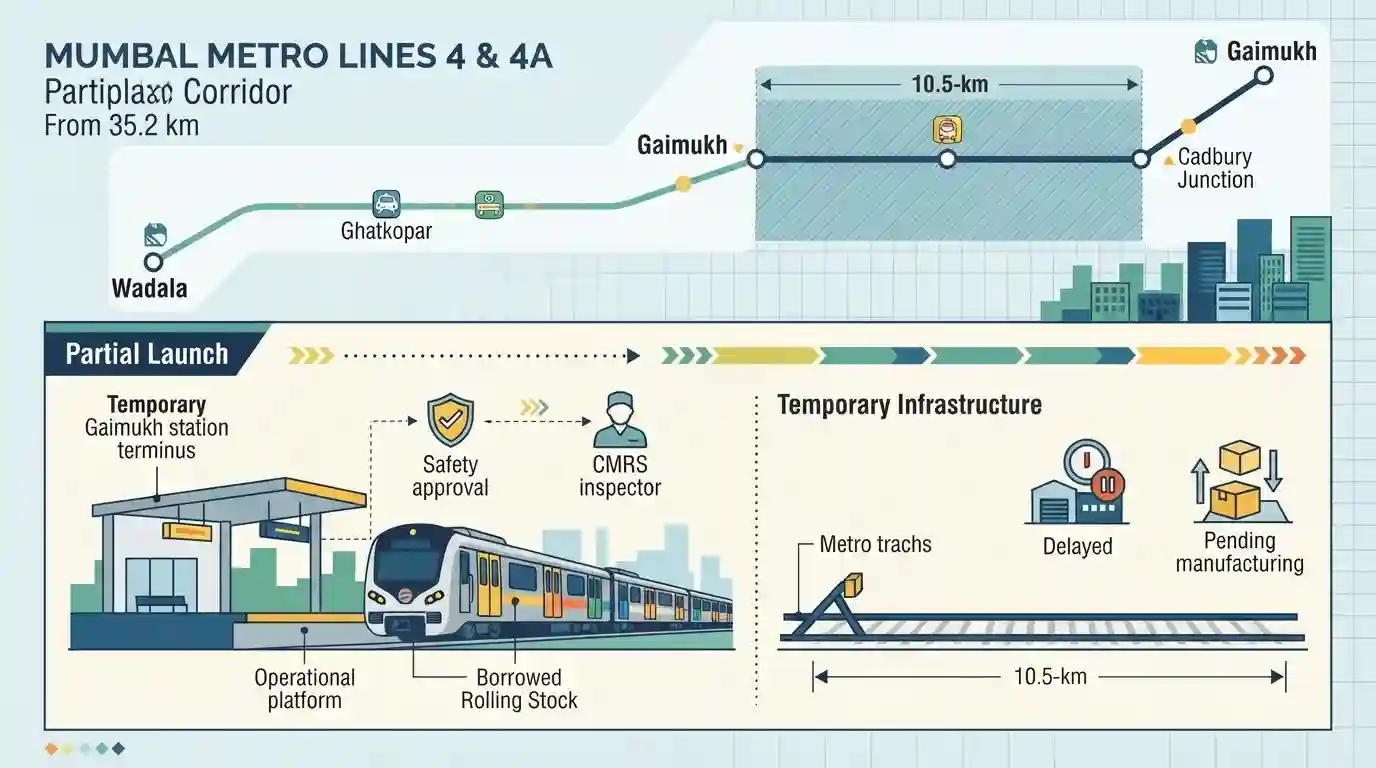
The Commissioner of Metro Railway Safety (CMRS) has approved safety clearances for the rolling stock of Mumbai Metro Lines 4 & 4A, paving the way for a partial launch of a 10.5-km stretch between Gaimukh and Cadbury Junction in Thane by late 2026. The initial phase will operate using temporary infrastructure at Gaimukh station and borrowed rolling stock from other metro lines due to delays in depot construction and rake deliveries. The complete 35.2 km corridor will connect Wadala to Gaimukh via Ghatkopar.
Key Points
- The Commissioner of Metro Railway Safety (CMRS) has granted crucial safety clearance for the rolling stock of Mumbai Metro Lines 4 and 4A [1.1].
- A partial launch of a 10.5-km section between Gaimukh and Cadbury Junction is anticipated by the end of 2026 [1.1]. This initial stretch comprises 10 stations [1.1].
- The complete network of Metro Lines 4 and 4A spans 35.2 km (Line 4 is 32.32 km, Line 4A is 2.88 km) and connects Wadala, Ghatkopar, Kasarvadavali, and Gaimukh [1.1].
- Due to delays in completing the dedicated Mogharpada depot on Ghodbunder Road, trains will temporarily operate using a maintenance pit at Gaimukh station [1.1].
- As the ordered rakes for the line are not yet delivered, Metro 4 and 4A will temporarily deploy rakes from Lines 2A, 7, and 9 housed at the Charkop depot [1.1].
- The projects are jointly executed and managed by the Mumbai Metropolitan Region Development Authority (MMRDA) and Maha Mumbai Metro Operation Corporation Limited (MMMOCL) [1.1].
Important Terms
Mumbai Metro Line 4

A 32.32 km under-construction elevated metro corridor connecting Wadala to Kasarvadavali (Thane), forming a key part of the Green Line developed by MMRDA.
UPSC context
MPSC GS-4 (Infrastructure); tests regional connectivity, urban transport systems, and planning in Maharashtra.
Mumbai Metropolitan Region Development Authority (MMRDA)
An apex statutory body of the Maharashtra government, established in 1975, responsible for planning, coordinating, and executing infrastructure and regional development in the MMR.
UPSC context
MPSC GS-2 (Statutory Bodies) and GS-4; tests regional urban planning and state-level developmental authorities.
MMRDA Act, 1974
The state legislation enacted by Maharashtra to establish the MMRDA, defining its administrative powers to execute developmental schemes and coordinate regional growth.
UPSC context
MPSC GS-2 (Polity and Governance); tests key state-level acts, statutory frameworks, and decentralization.
Maha Mumbai Metro Operation Corporation Limited (MMMOCL)
A wholly-owned company of MMRDA established in 2019 to handle the independent operation, maintenance, and non-fare box revenue of all metro corridors in the MMR.
UPSC context
MPSC GS-4 (Infrastructure); tests state public sector undertakings and urban public transport management.
Commissioner of Metro Railway Safety (CMRS)
A regulatory authority operating under the Union Ministry of Civil Aviation, tasked with inspecting, evaluating, and granting safety clearance before any new metro line opens.
UPSC context
MPSC GS-2 (Governance/Regulators) and GS-4; tests transport safety regulations and statutory authorities.
Ministry of Civil Aviation
The central ministry responsible for civil aviation policies, which also administratively controls the Commission of Railway Safety for independent regulatory safety oversight.
UPSC context
MPSC GS-2 (Union Ministries); tests ministerial jurisdictions and regulatory independence of safety commissions.
Prelims Trap
The Commissioner of Metro Railway Safety (CMRS) operates under the administrative control of the Union Ministry of Railways.
To ensure independent safety auditing, the Commissioner of Metro Railway Safety (CMRS) functions under the Ministry of Civil Aviation, not the Ministry of Railways.
Static Concepts Connected
What is the statutory structure of the MMRDA?
- Origin and Act: Established on January 26, 1975, under the MMRDA Act, 1974, as a statutory regional planning body.
- Leadership Structure: Chaired ex-officio by the Chief Minister of Maharashtra; the executive head is the government-appointed Metropolitan Commissioner.
- Territorial Jurisdiction: Spans 6,328 sq. km. comprising exactly 9 Municipal Corporations and several municipal councils.
Why does CMRS operate under Civil Aviation?
- Administrative Independence: Kept under the Ministry of Civil Aviation to prevent conflict of interest and ensure unbiased inspections.
- Statutory Mandate: Derives powers from the Railways Act, 1989 and the Metro Railways (Operations and Maintenance) Act, 2002.
Cross-Topic Patterns
Multilateral funding in state transit
Infrastructure projects co-funded by ADB and AIIB highlight Maharashtra's strategy of leveraging multilateral external debt to bypass direct state budgetary limitations.
Statutory bodies vs Municipal autonomy
Overlapping planning jurisdictions between statutory giants like MMRDA and constitutional bodies like the Metropolitan Planning Committee test the limits of urban local self-governance.

MMRDA's statutory setup, jurisdiction (9 Corporations), and the unique administrative alignment of CMRS are high-yield MPSC GS concepts.
Linked PYQs · 2
Linked PYQs · 2
- 2018MPSC_PRELIMSGS1
Which of the following statements about Mumbai Metropolitan Region Development Authority (MMRDA) is false ?
- 2021MPSC_PRELIMSGS1
The Mumbai Metropolitan Region spread over 6,328 sq.km. consists of ________ Municipal Corporations.
